

CIE Syllabus focus:
'Candidates should understand the advantages and disadvantages of each type of business entity from the viewpoint of owners and other stakeholders.'
Choosing a business entity affects control, risk, finance, continuity, and accountability. The best structure depends not only on the owner’s aims, but also on how employees, lenders, suppliers, customers, and investors are affected.
Why the choice of entity matters
A business entity is the legal form through which a business operates. The main forms at this level are sole traders, partnerships, and limited companies. Each structure creates different patterns of ownership, decision-making, risk, and reporting.
Stakeholder: A person or group with an interest in the activities, performance, or financial stability of a business.
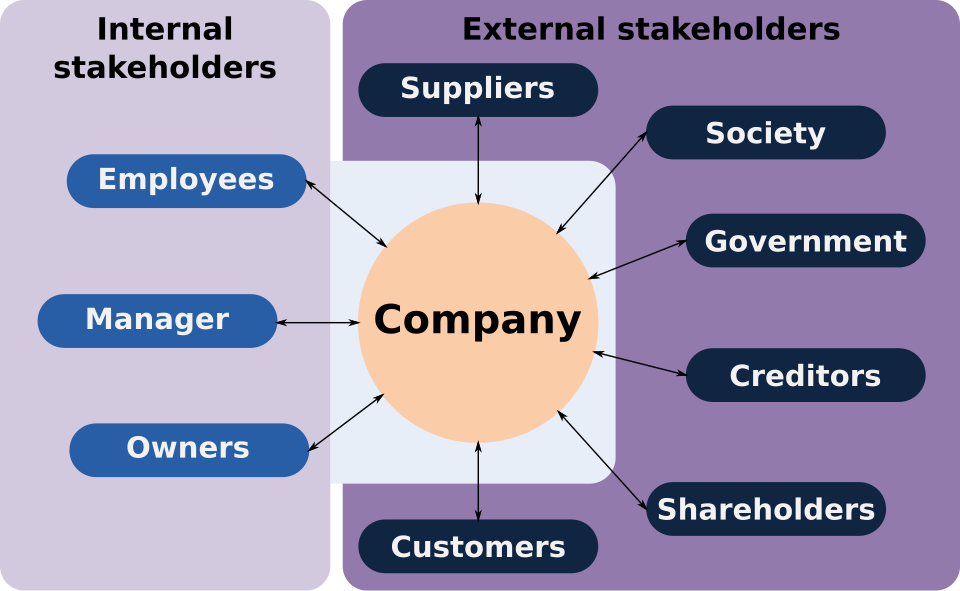
A stakeholder map showing major internal and external stakeholder groups connected to the business. It helps you quickly identify whose interests may change when the legal form (sole trader, partnership, or limited company) changes. Source
Owners usually focus on profit, control, and personal risk. Other stakeholders may focus more on job security, reliable supply, creditworthiness, continuity, and public accountability. This means a structure that suits the owner may not always be best for everyone else.
Sole traders
Advantages
A sole trader is owned by one person. This form offers important benefits for the owner:
Full control over decisions, policies, and business direction
All profits belong to the owner
A business can usually be set up quickly and cheaply
There is often greater privacy, because financial information is not widely published
Decisions can be made fast, without consulting partners or shareholders
From the viewpoint of some stakeholders, sole traders may also offer advantages:
Customers may receive more personal service because they deal directly with the owner
Employees may experience closer supervision and clearer leadership
Suppliers may find communication simple because there is only one main decision-maker
Disadvantages
The major disadvantage for the owner is unlimited liability.
Unlimited liability: The owner is personally responsible for the debts of the business, so personal assets may be used to repay business liabilities.
This increases financial risk, especially if the business borrows heavily or faces losses. Other disadvantages for the owner include:
The owner may have limited capital
Expansion can be difficult because finance often depends on one person
The owner carries the full burden of management
If the owner is ill, retires, or dies, the business may not continue easily
Other stakeholders may also face disadvantages:
Employees may have less job security because a small business is often less stable
Lenders may see the business as risky because it depends on one individual
Suppliers may be cautious about giving long credit periods
Customers may worry about continuity of service if the owner stops trading
Partnerships
Advantages
A partnership is owned by two or more people. For owners, partnerships improve on some weaknesses of sole trading:
More capital can be introduced by several partners
Partners may bring different skills, experience, and contacts
Workload and responsibility are shared
Decision-making can improve if partners contribute different strengths
The business may be larger and more stable than a sole trader
For other stakeholders, this can also be beneficial:
Employees may benefit from better organization and supervision
Suppliers may have more confidence in a business supported by several owners
Customers may receive better service if partners specialize in different areas
Disadvantages
However, partnerships also have weaknesses:
Profits must be shared
Disagreements between partners can slow decisions or damage the business
In many cases, partners still face unlimited liability
A partnership may be disrupted if a partner leaves, dies, or becomes insolvent
Owners may disagree over workload, drawings, or profit-sharing
Stakeholder disadvantages may include:
Employees can suffer from unclear leadership if partners disagree
Suppliers may face uncertainty if internal disputes affect payments
Customers may experience inconsistent service where partners have different priorities
Lenders may still regard the business as less secure than a limited company
So, a partnership usually offers more resources than a sole trader, but it also introduces the risk of conflict and shared control.
Limited companies
Advantages
A limited company has a separate legal identity from its owners. Ownership is held through shares. One major benefit is limited liability.
Limited liability: The liability of shareholders is restricted to the amount invested in the company’s shares.
This is a major advantage for owners because personal assets are protected if the company fails. Other owner advantages include:
Easier access to capital, especially from share issues
Better opportunities for growth and expansion
Greater continuity, because the company continues even if shareholders change
Ownership can be divided among many investors
A public limited company may raise very large amounts from the public
Other stakeholders may also prefer limited companies:
Lenders may have greater confidence because larger companies often have stronger capital bases
Suppliers may expect more stable long-term trading relationships
Employees may see improved job security in an established company
Customers may trust a company that appears permanent and well regulated
Disadvantages
For owners, limited companies also create disadvantages:
Formation and administration are usually more complex and costly
There are more legal requirements and regulations
Owners may lose some control, especially when ownership is spread widely
Profits are shared with shareholders through dividends
Financial statements are less private, reducing confidentiality
There can also be disadvantages for stakeholders:
Shareholders may be separated from management, so those making decisions are not always the owners
Employees may face pressure for efficiency or cost-cutting where profit targets are strict
Customers may receive less personal service than in smaller businesses
Public limited companies may face pressure from investors for short-term results, which can affect long-term decisions
Key issues when comparing entities
When judging the advantages and disadvantages of a business entity, focus on these factors:
Control: highest in a sole trade, shared in partnerships, often diluted in companies
Risk: highest with unlimited liability, lower with limited liability
Finance: usually easiest for limited companies, harder for sole traders
Continuity: stronger in limited companies than in sole trades or partnerships
Stakeholder confidence: often greater where the business is larger, more stable, and better regulated
No single entity is always best. The most suitable form depends on the balance between owner benefit and stakeholder needs.
Practice Questions
State two disadvantages of operating as a sole trader from the owner’s viewpoint. (2)
Any two valid points, 1 mark each:
unlimited liability
limited capital available
full responsibility for management
lack of continuity if owner retires, is ill, or dies
difficult to expand
Discuss the advantages and disadvantages of a limited company from the viewpoint of shareholders and one other stakeholder. (6)
Award up to 6 marks:
1 mark for each valid developed point, maximum 6
Possible answers:
shareholders benefit from limited liability
shareholders may gain from easier access to finance and growth
continuity of the company may protect shareholder investment
shareholders may lose control if ownership is widely spread
profits must be shared through dividends rather than kept by one owner
lenders may prefer a company because it may appear more secure
employees may benefit from greater job security in a larger company
customers may trust an established company more
employees or customers may experience less personal attention
public disclosure and legal regulation may increase confidence for outside stakeholders
FAQ
A sole trader may still be attractive when the business is small, low-risk, and built around one person’s skill or reputation.
Other reasons include:
complete control over decisions
no need to share profits
low setup costs
greater privacy than a company
For some owners, these practical benefits outweigh the financial risk, especially in the early stages of trading.
A partnership may look simple because ownership is shared, but management can become difficult when partners have different aims.
Common causes of tension include:
uneven effort between partners
disagreements over drawings
different views on expansion
disputes over how profits should be divided
Even when the business is profitable, these issues can weaken decision-making and affect staff, suppliers, and customers.
Lenders are concerned with whether they will be repaid, not just whether the business reports profit.
They may also consider:
stability of ownership
continuity of the business
legal structure
amount of capital invested
whether liability is limited or unlimited
quality of governance
A profitable business can still be risky if it depends too heavily on one person or has weak long-term stability.
Customers may prefer different entities depending on what matters most to them.
For example:
a sole trader may offer personal service and quick decisions
a partnership may provide broader expertise
a limited company may offer stronger continuity and reliability
Where customers value long-term support, warranties, or regular supply, a more permanent structure may be more attractive than a very small owner-managed business.
A limited company, especially a public one, is often more visible and accountable to a wider group of stakeholders.
This can matter because:
published accounts attract attention
more investors may be involved
employees, regulators, and the public may expect responsible behavior
reputation can affect share value and stakeholder confidence
A sole trader usually operates on a smaller scale, so public scrutiny is often lower, even though reputation still matters.

.svg)