CIE Syllabus focus:
'Candidates should understand why partnerships may maintain separate capital and current accounts and how to prepare these accounts.'
Partnership accounting is clearer when long-term investment is separated from yearly adjustments. This helps you identify each partner’s permanent stake, annual entitlement, and drawings without constantly changing the capital figure.
Capital and current accounts
A partnership may keep one account for each partner, or it may maintain separate capital accounts and current accounts.
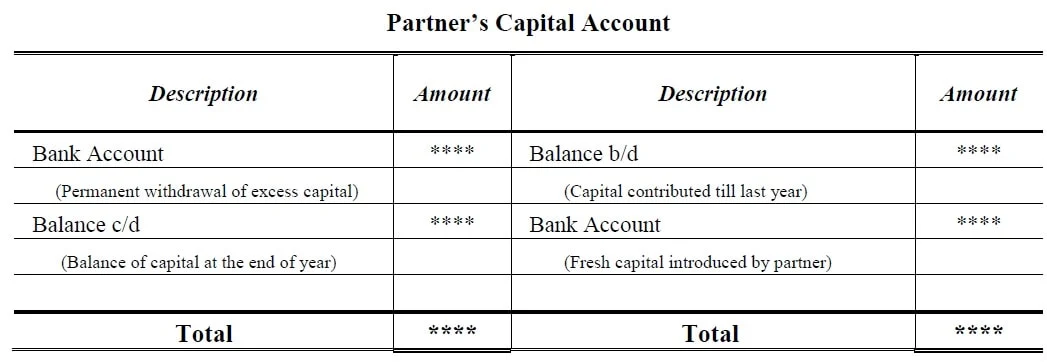
These diagrams illustrate the fixed capital system by separating each partner’s permanent Capital Account from their Current Account for routine yearly adjustments. Seeing the two T-accounts side-by-side helps you classify entries correctly (e.g., extra capital vs drawings and profit appropriation items). Source
Separate accounts are usually used under a fixed capital system, where the amount of capital invested by each partner is intended to remain fairly stable.
Capital account: An account used to record the long-term funds or assets introduced by a partner into the business.
When separate accounts are maintained, the capital account is used only for items that change the partner’s permanent investment in the partnership.
Current account: An account used to record the routine yearly adjustments relating to a partner, including amounts due to or from that partner.
This distinction is important because it prevents the capital figure from changing every time profit is shared or drawings are made.
Why partnerships maintain separate accounts
Separate capital and current accounts are useful because they improve clarity and control.
Main reasons
Capital remains fixed unless a partner introduces additional capital or permanently withdraws part of it.
Annual movements are easier to track because items such as drawings, salaries, and profit share are kept in one place.
Each partner’s net position is clearer since the current account shows whether the partner is owed money by the business or owes money to the business.
Financial statements are easier to prepare because permanent capital and short-term adjustments are already separated.
Comparisons between years are simpler because the capital accounts are more stable.
A partnership that does not use separate current accounts usually has fluctuating capital accounts. Under that system, all entries affecting a partner are recorded in the capital account, so the balance changes regularly throughout the year.
Preparing partners’ capital accounts
When separate accounts are used, the capital account includes only items affecting permanent capital.
Credit entries in a capital account
opening capital balance
additional capital introduced by the partner
non-cash assets introduced as capital, if accepted by the partnership
These entries increase the partner’s long-term investment.
Debit entries in a capital account
permanent withdrawal of capital by the partner
reduction in capital agreed by the partners
These entries reduce the partner’s long-term investment.
In many examination questions, the capital account may show only an opening balance and perhaps a later introduction or withdrawal of capital. Routine items should not be included if separate current accounts are being maintained.
Preparing partners’ current accounts
The current account records the regular yearly adjustments between the partnership and each partner. These usually come from the appropriation process and from the drawings records.
Credit entries in a current account
share of profit
partner’s salary
interest on capital
commission to a partner, if applicable
any other amount credited to the partner for the year
These entries increase the amount due to the partner from the business.
Debit entries in a current account
drawings of cash or goods
interest on drawings
share of loss
any other charge made against the partner
These entries reduce the amount due to the partner, or increase the amount owed by the partner to the business.
A credit balance on a current account means the partnership owes that amount to the partner. A debit balance means the partner has withdrawn more than their entitlement or has otherwise become indebted to the business.
Important distinctions when recording entries
Students often lose marks by placing entries in the wrong account. The key test is whether the item affects permanent capital or only a yearly adjustment.
Record in the capital account
original capital introduced
extra capital introduced later
permanent capital withdrawn
Record in the current account
drawings
interest on drawings
interest on capital
salary
commission
share of profit or loss
For example, interest on capital does not increase the partner’s permanent investment. It is an annual appropriation of profit, so it belongs in the current account when separate accounts are used.
Balancing the accounts
Each partner has their own capital account and their own current account. The balances are carried down to the next accounting period.
Capital account balance
The capital account usually has a credit balance, because it represents the partner’s investment in the business. It normally stays unchanged unless capital is added or withdrawn.
Current account balance
The current account may end with:
a credit balance, showing an amount due to the partner
a debit balance, showing an amount due from the partner
This is one reason why separate current accounts are useful: they show the effect of annual adjustments without changing the fixed capital figure.
Presentation points
In partnership ledger accounts, each partner’s accounts must be prepared separately. Do not combine partners into one account. Use clear headings such as Partner A Capital Account and Partner A Current Account.
Always check that:
items from the appropriation account are transferred to the correct partner’s current account
drawings are debited to the correct partner
capital introduced is entered in the capital account, not the current account
balances brought down are shown on the correct side
Accurate classification is the main skill in this topic. If you understand the purpose of each account, preparing them becomes much more straightforward.
Practice Questions
State two reasons why a partnership may maintain separate capital and current accounts for each partner. (2 marks)
1 mark for stating that permanent capital can be kept separate from yearly adjustments.
1 mark for any other valid reason, such as:
easier tracking of drawings and profit share
clearer record of each partner’s net position
simpler preparation of financial statements
capital balances remain stable for comparison
A partnership maintains fixed capital accounts and separate current accounts.
The following information relates to the year ended December 31:
Partner H:
Opening current account balance: credit 4,000
Interest on capital: 2,700
Interest on drawings: 3,500
Partner J:
Opening current account balance: debit 2,000
Interest on capital: 1,900
Interest on drawings: 2,500
Prepare the partners’ current accounts for the year ended December 31.
(6 marks)
1 mark: correct opening balances entered on correct sides
1 mark: correct credit entries for H
1 mark: correct debit entries for H
1 mark: correct credit entries for J
1 mark: correct debit entries for J
1 mark: correct closing balances
Expected closing balances:
H current account: credit 2,800
FAQ
A partner’s loan account is separate from the current account.
A loan account records money lent by a partner to the business.
A current account records yearly partnership adjustments such as drawings and profit share.
A loan is not part of the partner’s ownership interest in the same way as capital and current account balances. It is usually treated more like a liability owed by the partnership.
Interest on a partner’s loan is also treated differently from interest on capital.
Yes. A partnership can change its accounting approach if the partners agree.
Usually:
the existing capital balances become the fixed capital balances
future yearly adjustments are recorded in current accounts instead
comparative clarity improves, especially in larger partnerships
The key point is consistency after the change. Once separate accounts are introduced, routine items should no longer be posted to capital accounts unless they affect permanent capital.
If a partner introduces an asset, such as equipment or a vehicle, as capital, the agreed value of that asset is credited to the partner’s capital account.
The asset is then recorded in the business accounts at that agreed value.
This treatment reflects that the partner has increased their long-term investment, even though no cash was paid into the business.
Any later depreciation or disposal of that asset is handled in the normal business records, not through the partner’s current account.
A long-term debit current account may arise when a partner regularly withdraws more than their annual entitlement.
Possible causes include:
high drawings
low profit share
repeated losses
interest on drawings adding to the deficit
This can create tension between partners because one partner may appear to be using more business funds than agreed. In practice, the partnership may review drawings limits or require the debit balance to be cleared.
Yes. Drawings of goods are usually treated in the same broad way as cash drawings for partnership purposes: they reduce the partner’s current account.
The main difference is how the value is identified. Goods withdrawn are recorded at the value required by the accounting policy or question instruction.
Once valued, they are debited to the partner’s current account because they represent a withdrawal of benefit from the business by that partner.