CIE Syllabus focus:
'Candidates should calculate and record adjustments for accruals, prepayments, irrecoverable debts, recovered debts, allowances, depreciation, inventory valuation and error correction.'
Draft financial statements are only a starting point. Year-end adjustments make sure revenue, expenses, assets, and liabilities are reported in the correct period and at values that are reasonable and supportable.
Why adjustments are needed
A draft financial statement is prepared from ledger balances before all year-end matters have been updated. Some expenses relate to the current year but have not yet been paid, some assets have fallen in value, and some receivables may never be collected. If these items are ignored, both profit and the statement of financial position will be misleading.
Adjustments are made to apply the matching principle: income and expenses should be included in the accounting period to which they relate. They also help ensure that assets are not overstated and liabilities are not understated. In examinations, the key skill is to identify the adjustment, calculate the amount required, and record its effect in the correct statement.
Accruals and prepayments
Accruals
An accrual must be recognized when an expense has been incurred in the current accounting period but has not yet been paid or recorded.
Accrual: An expense owing at the end of the accounting period that relates to the current period.
When an accrual is created, the expense in the statement of profit or loss is increased, and a current liability is shown in the statement of financial position.
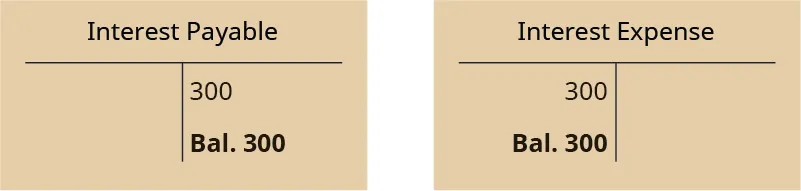
Adjusting entry for an accrual (Interest Expense vs Interest Payable) and the corresponding T-accounts after posting. The visual makes the dual effect explicit: expense increases in profit or loss, while a payable (liability) is recognized in the statement of financial position. Source
This prevents profit from being overstated.
Prepayments
A prepayment arises when a payment has already been made for a future accounting period.
Prepayment: An amount paid during the current period for an expense that relates wholly or partly to a future period.
A prepayment reduces the expense charged to the current year and is shown as a current asset. This prevents the current year’s profit from being understated. The same logic can be applied whenever the timing of payment does not match the period to which the expense belongs. In adjustment questions, always focus on the amount relating to the current year rather than the amount paid.
Irrecoverable debts, recovered debts, and allowances
Irrecoverable debts and recovered debts
An irrecoverable debt is a receivable that the business no longer expects to collect.
Irrecoverable debt: A trade receivable balance that is written off because it is no longer considered collectible.
Writing off an irrecoverable debt reduces trade receivables in the statement of financial position and increases expenses in the statement of profit or loss. This ensures receivables are not shown at an amount the business is unlikely to receive.
Sometimes a customer later pays an amount that had already been written off. This is a recovered debt. It is treated as other income, not as new sales, because the original sale belonged to an earlier period. The cash or bank balance increases, and the recovered amount is credited in the current period’s statement of profit or loss.
Allowances
Businesses may also create an allowance for receivables for debts that are doubtful but not yet definitely irrecoverable.
Allowance for receivables: An estimate of the amount of trade receivables that may not be collected in the future.
The closing allowance is deducted from trade receivables in the statement of financial position.

Balance sheet presentation of receivables showing Accounts Receivable less Allowance for Doubtful Accounts to arrive at net receivables (net realizable value). This layout helps you remember that the allowance reduces the reported asset value without changing the gross receivables ledger balance. Source
However, the statement of profit or loss is affected only by the change in the allowance between the start and end of the period. If the required closing allowance is larger than the existing allowance, the increase is charged as an expense. If it is smaller, the decrease is credited, increasing profit.
= Amount charged or credited in the statement of profit or loss
= Allowance needed at the end of the period
= Allowance already in the accounts before adjustment
A careful distinction is essential:
Irrecoverable debts are known losses and are written off.
Allowances are estimates for possible future losses.
Recovered debts are cash receipts from amounts previously written off.
Depreciation and inventory valuation
Depreciation
A depreciation adjustment records the part of a non-current asset’s cost that relates to the current accounting period. The depreciation charge appears as an expense in the statement of profit or loss. In the statement of financial position, the carrying amount of the asset is reduced, usually through accumulated depreciation.

Non-current asset disclosure showing the asset at cost, accumulated depreciation, and the resulting net book value (carrying amount). It visually ties the depreciation charge over time to the build-up of accumulated depreciation and the reduction in the asset’s carrying amount. Source
When preparing final accounts, use the depreciation amount required by the business’s chosen policy. The important point in this subsubtopic is not selecting the method, but making sure the current period’s charge is included and asset values are updated accordingly. If depreciation is omitted, profit and non-current assets will both be overstated.
Inventory valuation
Closing inventory valuation must also be adjusted at the end of the period. Inventory is included as a current asset in the statement of financial position and is used to arrive at the correct cost of sales in the statement of profit or loss. Inventory should be valued at the lower of cost and net realizable value, so damaged, obsolete, or slow-moving goods may need to be reduced in value. If closing inventory is overstated, profit and current assets will be overstated; if understated, both will be understated.
Error correction
Some draft financial statements contain errors that must be corrected before the accounts are finalized. These may include omitted adjustments, items entered in the wrong account, incorrect amounts, or a failure to update a year-end figure. The correction must be made to the relevant ledger accounts so that the final figures are accurate.
In adjustment questions, concentrate on the accounting effect of the correction:
whether profit increases or decreases
whether assets or liabilities increase or decrease
which balance must be removed or replaced
Error correction is especially important because a single mistake can affect more than one figure. For example, an unrecorded accrual affects both expenses and liabilities, while an omitted write-off affects both receivables and profit. Each adjustment should be supported by clear year-end information and reflected before the final financial statements are prepared.
Practice Questions
A business discovers at the year-end that insurance of $1,200 has been paid in advance. State how this prepayment should be recorded in the financial statements. [2]
Insurance expense in the statement of profit or loss is reduced by 1,200 is shown in the statement of financial position. (1)
At the year-end, trade receivables are 1,400 is to be written off as irrecoverable. The existing allowance for receivables is $900. A closing allowance equal to 4% of the remaining trade receivables is required.
Prepare the adjustments needed for the statement of profit or loss and statement of financial position. [5]
Irrecoverable debt written off: 48,600. (1)
Required closing allowance: 1,044. (1)
Trade receivables shown in statement of financial position at $46,656. (1)
FAQ
Accounting reports must be prepared on time, even when some outcomes are still uncertain.
Items such as depreciation, allowance for receivables, and net realizable value depend on judgment about future benefit or recoverability. The estimate should be reasonable, consistent, and supported by evidence rather than guesswork.
A business may rely on other documents to estimate the amount due.
Useful evidence includes:
contracts or service agreements
supplier statements
meter readings
recurring monthly charges
invoices received shortly after year-end that clearly relate to the earlier period
Yes. Many adjustments do not end with the current year.
For example:
an accrual becomes an opening liability
a prepayment becomes an opening asset
accumulated depreciation carries forward
a closing allowance becomes next year’s opening allowance
closing inventory becomes opening inventory for the next period
The decision depends on how certain the loss is.
A balance is usually written off when there is strong evidence it will not be collected, such as bankruptcy, disappearance of the customer, or failed legal action. If collection is doubtful but still possible, it is more appropriate to include it within the allowance instead.
The business can still estimate year-end inventory, but extra care is needed.
It must adjust the later count for:
goods sold after year-end
purchases received after year-end
goods in transit
cut-off errors
items not owned by the business
This is done to reconstruct the inventory figure that existed exactly at the reporting date.