

CIE Syllabus focus:
'Predict the type of structure and bonding present in a substance by interpreting numerical data and other relevant information.'
This topic is about using evidence such as melting point, conductivity, and solubility to infer what particles a substance contains and how those particles are held together.
What this skill involves
In this part of the course, you are not just recalling properties. You are interpreting data to decide whether a substance has ionic, metallic, giant covalent, or simple molecular structure. The key is to connect each property to the particles present and whether those particles can move.
A strong answer identifies both:
the type of structure
the type of bonding
and the evidence from the data
For example, conductivity data tells you whether there are mobile charged particles, while melting and boiling temperatures suggest whether the forces holding the substance together are relatively weak or very strong.
Giant lattice: A three-dimensional repeating arrangement containing very large numbers of particles held together by strong forces or bonds throughout the structure.
Giant lattices include giant ionic, giant metallic, and giant covalent structures.
Main structure types and their data patterns
Giant ionic lattice
A giant ionic lattice contains positive and negative ions held by strong electrostatic attraction.
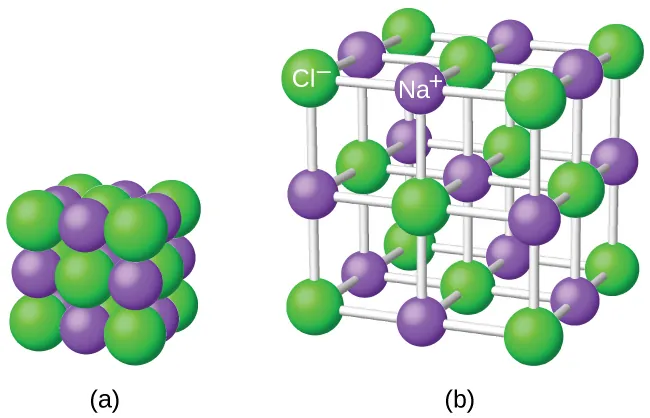
A labeled model of the sodium chloride crystal lattice, showing alternating and ions in a repeating 3D arrangement. This directly visualizes the “giant ionic lattice” idea: strong electrostatic attractions act throughout the entire structure rather than within discrete molecules. Source
Typical evidence:
high melting temperature
often brittle
does not conduct electricity when solid
does conduct when molten
often does conduct in aqueous solution
often soluble in water
The key clue is the change in conductivity. In a solid ionic lattice, ions are fixed in place, so they cannot carry charge. When molten or dissolved, the ions become mobile.
Simple molecular structure
A simple molecular substance contains discrete molecules. The covalent bonds inside each molecule are strong, but the forces between molecules are much weaker.
Typical evidence:
low melting and boiling temperatures
often gases, liquids, or soft solids at room temperature
does not conduct in solid or liquid form
often volatile
This pattern suggests there are no mobile ions and no delocalized electrons. A low boiling temperature is especially important because it shows that only weak attractions are being overcome.
Giant covalent structure
A giant covalent structure is a network of atoms joined by covalent bonds throughout the whole lattice.
Typical evidence:
very high melting temperature
usually very hard
insoluble
usually does not conduct electricity
This is because many strong covalent bonds must be broken to melt the substance. Most giant covalent substances do not conduct because they do not have mobile charged particles.
A very important exception is graphite and also graphene, which conduct because they have delocalized electrons.
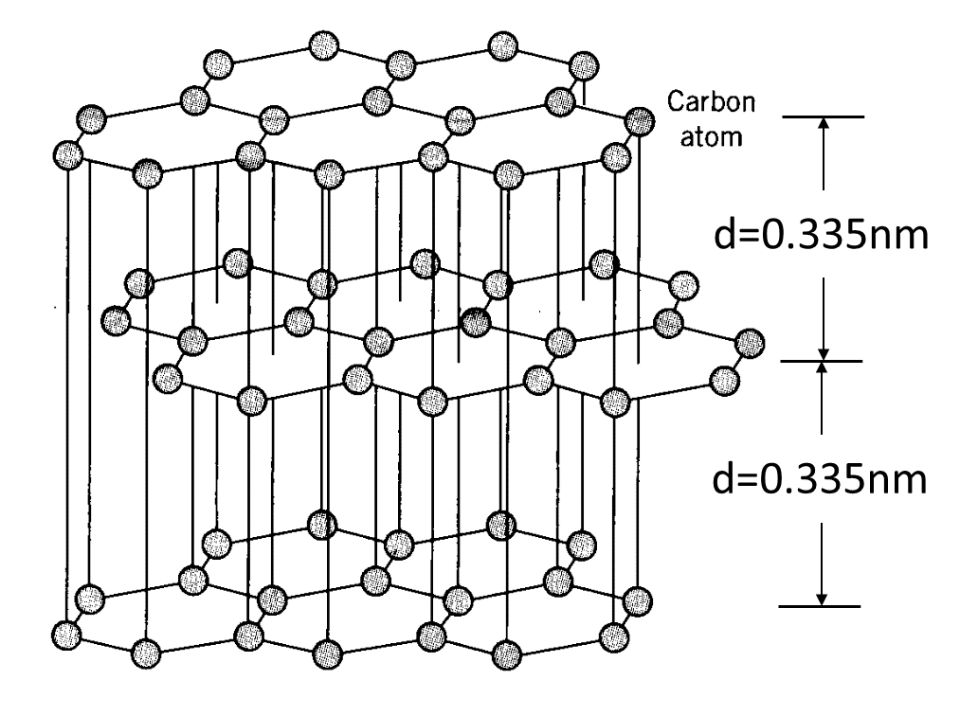
A labeled structural diagram of graphite showing stacked hexagonal carbon layers (ABAB stacking) with the interlayer spacing marked. The layered arrangement helps explain graphite’s unusual property set: strong covalent bonding within sheets but much weaker forces between sheets, while delocalized electrons within the sheets enable electrical conductivity. Source
Metallic structure
A metallic structure consists of positive metal ions in a lattice with delocalized electrons.
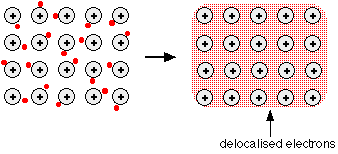
A conceptual diagram illustrating metallic bonding, where positive metal ion cores form a lattice and the valence electrons are delocalized and mobile throughout the structure. This model links directly to data interpretation: metals conduct electricity in the solid state because these delocalized electrons can move and carry charge. Source
Typical evidence:
usually high melting temperature
conducts electricity when solid
conducts when molten
often malleable rather than brittle
generally insoluble in water
The most distinctive clue is conductivity in the solid state. Metals conduct because delocalized electrons are free to move through the structure.
How to interpret data systematically
A good method is to work through the data in stages.
1. Look at melting and boiling temperatures
This often gives the first clue:
low values suggest simple molecular
high values suggest a giant structure
Do not treat this as an absolute rule. Some substances have intermediate values, so you must still use the rest of the data.
2. Look at electrical conductivity
This is often the most useful test.
conducts when solid and molten: usually metallic
does not conduct when solid, but conducts when molten: usually ionic
does not conduct in any state: often simple molecular or giant covalent
conducts despite being giant covalent: think about graphite or graphene
Always explain conductivity in terms of mobile ions or delocalized electrons.
3. Look at solubility and solution behavior
Solubility can support your answer, but it should not be used alone.
if a substance dissolves in water and the solution conducts, this supports ionic structure
if it is insoluble and has a very high melting temperature, it may be giant covalent or metallic
if it has a low melting temperature and does not conduct, it is likely simple molecular
The most useful phrase is not just “it dissolves,” but “it forms a conducting solution because ions are present.”
4. Use mechanical properties if given
Properties such as hardness, brittleness, and malleability can separate similar options.
brittle supports ionic
malleable supports metallic
very hard supports giant covalent
soft supports simple molecular or layered structures such as graphite
Recognizing the most common patterns
Some combinations of data appear repeatedly in exam questions.
Pattern 1: High melting temperature, no conductivity as a solid, conductivity when molten
This strongly indicates a giant ionic lattice. The particles are ions, but they only carry charge when mobile.
Pattern 2: Low melting and boiling temperatures, no conductivity
This strongly indicates a simple molecular structure. The substance is made of molecules with weak intermolecular attractions between them.
Pattern 3: Very high melting temperature, no conductivity in any state
This usually indicates a giant covalent structure. The atoms are joined by many strong covalent bonds and there are no mobile charge carriers.
Pattern 4: Good conductivity as a solid
This usually indicates metallic bonding, unless other evidence points to graphite.
Common mistakes to avoid
Using one property only to identify the structure
Saying a substance conducts “because it has electrons” without stating whether they are mobile
Forgetting that ionic solids do not conduct when solid
Assuming that all substances that dissolve in water conduct electricity
Forgetting the graphite exception
Naming the structure correctly but not linking it to the data provided
In exam answers, the best approach is to make a clear identification and then justify it with precise property evidence and particle-level reasoning.
Practice Questions
A substance has a low boiling temperature and does not conduct electricity in either the solid or liquid state.
Identify the type of structure and bonding present. (2 marks)
1 mark: simple molecular structure
1 mark: covalent bonding within molecules and no mobile charged particles / weak forces between molecules
A solid compound has the following properties:
melting temperature = 801°C
brittle
does not conduct electricity as a solid
conducts electricity when molten
dissolves in water to give a conducting solution
Use this information to identify the type of structure and bonding in the compound and explain your answer. (6 marks)
1 mark: giant ionic lattice / ionic structure
1 mark: contains oppositely charged ions
1 mark: strong electrostatic attraction between ions explains the high melting temperature
1 mark: ions are fixed in place in the solid, so it does not conduct as a solid
1 mark: ions are mobile when molten, so it conducts
1 mark: dissolved ions are mobile in aqueous solution, so the solution conducts
FAQ
Melting temperature is useful, but different structure types can overlap.
For example:
ionic, metallic, and giant covalent substances can all have high melting temperatures
some molecular substances have higher melting temperatures than expected if their molecules are large
You need at least one more clue, usually conductivity or solubility, to make a secure identification.
Graphite breaks a common shortcut: “giant covalent substances do not conduct.”
It is still giant covalent, but each carbon atom forms three covalent bonds, leaving one electron delocalized. These electrons can move through the layers and carry charge.
That means conductivity does not always mean metallic bonding. If the substance is carbon-based, soft, layered, and has a very high melting temperature, graphite is a serious possibility.
Yes. Dissolving and conducting are not the same thing.
A molecular substance may dissolve because its molecules interact well with water, but if it stays as neutral molecules in solution, the solution will not conduct well.
Conductivity in solution requires mobile charged particles:
ions already present, as in an ionic compound
or molecules that react to form ions
So “soluble in water” is weaker evidence than “forms a conducting aqueous solution.”
Start with the most diagnostic evidence:
conductivity as a solid
conductivity when molten
conductivity in aqueous solution
These usually tell you more than a single melting temperature value.
Then check whether the other data support that conclusion. If one property seems inconsistent, think about:
an exception, such as graphite
experimental error
impurities in the sample
Exams usually expect the structure that best fits the full pattern, not just one number.
The formula is helpful, but it should support the physical data rather than replace it.
Useful clues include:
metal + nonmetal often suggests ionic
a pure metal element suggests metallic
only nonmetals suggest molecular or giant covalent
But formulas do not always give the full answer. For example, carbon can form diamond, graphite, or graphene, and all have different properties. Likewise, a formula such as $SiO_2$ does not behave like a small molecule even though it contains only nonmetals.

