

CIE Syllabus focus:
'Know and compare the different structures formed by carbon atoms, including diamond, graphite and graphene.'
Carbon can form several distinct giant covalent structures because its atoms bond strongly in different patterns. The most important for this course are diamond, graphite, and graphene.
Carbon allotropes
Carbon exists as several allotropes.
Allotrope: One of two or more different structural forms of the same element in the same physical state.
The atoms are all carbon, but they are arranged differently in space. This changes how many atoms each carbon bonds to and how electrons move through the structure, so the physical properties of each allotrope are very different.
Why carbon forms different structures
Carbon is especially good at forming different structures because it has four outer-shell electrons and forms strong carbon-carbon covalent bonds. Depending on how these bonds are arranged, carbon can make a rigid three-dimensional network, stacked layers, or a single atomic sheet.
Diamond
In diamond, each carbon atom forms four covalent bonds to four other carbon atoms.
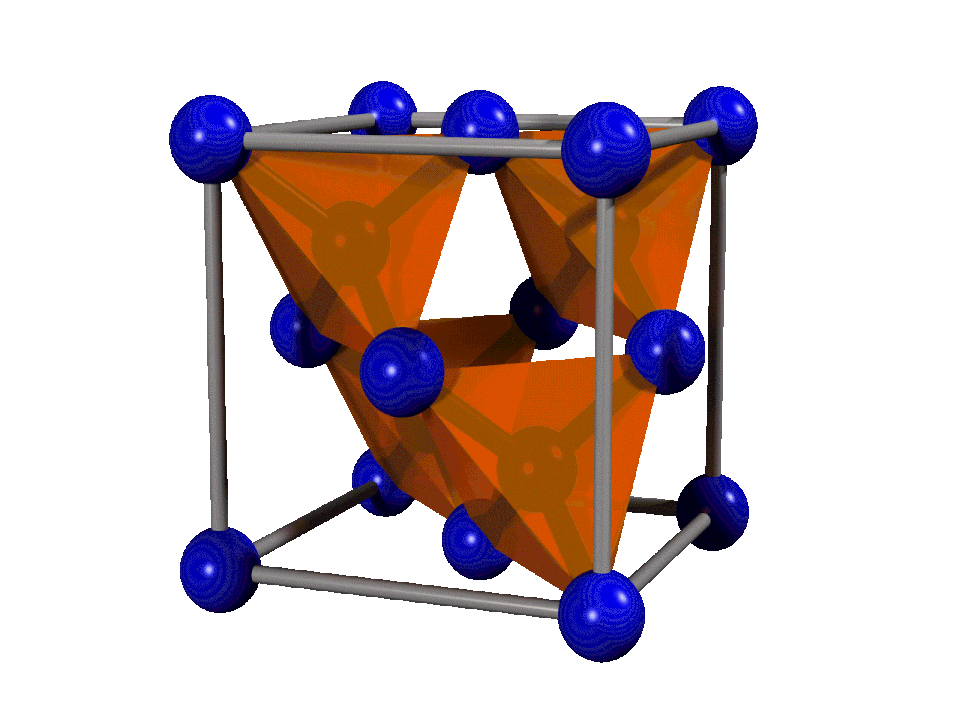
Diamond adopts the diamond-cubic structure, where each carbon is tetrahedrally coordinated to four others in a continuous 3D covalent network. This diagram highlights the repeating unit cell that builds the giant covalent lattice responsible for diamond’s rigidity and high melting point. Source
The bonding extends in all directions, creating a three-dimensional giant covalent lattice. The arrangement around each carbon is tetrahedral, so the structure is very regular and rigid.
Because every carbon atom is held by strong covalent bonds, diamond has a very high melting point. A large amount of energy is needed to break the many strong bonds throughout the lattice.
Diamond is very hard because there are no planes of weakness in the structure. The bonding network is strong in every direction, so when a force is applied, the atoms cannot easily move relative to one another.
Diamond does not conduct electricity. All four outer electrons of each carbon atom are used in covalent bonding, so there are no delocalized electrons or other mobile charge carriers.
Diamond is also a very good thermal conductor. Energy can pass through the stiff lattice efficiently as vibrations are transferred from atom to atom. This is different from electrical conductivity, which requires mobile charged particles.
Diamond is usually transparent. Since it has no mobile electrons, it does not absorb visible light in the same way as graphite.
Graphite
In graphite, each carbon atom forms three covalent bonds to three other carbon atoms. This creates flat hexagonal layers.
The fourth outer electron from each carbon becomes delocalized within the layer.
These delocalized electrons can move along the layers, so graphite conducts electricity. The electrons are free to carry charge through the structure.
Graphite also has a high melting point because each layer contains many strong covalent bonds. Even though graphite is softer than diamond, the covalent bonds within a layer are still very strong.
Graphite is soft and slippery because the layers are held together only by weak forces between them. These weak attractions can be overcome easily, so the layers slide past each other.
This means graphite has different properties in different directions. It is strong within a layer because of covalent bonding, but much weaker between layers. This directional difference is an important feature of its structure.
Graphite is dark and opaque. Its delocalized electrons interact with light, unlike the electron arrangement in diamond.
Graphite can be thought of as a stack of many carbon sheets. The key idea is that bonding within each sheet is strong, but attractions between sheets are much weaker.
Graphene
Graphene is a single layer of carbon atoms arranged in a hexagonal pattern.
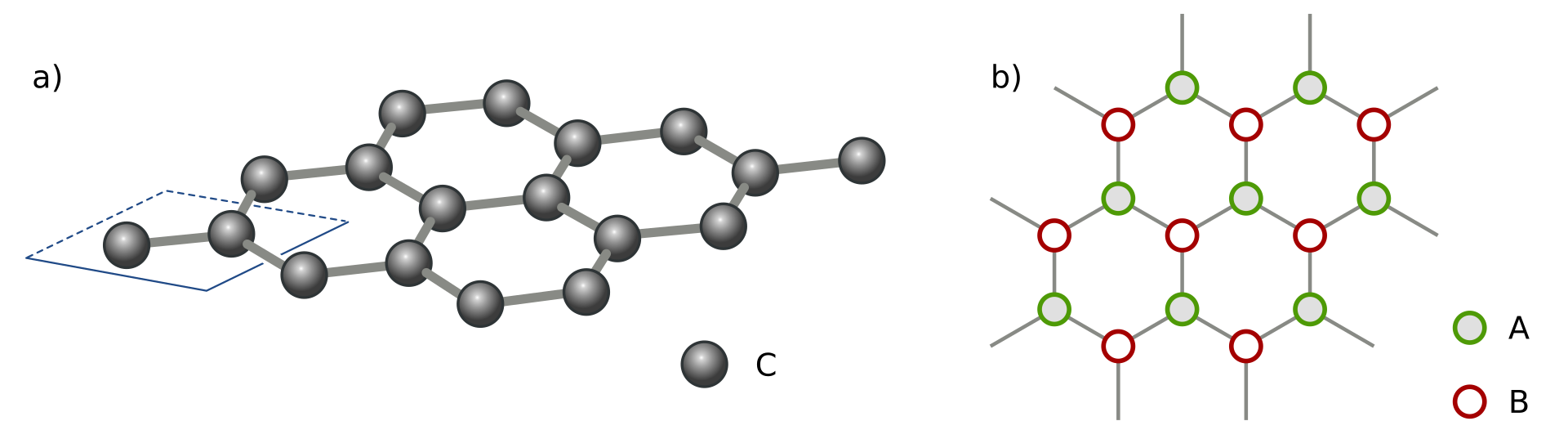
Graphene is a single-atom-thick sheet of carbon arranged in a 2D honeycomb lattice. This figure shows both a ball-and-stick representation and a schematic top view highlighting the repeating unit cell (two carbon atoms) that tiles to form the sheet. Source
You can think of it as one sheet taken from graphite.
Each carbon atom in graphene forms three covalent bonds, leaving one electron per atom delocalized across the sheet. Because these electrons can move, graphene conducts electricity very well.
Graphene is extremely strong because the covalent bonds across the sheet are very strong. Unlike graphite, there are no multiple layers that can slide over one another within the structure itself.
It is also very light because it is only one atom thick. Even though it is so thin, the bonding across the sheet makes it highly resistant to being pulled apart.
Graphene can also conduct heat very efficiently. Its delocalized electrons and strong bonding allow energy to move rapidly across the sheet.
Graphene is important in modern materials science because it combines strength, low mass, flexibility, and excellent conductivity in one structure.
Comparing diamond, graphite, and graphene
Although diamond, graphite, and graphene are all made only of carbon atoms, their properties differ because the arrangement of atoms and the behavior of electrons are different.
Diamond: each carbon bonds to 4 others in a rigid three-dimensional network.
Graphite: each carbon bonds to 3 others in layers, with delocalized electrons and weak forces between layers.
Graphene: each carbon bonds to 3 others in a single layer, also with delocalized electrons.
A useful way to compare them is by structure:
Diamond is a 3D network.
Graphite is a layered structure.
Graphene is a single 2D sheet.
Important comparisons to remember:
Diamond vs graphite: both have strong covalent bonds and high melting points, but diamond is hard and does not conduct electricity, while graphite is soft and does conduct electricity.
Graphite vs graphene: both conduct electricity because of delocalized electrons, but graphite has many layers, whereas graphene is only one layer.
Diamond vs graphene: both are very strong, but graphene conducts electricity and diamond does not.
For exam answers, always link each property directly to the structure and bonding rather than simply listing facts.
Practice Questions
Explain why diamond does not conduct electricity. (2 marks)
Each carbon atom uses all four outer electrons in covalent bonds. (1)
There are no delocalized electrons or other mobile charge carriers. (1)
Describe the structures of diamond, graphite, and graphene, and explain one physical property of each. (6 marks)
Award one mark for each valid point, up to 6 marks.
Diamond: each carbon bonded to 4 other carbon atoms / giant three-dimensional covalent lattice. (1)
Diamond property explained: hard / very high melting point / does not conduct electricity because there are no delocalized electrons. (1)
Graphite: each carbon bonded to 3 other carbon atoms in layers of hexagons. (1)
Graphite property explained: conducts electricity because of delocalized electrons, or is soft because weak forces allow layers to slide. (1)
Graphene: single layer of carbon atoms in a hexagonal arrangement / each carbon bonded to 3 others. (1)
Graphene property explained: conducts electricity because of delocalized electrons, or is very strong because of strong covalent bonds across the sheet. (1)
FAQ
Graphene is called two-dimensional because its atoms are arranged in a sheet that is only one atom thick.
The important bonding is across the length and width of the sheet.
Electrons mainly move within that plane.
It still exists in the real world, but structurally it is treated as a 2D material.
Their atoms are packed differently.
In diamond, the three-dimensional network holds atoms in a tightly connected arrangement. In graphite, the atoms are arranged in layers with larger gaps between those layers.
Diamond is therefore more compact.
Graphite has more empty space between layers.
That difference in packing gives diamond a higher density.
Hardness and ease of cutting are not exactly the same property.
Diamond strongly resists scratching because of its rigid covalent network. However, in certain directions the crystal can split along planes where bonds are arranged in a way that makes cleavage easier.
So diamond is extremely hard.
But a skilled cutter can still cleave it along specific crystal planes.
Graphene can be produced by separating individual layers from graphite.
Methods include:
mechanical separation, sometimes called exfoliation
chemical methods that help pull layers apart
growth on surfaces in specialized industrial processes
The challenge is making large, defect-free sheets. Graphite naturally contains many stacked layers, so isolating just one high-quality layer is difficult.
A pure diamond is usually colorless, but small amounts of other atoms can alter how light is absorbed.
For example:
nitrogen can give a yellow tint
boron can produce a blue color
These impurity atoms slightly change the electronic structure of the crystal, so different wavelengths of visible light are absorbed. The remaining transmitted or reflected light gives the diamond its color.


