IB Syllabus focus: 'Views on power may be explored through thinkers such as Arendt, Foucault, Gramsci, Hooks, Lukes, Nye and others.'
Understanding power in global politics requires comparing how major thinkers explain where power comes from, how it operates, and whether it is visible, hidden, collective, or embedded in everyday life.
Why thinkers matter
Power is a contested concept, so different thinkers emphasize different dimensions of political life. Some focus on consent, some on coercion, some on ideas and culture, and others on how institutions shape what people see as normal or possible.
Power: The ability to shape outcomes, behavior, beliefs, or the conditions under which choices are made.
In IB Global Politics, evaluating thinkers means asking two questions: What does this approach help us see clearly? and What does it risk overlooking? Strong analysis compares perspectives rather than treating one as complete.
Key thinkers
Hannah Arendt
Arendt argued that power comes from people acting together. For her, power is rooted in collective consent and participation, not simply in force. She drew a sharp distinction between power and violence: violence can destroy power, but it cannot create lasting legitimacy on its own.
This view is useful when analyzing protests, revolutions, and democratic movements, because it highlights how governments depend on some degree of public acceptance. However, Arendt can be criticized for underestimating how durable coercion and inequality can be, especially in authoritarian systems where fear remains politically effective.
Michel Foucault
Foucault saw power as diffuse rather than located only in governments or elites. Power operates through institutions, knowledge, and discourses that shape what counts as true, normal, healthy, or deviant. In this sense, power is not only repressive; it is also productive, because it helps create identities, categories, and acceptable behavior.
Foucault is valuable for studying surveillance, expertise, media narratives, and the politics of classification.
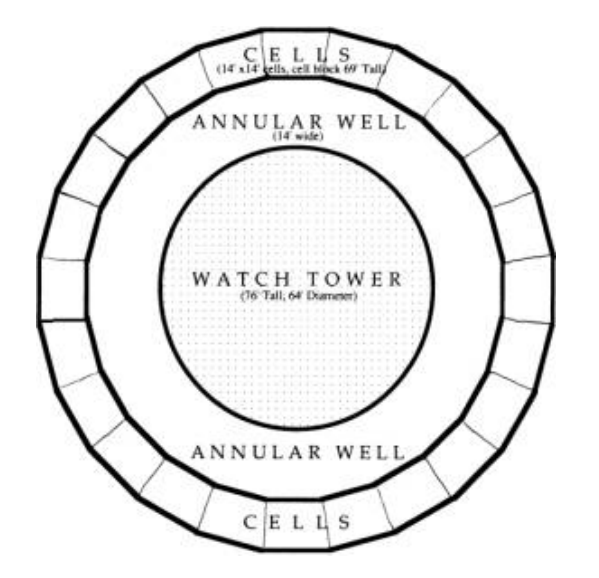
Plan-view diagram of a panopticon: an outer ring of individual cells arranged around a central watchtower. The layout illustrates how constant potential visibility can produce self-discipline, linking institutional design to power as a productive, normalizing force (a core theme in Foucault’s account of modern power). Source
He helps explain why people may internalize norms without direct force. A limitation is that his approach can make power seem so widespread that responsibility becomes hard to locate. It may also offer less clarity about who can be held accountable for major political decisions.
Antonio Gramsci
Gramsci emphasized hegemony, arguing that dominant groups maintain power not only through the state, but also by winning consent in civil society through schools, religion, media, and cultural leadership.
Hegemony: The dominance of a social group achieved partly through consent, when its ideas and values become accepted as common sense.
Gramsci is especially useful for explaining why unequal systems can appear natural or legitimate. He shows that political struggle is also a struggle over ideas. This helps in analyzing nationalism, class interests, and ideological leadership. A criticism is that Gramsci’s framework is often strongly centered on class, so it may need adaptation to capture gender, race, and other forms of domination more fully.
bell hooks
bell hooks examined power through interconnected systems of race, gender, and class domination. Her work draws attention to voices often marginalized in mainstream political theory and shows that power is experienced differently depending on social position. She also stresses that culture, education, and representation are political sites where domination can be reproduced or challenged.
Her approach is powerful for exposing how global politics affects lived experience, especially for women and racialized groups. It also broadens political analysis beyond formal institutions. A limitation is that hooks is less often used as a single, formal model of power, so her insights are sometimes strongest when combined with more institutional or systemic frameworks.
Steven Lukes
Lukes argued that power has three dimensions. The first is visible decision-making. The second is agenda control, where powerful actors prevent some issues from being debated. The third is the shaping of preferences, where people may accept arrangements that work against their interests because alternatives seem unthinkable.
Lukes is useful because he moves analysis beyond obvious conflict. He helps explain hidden power and why inequality can persist even without open resistance. His third dimension is especially influential because it links power to ideology and socialization. Critics argue, however, that it can be difficult to prove when preferences are genuinely manipulated rather than freely formed.
Joseph Nye
Nye defined power broadly as the ability to affect others to obtain preferred outcomes. He stressed that power depends not just on resources, but on the ability to convert resources into influence. His work is important because it recognizes that attraction, legitimacy, and credibility can matter alongside force.
Nye is helpful for understanding why some states or actors gain influence through image, values, and diplomacy. However, his approach can be criticized for being difficult to measure and for sometimes underplaying the structural inequalities that shape whose attraction is noticed and whose is ignored.
Comparing the thinkers
These thinkers do not simply disagree; they focus on different locations and mechanisms of power.

The “Powercube” is a conceptual 3D model used to organize power analysis across multiple axes (commonly forms, spaces, and levels). As a study aid, it reinforces the idea that power can be visible or overt, hidden through agenda-setting and exclusion, and invisible through norms and internalized assumptions—helping students systematically compare different theoretical lenses. Source
Arendt highlights collective action and legitimacy.
Foucault highlights discourse, knowledge, and normalization.
Gramsci highlights consent and ideological leadership.
hooks highlights interlocking domination and lived experience.
Lukes highlights visible, hidden, and internalized power.
Nye highlights the conversion of resources into influence.
A strong evaluation recognizes that no single thinker captures all political reality. Comparing them helps students decide whether a case is best explained by collective agency, social norms, ideology, marginalization, hidden control, or influence through attraction.
Practice Questions
Identify one way in which Arendt’s view of power differs from Foucault’s. [2]
1 mark for identifying that Arendt sees power as based on collective action, consent, or people acting together.
1 mark for identifying that Foucault sees power as diffuse, operating through institutions, knowledge, or discourse, not only through collective public action.
Compare two thinkers on power and assess which perspective is more useful for explaining why people accept unequal political arrangements. [6]
1–2 marks for an accurate explanation of the first thinker’s view of power.
1–2 marks for an accurate explanation of the second thinker’s view of power.
1 mark for a clear comparison focused on why inequality is accepted, such as consent, normalization, agenda control, or preference shaping.
1 mark for a justified assessment of which thinker is more useful.
FAQ
hooks chose to write her name in lowercase as a political and stylistic decision.
It shifted attention away from the author’s status and toward the ideas, the struggle, and the people at the center of her work. In academic writing, many scholars respect that choice by keeping her name in lowercase.
A genealogy traces how ideas, institutions, and categories develop over time instead of treating them as natural or timeless.
For power analysis, this matters because it shows that things like punishment, sexuality, or “normality” are historically produced. If they were made, they can also be challenged and changed.
Gramsci gave scholars a way to study power through culture, not only through the economy or the state.
That made his work useful in fields such as media studies, education, cultural studies, and postcolonial theory. His concept of hegemony helps explain why ruling ideas can spread across very different societies.
It is usually studied indirectly rather than measured in a simple way.
Researchers often combine:
discourse analysis
interviews
policy agenda analysis
historical comparison
They look for cases where options are narrowed before debate begins, or where people describe unequal outcomes as natural, inevitable, or desirable.
Because resources only matter if they can actually change another actor’s behavior or preferences.
A state may have a large economy, military, or media presence and still fail to influence others if it lacks credibility, strategy, or legitimacy. Nye’s point is that conversion matters: possession alone does not guarantee political effect.