IB Syllabus focus: 'Power classifications should not only be defined abstractly; students should evaluate their advantages, limitations, similarities and links.'
Studying power through classifications helps students move beyond memorizing labels. The main task is to judge how useful each framework is for explaining political influence, not just to list categories.
Why compare classifications of power?
A power classification sorts power into categories so it can be analyzed more clearly. In IB Global Politics, this matters because political influence is complex and cannot usually be understood through one single lens.
Power classification: A way of organizing different forms or dimensions of power so political influence can be identified, compared, and analyzed.
Comparing classifications matters because each one highlights a different question:
How is power exercised?
Where does power come from?
Who can use it?
What kind of effects does it produce?
This means classifications are not only descriptive. They are also analytical tools. A strong answer does more than define them; it judges whether a classification is useful, too narrow, or best combined with another framework.
Main ways power is classified
By method of influence
One common classification distinguishes power by the means used to influence others:
Hard power focuses on pressure, threats, or coercion.
Soft power focuses on attraction and persuasion.
Smart power emphasizes combining different methods strategically.
This classification is useful when the main issue is the technique of influence.
By location of influence
Another classification asks whether power lies in positions and systems or in relationships:
Structural power emphasizes institutions, roles, and rules.
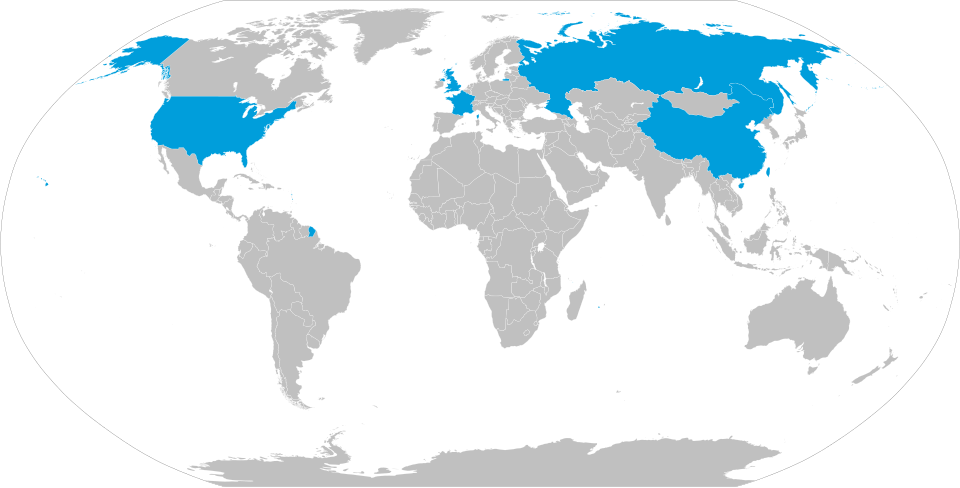
World map highlighting the five permanent members of the UN Security Council (United States, United Kingdom, France, Russia, and China). As a study aid, it makes the distribution of entrenched institutional privilege visually immediate, supporting discussion of how global governance structures allocate unequal influence. Source
Relational power emphasizes interactions between actors.
This is useful when analyzing whether outcomes are shaped more by formal structures or by the ability to influence others directly.
By sphere of impact
Power can also be classified by the domain in which it operates:
Economic
Political
Social
Cultural
This framework helps show that power is not only military or governmental. Influence can come from wealth, office, status, norms, or ideas.
By agency and interaction
A further classification distinguishes between:
Power to: capacity to act
Power over: domination or control
Power with: collective capacity through cooperation
This framework is especially useful for showing that power is not always negative or coercive.
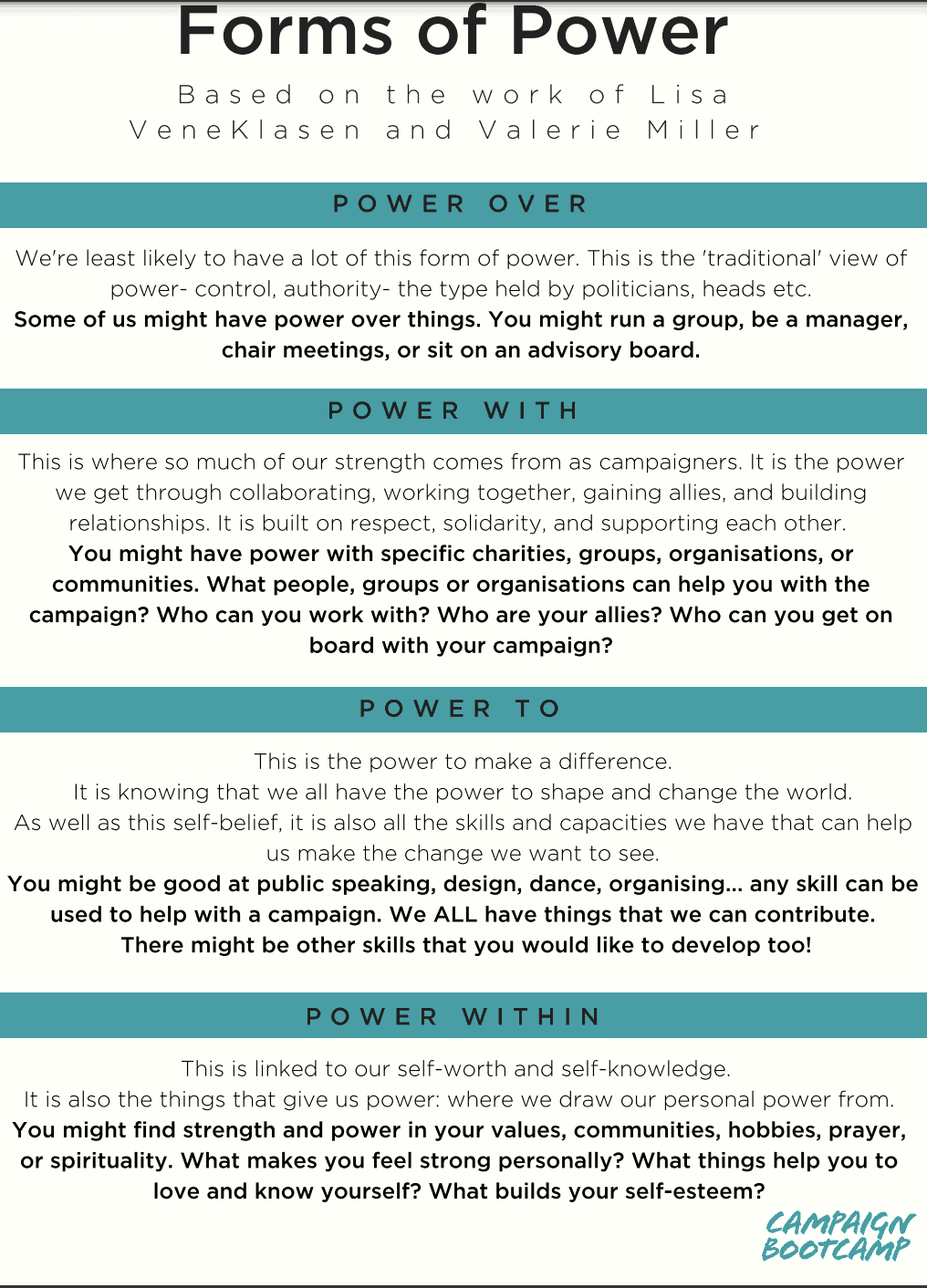
A compact visual typology contrasting “power over,” “power with,” and “power to” (and “power within”) as distinct ways influence operates in social and political life. The layout reinforces that power can be coercive, enabling, or collectively generated—useful for analyzing legitimacy, cooperation, and empowerment in case studies. Source
It can also involve empowerment and collective action.
Advantages of comparing classifications
Comparing classifications improves analysis in several ways.
First, it prevents a one-dimensional understanding of politics. If students only use one model, they may miss important forms of influence.
Second, comparison improves conceptual precision. For example, asking whether power is structural or relational is different from asking whether it is soft or hard. The first focuses on the location of power; the second focuses on the method.
Third, comparison helps identify which framework is most appropriate for a particular question:
A question about institutions may suit a structural approach.
A question about leadership and bargaining may suit a relational approach.
A question about cooperation may benefit from power with.
Fourth, comparison encourages evaluation, which is essential in IB Global Politics. Students can show that a classification may be useful in one context but limited in another.
Limitations of classifications
Although classifications are useful, they also have weaknesses.
A major limitation is oversimplification. Real political situations often involve several forms of power at once. A classification may separate categories neatly, but actual politics is messy and overlapping.
Another limitation is that classifications can create false boundaries. For instance, cultural influence may have economic effects, and relational power may depend on structural advantages. The categories are often linked rather than fully separate.
Some classifications may also privilege certain actors or forms of influence. A framework centered on states may overlook social movements, activists, corporations, or international organizations.
There is also a risk of static thinking. Classifications can make power seem fixed, when in reality it changes across time, context, and issue area.
Finally, a classification may answer one question well but fail to answer another. A framework that explains how power works may not explain why some actors possess more power in the first place.
Similarities across classifications
Even when classifications differ, they share important features.
All are attempts to make a complex concept more manageable.
All select one dimension of power as most important.
All involve choices about what to emphasize and what to leave out.
All are more useful when applied to concrete political analysis rather than learned as abstract labels.
This means similarities exist not only in content, but also in purpose. Every classification is a way of organizing political reality for analysis.
Links between classifications
The most important insight is that classifications are often connected, not competing.
A single political situation can be understood through multiple classifications at the same time:
An actor may have power to act because of a strong structural position.
Soft power may operate through cultural power.
Power with may strengthen relational power.
Economic power can support both hard and soft forms of influence.
These links show that classifications often answer different questions about the same issue. Rather than choosing only one, strong analysis may combine them carefully.
How to evaluate classifications effectively
When comparing classifications, students should ask:
What aspect of power does this classification reveal most clearly?
What does it ignore or understate?
Does it focus on methods, structures, relationships, or outcomes?
Is it better for explaining state action, non-state action, or both?
Can it be linked with another classification for a fuller explanation?
A high-quality comparison does not treat classifications as right or wrong. Instead, it judges their usefulness, limits, and fit for political analysis.
Practice Questions
Identify one reason why classifications of power should be evaluated rather than only defined abstractly. [2]
1 mark for identifying a valid reason, such as improving analysis, revealing different dimensions of power, or avoiding oversimplification.
1 mark for briefly explaining how that reason helps political analysis.
Compare two classifications of power, explaining one similarity between them and one limitation of each for political analysis. [6]
1 mark for accurately outlining the first classification.
1 mark for accurately outlining the second classification.
2 marks for a clear similarity, such as both simplifying complex political reality or both emphasizing one dimension of influence.
1 mark for explaining one limitation of the first classification.
1 mark for explaining one limitation of the second classification.
FAQ
Power is a very broad concept, so different scholars build classifications around different priorities.
For example, one model may focus on means of influence, while another focuses on institutions, relationships, or collective action.
Different classifications exist because:
political life is complex
researchers ask different questions
no single model captures every dimension of power
This is not necessarily a weakness. It shows that power can be studied from multiple valid angles.
Yes. A classification may reflect assumptions about what counts as “real” power.
For example:
state-centered frameworks may downplay civil society
materialist approaches may undervalue ideas and norms
liberal approaches may give more attention to cooperation and legitimacy
Bias does not make a classification useless, but it means students should ask what perspective shaped it and whose power it may overlook.
Start with the wording of the question.
Then ask:
Is the question about methods of influence?
Is it about institutions or relationships?
Is it about capacity, domination, or cooperation?
Is it about a particular domain, such as culture or economics?
Choose the classification that fits the question most directly.
If needed, combine two frameworks, but only if the link is clear and improves analysis rather than making the answer descriptive.
That is often a sign of strong analysis, not confusion.
An actor may:
hold major structural advantages
but lack soft power
have economic resources
but weak relational influence
This shows that power is uneven and context-dependent.
In practice, different classifications can reveal contradictions in an actor’s position. Recognizing those contradictions can make an argument more nuanced and convincing.
Not always.
Some classifications were developed mainly with states in mind, especially those focusing on coercion, formal institutions, or interstate influence.
Others may be more adaptable to non-state actors:
power with works well for social movements
cultural or social power can fit media and advocacy networks
relational power can help analyze NGOs, corporations, and activists
A useful test is to ask whether the classification assumes formal authority or whether it can also explain informal influence.