IB Syllabus focus: 'Students should explicitly address power to, power over and power with, evaluating their usefulness for political analysis.'
These concepts help students analyze politics from three angles: what actors can do, how they dominate others, and how people achieve change together through coordinated collective action.
Understanding the three concepts
Power in global politics is not only about who wins.
It also concerns capacity, control, and cooperation. Using power to, power over, and power with allows political analysis to move beyond a single idea of power and ask different questions about agency, domination, and collective action.
Power to
Power to focuses on the ability of an actor to act effectively and pursue goals.
Power to: The capacity of a political actor to make choices, take action, and produce outcomes.
This concept highlights agency. Individuals, groups, and institutions can sometimes shape outcomes even when they lack major resources. A small movement may have the power to place an issue on the agenda, while a court may have the power to enforce rights through legal decisions. In analysis, power to directs attention to capabilities such as organization, leadership, knowledge, legitimacy, and access to decision-makers.
It is especially useful when studying actors often described as weak. Citizens, NGOs, minority communities, and youth movements may still have power to influence debate, mobilize support, or pressure leaders.
Power over
Power over emphasizes domination and constraint in political relationships.
Power over: The ability of one actor to control, direct, or limit the actions and choices of another actor.
This form of power is most visible when one actor can shape what another actor does, thinks, or is allowed to do. Governments may exercise power over citizens through law, policing, surveillance, censorship, or punishment. Employers may exercise power over workers through contracts, wages, and conditions. Power over can be direct, such as banning a protest, or indirect, such as creating fear that discourages dissent.
In political analysis, this concept is valuable because it exposes inequality and asymmetry. It asks who sets limits, whose preferences matter most, and who bears the costs. It is particularly useful for examining coercion, exclusion, and hierarchy.
Power with
Power with refers to collective capacity created through cooperation and shared purpose.
Power with: The ability to achieve political goals through collaboration, solidarity, and coordinated action with others.
Unlike power to, which can be held by a single actor, or power over, which stresses domination, power with centers on solidarity, coordination, and shared purpose. Trade unions, indigenous movements, neighborhood campaigns, and transnational advocacy networks often gain influence by acting together. Their collective voice can be greater than the sum of individual efforts.
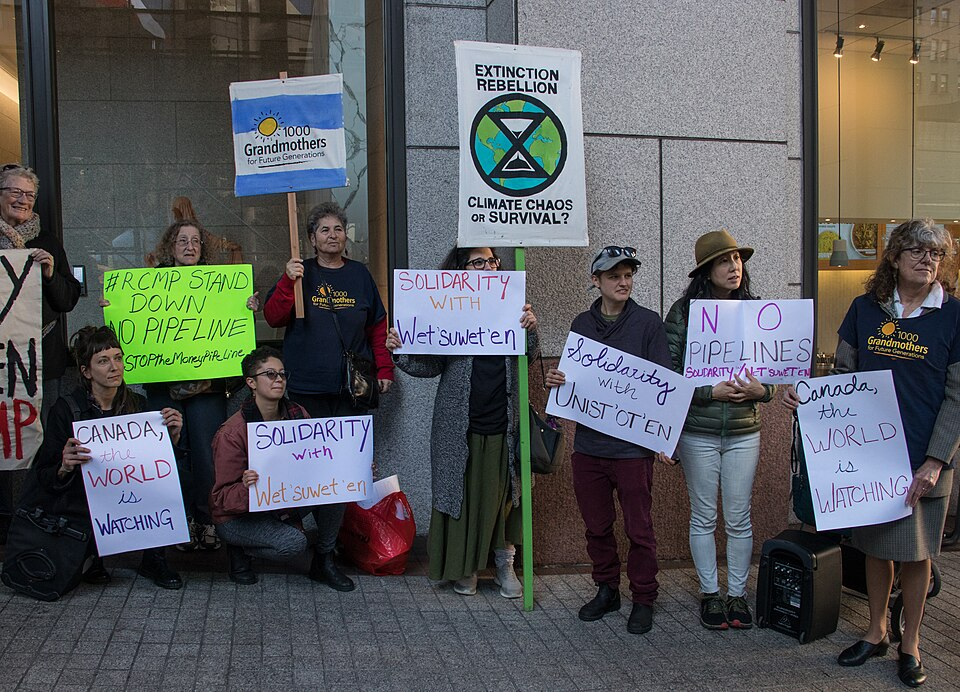
This photograph shows a public solidarity rally, illustrating how political influence can be generated through coordinated collective presence. As a visual example of power with, it highlights shared framing (signs/slogans) and mobilization as resources that can amplify groups beyond individual capacity. Source
For political analysis, power with matters because many outcomes are not produced by isolated individuals. They depend on coalition-building, trust, common framing of issues, and sustained participation over time.
Comparing the concepts
These three ideas are related but not identical.
Power to asks: what can an actor do?
Power over asks: who can control or constrain others?
Power with asks: what becomes possible through collective action?
A single political process may involve all three. A protest movement may develop power with by building a coalition, gain power to pressure officials, and challenge the state’s power over public space or speech. This is why the concepts are most useful when treated as complementary rather than competing labels.
Usefulness for political analysis
Using the three concepts improves analysis in several ways.
It avoids reducing politics to force alone.
It helps identify both individual agency and collective agency.
It reveals that outcomes may depend on domination, negotiation, or cooperation.
It allows comparison between different actors, including leaders, states, civil society groups, and communities.
These concepts are also helpful for asking sharper case-study questions.
Does an actor have the ability to act, or only the desire to act?
Is compliance voluntary, negotiated, or imposed?
Are political gains produced by one leader or by organized collective effort?
Such questions help students move from description to explanation. Instead of only saying that an actor was influential, they can explain how that influence worked and what kind of power was involved.
Limitations and cautions
Although useful, these categories have limits.
First, they can overlap. Collective action can create power with, but that shared effort may also increase a group’s power to achieve change. Second, the concepts can hide differences in scale. A local campaign and a national government both have power, but the reach and durability of their power are very different. Third, power can change over time. An actor may gain power with during a crisis and lose it when unity weakens.
Visible outcomes do not always reveal the full picture. A group may seem powerless because it did not win, yet it may still have had power to shape public debate or maintain resistance. Good political analysis therefore examines processes, relationships, and constraints, not only final results.
Common analytical mistakes
Students should avoid several common errors.
Treating power to as automatically positive. Agency can be used for emancipatory or harmful purposes.
Treating power over as the only “real” form of power. This misses organization, consent, and solidarity.
Treating power with as automatically equal or democratic. Coalitions can include internal exclusions and unequal leadership.
Using the three terms as synonyms. Each captures a different dimension of political life.
Ignoring context. The same actor may have strong power in one arena and weak power in another.
Context determines which lens is most revealing in a given political case.
Practice Questions
Explain one difference between power to and power over.
1 mark for accurately explaining power to as capacity, agency, or the ability to act.
1 mark for accurately explaining power over as control, domination, or the ability to constrain others.
1 mark for a clear distinction between them, such as capacity versus domination, ideally linked to a political context or example.
Explain why distinguishing between power to, power over, and power with is useful in political analysis.
1 mark for an accurate explanation of power to.
1 mark for an accurate explanation of power over.
1 mark for an accurate explanation of power with.
Up to 2 marks for explaining how the distinctions improve analysis, such as showing agency, exposing domination, or identifying collective action.
1 mark for applying the distinction to a relevant political example or process.
FAQ
Yes. A political actor can shift between them depending on context.
For example:
A movement may use power with to build a coalition.
It may gain power to influence policy once organized.
If it later controls institutions, it may exercise power over others.
This matters because political roles change. Opposition groups, governments, and civil society organizations do not use power in the same way at every stage of a conflict or campaign.
Digital platforms can strengthen power with by making coordination faster and cheaper.
They can help groups:
share information quickly
create common messages
organize protests across different places
maintain visibility during repression
However, digital power with can also be fragile. Online participation may be shallow, platforms can amplify misinformation, and authorities may monitor activists. Digital coordination helps collective action, but it does not automatically create trust, discipline, or long-term organization.
Useful evidence depends on the form of power you are analyzing.
Look for:
Power to: leadership decisions, legal authority, resources, strategic choices
Power over: laws, arrests, censorship, threats, dependency relationships
Power with: coalition statements, membership size, protest turnout, joint campaigns, alliance networks
Strong analysis usually combines different sources, such as speeches, policy documents, media reporting, NGO reports, and interviews. This reduces the risk of assuming power only from public appearances.
Often, yes. Legitimacy can make all three forms of power more stable.
Power to becomes stronger when others accept an actor’s right to act.
Power over may last longer when rules are seen as justified, not just feared.
Power with is easier to sustain when participants believe the coalition is fair and representative.
Without legitimacy, actors may still be powerful, but they often depend more heavily on pressure, short-term loyalty, or emergency conditions.
Coalitions can fail because collective power depends on more than numbers.
Common problems include:
unclear goals
competing leadership claims
unequal risks among members
weak organization
loss of trust
outside pressure that divides the group
A coalition may look united in public but be fragmented internally. That is why analysts should examine decision-making, discipline, and shared incentives, not just visible solidarity.