IB Syllabus focus: 'Affected stakeholders should be considered, even where individuals or groups lack the agency or means to exercise power directly.'
Global political analysis is incomplete if it focuses only on visible decision-makers. Many people most affected by political outcomes cannot shape them directly, yet their experiences and interests remain politically important.
Understanding the concept
In this topic, the focus is on affected stakeholders whose lives, security, rights, or opportunities are shaped by political decisions but who have little ability to influence those decisions themselves. Their weakness may be legal, economic, social, or practical.
Political agency: The capacity of an individual or group to influence political decisions or outcomes through participation, representation, organization, resources, or pressure.
A lack of political agency does not mean a lack of importance. It means that influence is limited or blocked. A group may be highly affected by war, migration policy, border controls, development projects, or climate impacts while having little direct voice in the institutions deciding those issues.
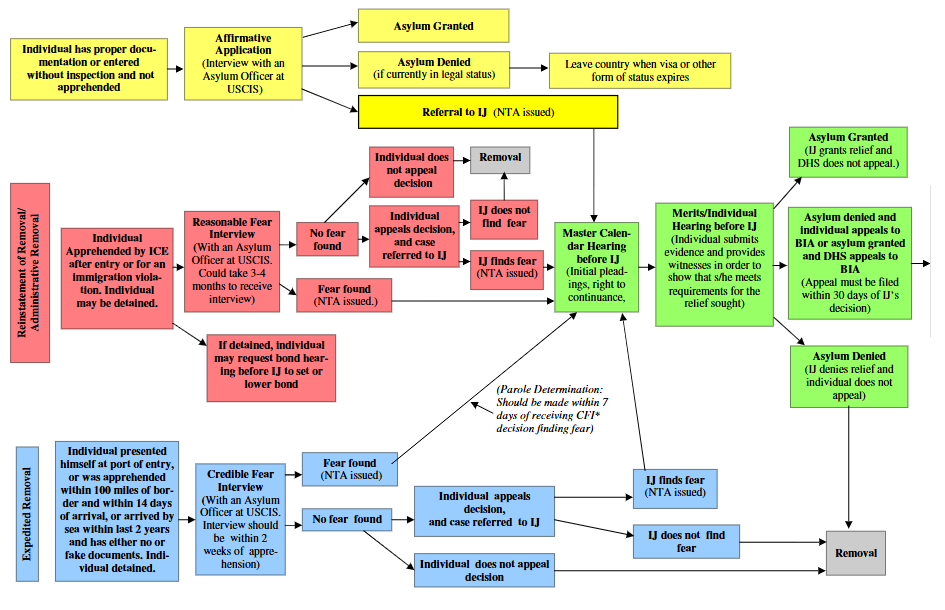
This flow chart summarizes key pathways through the U.S. refugee resettlement and asylum system, including steps such as credible fear interviews, immigration court proceedings, detention, and removal outcomes. It highlights how life-altering decisions are made through complex institutions, often leaving affected applicants with limited ability to shape timelines or results. Source
Who can fall into this category
Stakeholders without strong agency may include:
Children, especially in conflict, poverty, or displacement
Refugees, asylum seekers, and internally displaced people
Stateless populations
Prisoners or detained migrants
People living under occupation, conflict, or extreme repression
Very poor or isolated communities with weak access to media, education, or transport
Future generations, who will be affected by present decisions but cannot participate now
These groups are not all powerless in the same way. Some may resist informally, attract sympathy, or gain support from others. However, they often lack the means to exercise power directly.
Why they must be considered
A major reason to include these stakeholders is that global politics is not only about who decides, but also about who bears the consequences.
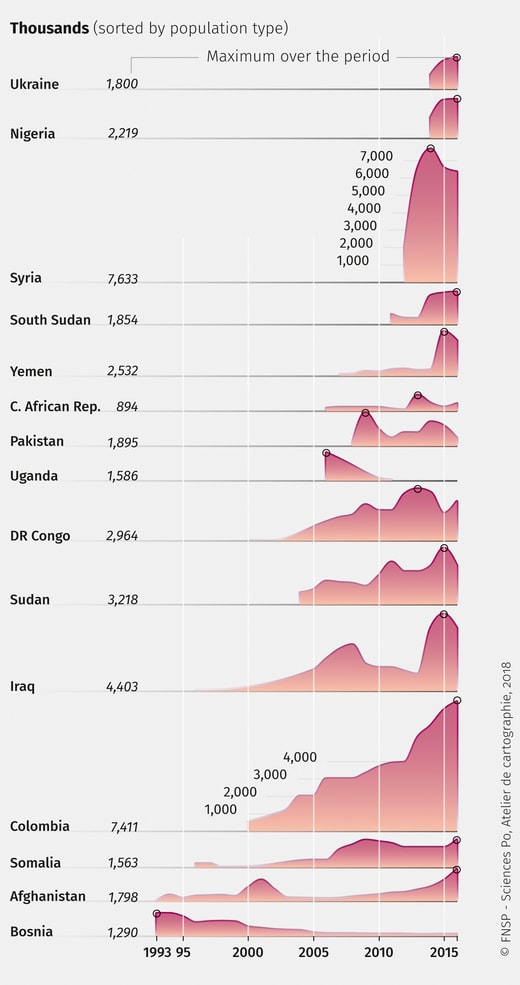
This chart tracks the evolution of internally displaced persons (IDPs) across multiple conflict-affected countries from 1993–2016, showing abrupt surges as violence escalates and fluctuates. The visual format makes it easier to compare patterns across cases and to see displacement as a direct human consequence of political insecurity. Source
If analysis looks only at powerful actors, it can miss the real human impact of political choices.
Considering stakeholders without agency is important because it:
reveals unequal power relationships
highlights issues of justice, representation, and exclusion
prevents political analysis from becoming too state-centered or elite-centered
shows that “successful” policies may still impose heavy costs on vulnerable groups
improves judgments about legitimacy, since decisions affecting people without hearing them may be less legitimate
This also matters for evaluating policy outcomes. A border policy may appear effective from the perspective of enforcement, but harmful from the perspective of families separated by it. A climate decision may benefit present economic interests while imposing risks on future populations. In both cases, analysis becomes stronger when it includes those with limited voice.
Political and ethical importance
There is both a political and an ethical dimension here.
Politically, excluded stakeholders can still shape outcomes indirectly by becoming symbols of injustice, sources of instability, or subjects of advocacy. Their exclusion may produce resentment, weak compliance, or long-term conflict.
Ethically, ignoring them implies that only those with power count. IB Global Politics instead requires attention to the fact that some people are deeply affected even when they cannot speak effectively within political systems.
Why agency may be limited
Political agency can be restricted in different ways:
Legal barriers: no citizenship, no voting rights, uncertain legal status
Material barriers: poverty, poor transport, lack of internet access, low literacy
Security barriers: fear of violence, detention, intimidation, or retaliation
Social barriers: discrimination based on age, gender, ethnicity, class, or disability
Institutional barriers: decisions made far away in forums they cannot enter
Time barriers: future generations cannot directly represent their interests
These barriers often overlap. For example, a displaced child may face legal insecurity, poverty, trauma, and lack of access to formal institutions at the same time. This intersection of barriers can make direct participation almost impossible.
It is also important not to assume that low agency is natural or accidental. In many cases, it is produced by political structures and choices. Exclusion itself can be a political outcome.
Analyzing these stakeholders in case studies
When studying a global political issue, students should ask not only “Who is making decisions?” but also “Who is affected but unheard?” This changes the quality of analysis.
Questions to ask
Useful analytical questions include:
Who is most affected by this issue?
In what specific ways are they affected?
Why do they have limited direct influence?
What barriers prevent participation or representation?
Who claims to speak on their behalf?
How accurate or accountable is that representation?
What happens when their interests are ignored?
This approach helps students move beyond formal politics and identify hidden exclusions. It also encourages more precise analysis of power: not just who has power, but who lacks it and why.
Representation problems and common mistakes
Because these stakeholders often cannot advocate effectively for themselves, others may speak for them. This can make them more visible, but it also creates risks.
Key representation problems include:
misrepresentation, where outsiders simplify or distort their interests
tokenism, where affected people are included symbolically but not meaningfully
dependency, where visibility depends on outside attention
selective empathy, where some vulnerable groups receive attention while others remain ignored
A common mistake is to treat such groups as a single, passive mass. In reality, they are often diverse, with different needs, identities, and priorities. Another mistake is to assume that if a group lacks direct power, it has no political significance. Often, the opposite is true: the absence of agency is exactly what makes the case politically important.
Strong analysis therefore recognizes three points at once:
these stakeholders are affected
their direct influence is limited
their exclusion is itself a political issue
Practice Questions
Identify two reasons why stakeholders without political agency should be considered in global political analysis. [2]
1 mark for identifying that they may be strongly affected by political decisions.
1 mark for identifying that including them reveals inequalities in power, legitimacy, representation, or justice.
Accept any other valid reason clearly linked to their lack of direct influence.
Explain how limited political agency can shape the experiences of affected stakeholders in one global political issue. [6]
Award up to 3 marks for each well-explained way, up to 6 marks total. Possible points include:
Limited agency reduces their ability to influence decisions that affect their rights, security, or welfare.
Their interests may be ignored, misunderstood, or represented inaccurately by others.
Exclusion can deepen vulnerability by making harmful policies harder to challenge.
Lack of direct voice can reduce the legitimacy of political decisions.
Their experiences may become visible only through media attention, advocacy, or crisis. To reach 5–6 marks, the response should explain links clearly and apply them to one relevant global political issue.
FAQ
A person can lack full political rights, such as voting, and still have some agency through protest, community organization, or public visibility.
By contrast, lacking political agency is broader. It means someone has very limited practical ability to shape outcomes, even if some formal rights exist on paper.
Sometimes, yes. Phones, messaging apps, and social media can help people document abuses, share testimony, and connect with supporters.
However, technology can also exclude. People may lack access, face surveillance, or be targeted for speaking publicly. Digital tools can widen voice, but they do not remove deeper inequalities by themselves.
Present decisions on climate, debt, infrastructure, and resource use can shape the lives of people who are not yet able to participate politically.
They are treated as stakeholders because they will inherit the long-term consequences. Their lack of present voice raises major questions about fairness and responsibility across time.
Warning signs include:
no evidence of consultation
speaking in overly simple or emotional terms
treating the group as uniform
using the group mainly to advance another agenda
Good representation usually involves listening, accuracy, accountability, and some way for affected people to respond or disagree.
Ethical research should minimize harm and avoid extracting stories without benefit or consent.
Important practices include:
informed consent where possible
protecting anonymity and safety
avoiding pressure to disclose trauma
checking whether participation creates risk
being honest about how information will be used
The goal is not just to gather data, but to avoid repeating the same patterns of powerlessness being studied.