IB Syllabus focus: 'Political system dynamics shape possible courses of action and can affect actors’ power and legitimacy across diverse contexts.'
Political systems are not static.
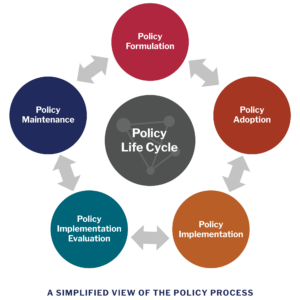
This figure depicts policymaking as a continuous loop rather than a linear chain, highlighting how governance involves ongoing adjustment and maintenance. It pairs well with system-dynamics thinking: implementation and evaluation become pressures that can stabilize a regime or trigger reform, contestation, or crisis. Source
Their changing relationships, pressures, and patterns of decision-making influence what political actors can do, how effectively they can do it, and whether others accept their authority.
Understanding political system dynamics
Political system dynamics refer to the ways a political system changes, responds, and operates over time. A system may appear stable on the surface, yet still contain ongoing tensions, bargaining, competition, and adaptation.
Political system dynamics: The shifting processes, relationships, pressures, and interactions within a political system that shape political outcomes over time.
Dynamics matter because politics is rarely just about formal rules. It is also about how rules are applied, challenged, ignored, or reinterpreted in practice. The same formal system can produce very different outcomes depending on the speed of decision-making, the level of public support, elite divisions, or the presence of crisis.
Political dynamics often include:
Competition between political actors
Cooperation and coalition-building
Conflict over values, resources, or authority
Adaptation to public pressure or external shocks
Resistance to change by powerful interests
These processes affect what actions are realistic, acceptable, or likely to succeed.
How dynamics shape courses of action
A key idea in this subsubtopic is that political dynamics shape the possible courses of action available to actors. In theory, actors may have many options. In reality, those options are narrowed or expanded by the political environment.
Open and closed political moments
Some political systems experience periods of openness, when change becomes easier. This can happen when:
governing coalitions are weak or divided
public opinion strongly demands action
a crisis creates urgency
elections increase responsiveness
new alliances emerge
At other times, systems become more closed. This may happen when:
leaders consolidate authority
opposition is fragmented
institutions are slow or deadlocked
public fear discourages dissent
entrenched interests block reform
As a result, the same actor may have very different opportunities at different moments.
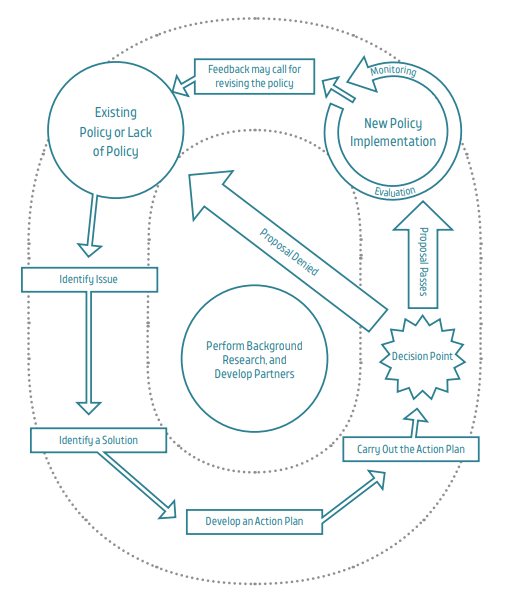
This diagram emphasizes that political action is conditional: proposals can fail at decision points, require coalition-building, and be revised through feedback after implementation and evaluation. It provides a concrete way to illustrate why the same reform idea may be impossible in one moment but feasible later, as dynamics shift across the cycle. Source
A proposal that is impossible in one period may become politically feasible later.
Formal power versus practical influence
Political dynamics also show that having formal authority does not always mean having effective control. A leader may hold office but face resistance from rival elites, administrative weakness, or mass protest. By contrast, an actor with limited formal authority may gain influence through momentum, public support, or strategic alliances.
This means students should look beyond official titles and ask:
Who can actually shape decisions?
Who can delay or block action?
Who benefits from the current balance of forces?
What events are changing that balance?
Dynamics and changing power
Power in politics is relational and fluid. It depends not only on resources, but also on timing, perception, and the wider political context.
Political dynamics can increase an actor’s power when:
they gain broader support
opponents lose unity
a crisis makes their message more persuasive
institutions begin to favor their position
they successfully frame an issue in compelling terms
Political dynamics can reduce power when:
public trust falls
coalitions collapse
decision-making shifts elsewhere
unrest exposes weakness
new actors enter and challenge established authority
Power is therefore not fixed. It can move quickly, especially in periods of uncertainty. Elections, scandals, protests, economic downturns, and security threats can all alter the political balance.
Dynamics and legitimacy
Legitimacy is central to understanding why some actors can govern effectively while others struggle, even when they possess legal authority.
Legitimacy: The belief that a political actor, institution, or decision has a rightful and acceptable claim to authority.
Legitimacy is shaped by political dynamics because public acceptance changes over time. It is not guaranteed simply by law or tradition. Actors often need to maintain legitimacy through performance, responsiveness, accountability, and perceived fairness.
How legitimacy is strengthened
Legitimacy may grow when political actors:
respond effectively to major problems
act consistently with shared values
include affected groups in decision-making
communicate clearly and truthfully
manage conflict without excessive coercion
When actors are seen as competent and fair, their authority often becomes easier to exercise. Others are more likely to comply voluntarily, which increases political effectiveness.
How legitimacy is weakened
Legitimacy may decline when actors are perceived as:
corrupt
unresponsive
repressive
ineffective
detached from public needs
In dynamic political systems, legitimacy can erode gradually or collapse suddenly. A long period of dissatisfaction may produce a tipping point, where a single event triggers mass rejection of authority. This can radically alter who holds power and what actions become possible.
Why context matters
Although this subsubtopic focuses on dynamics rather than structures, context still matters because dynamics operate differently across political settings. For example, political conflict in one context may lead to negotiation, while in another it may produce paralysis or repression.
Students should therefore avoid assuming that similar pressures always produce similar outcomes. Instead, they should analyze:
the pace of political change
the level of contestation
the resilience of governing arrangements
the degree of public consent
the ability of actors to adapt
This helps explain why political systems can appear stable yet suddenly change, or seem fragile yet survive repeated crises.
Analytical approach for IB Global Politics
When analyzing political system dynamics, focus on change over time rather than a static description.

This diagram presents the policy process as an iterative cycle (agenda setting → enactment → implementation → evaluation), emphasizing that political decisions are rarely one-off events. The feedback arrow is especially useful for Global Politics analysis because it shows how outcomes and public responses can reshape the next round of political choices. Source
Strong answers usually examine:
which actors are gaining or losing influence
what events or pressures are driving change
how the range of political choices is being expanded or restricted
whether legitimacy is being strengthened or undermined
why outcomes differ across contexts
This approach highlights politics as an evolving process. Political actors do not operate in a vacuum; they act within shifting systems that shape both their power and their legitimacy.
Practice Questions
Identify one way political system dynamics can affect an actor’s power. [2 marks]
1 mark for identifying a relevant way political system dynamics affect power, such as changes in public support, elite division, crisis, coalition-building, or institutional deadlock.
1 mark for briefly explaining how that dynamic increases or reduces the actor’s ability to influence decisions.
Explain how political system dynamics can shape both possible courses of action and legitimacy. [6 marks]
1-2 marks: Basic understanding of political system dynamics with limited explanation.
3-4 marks: Explains how changing pressures, competition, crisis, or cooperation can expand or restrict political choices.
5-6 marks: Clearly explains both parts of the question by showing:
how dynamics affect what actors can realistically do
how those same dynamics can strengthen or weaken legitimacy through performance, responsiveness, fairness, or public trust
a logically organized answer using relevant political language
FAQ
A sudden event is usually a trigger, such as a scandal, protest, or economic shock.
Political system dynamics are broader. They include the ongoing processes that shape how the system reacts to that event, such as elite bargaining, public opinion shifts, or institutional rivalry.
So, an event may start change, but dynamics determine whether that change is absorbed, resisted, or transformed into a deeper political shift.
Yes. Apparent stability can hide intense political movement beneath the surface.
For example:
alliances may be shifting quietly
public trust may be falling slowly
factions inside leadership may be competing
policy deadlock may be building pressure
A system may seem calm until these underlying dynamics become visible through a crisis or abrupt change.
Crises compress time. They force decisions faster than usual and can weaken old routines.
During a crisis:
leaders may gain emergency authority
opposition may lose space to challenge
citizens may accept stronger measures
failures become more visible
Crises can therefore rapidly change both power and legitimacy, but the direction of change depends on whether actors are seen as effective and justified.
Not always. Legitimacy and power often support each other, but they are not identical.
An actor may have:
high legitimacy but weak practical capacity
strong coercive power but low legitimacy
In the long term, low legitimacy often makes power harder to sustain because compliance becomes more costly and resistance becomes more likely.
Dynamics do not always produce action. Sometimes they create blockage.
This can happen when:
rival actors have enough power to veto each other
leaders fear losing support
public opinion is polarized
short-term survival matters more than long-term policy
In such cases, the system is still dynamic, but the result is delay, bargaining, or paralysis rather than decisive change.