IB Syllabus focus: 'Similar actors in different contexts or systems may have drastically different levels of power and perceived legitimacy.'
In global politics, actor labels alone reveal little. A mayor, judge, NGO, or media outlet may appear similar across countries but operate with very different influence and credibility.
Why context matters
The same type of political actor does not carry the same weight everywhere. An actor’s title may look similar across systems, but its real power depends on the wider political setting in which it operates. Context includes constitutional rules, political culture, economic resources, security conditions, and patterns of public trust.
Power should therefore be understood as relational: it depends on what an actor can do in relation to other actors. A president, for example, may be highly constrained by courts, parties, and legislatures in one system, but dominate all major decisions in another.
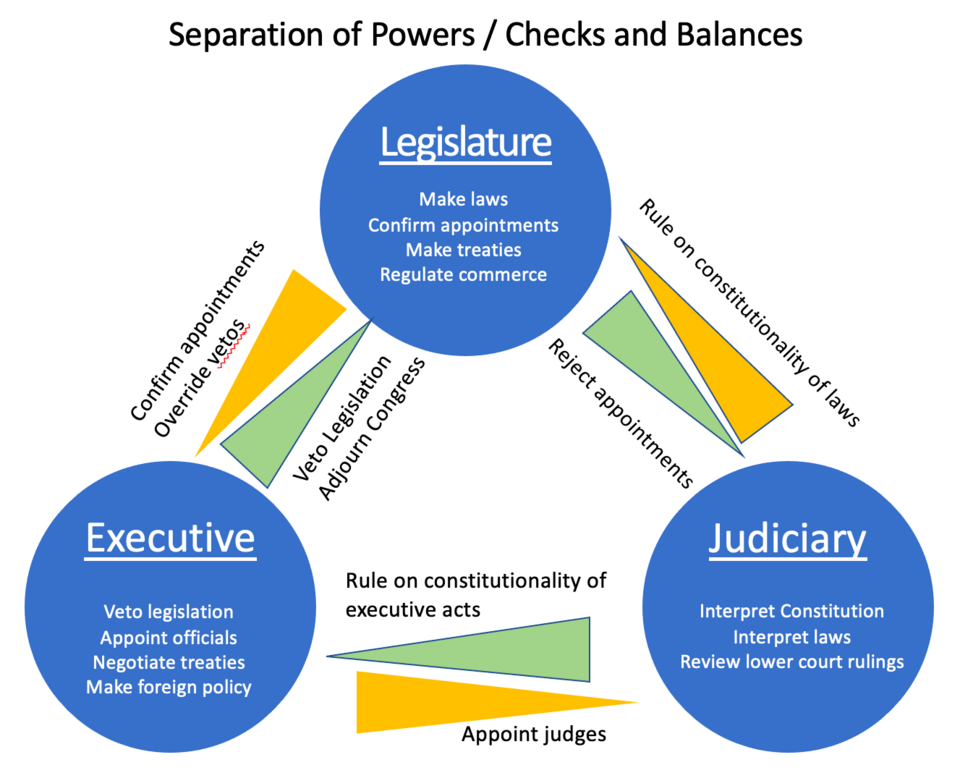
Diagram of separation of powers and checks and balances in the U.S. system, showing how executive, legislative, and judicial institutions can constrain one another. It helps illustrate how “real power” is shaped by the wider institutional context rather than by office title alone. Source
Looking only at formal office can be misleading.
A crucial issue is legitimacy.
Legitimacy: The belief that an actor’s authority, actions, or role are appropriate, lawful, justified, or deserving of support.
Perceived legitimacy matters because it affects whether others obey, cooperate, resist, or challenge an actor. An actor with strong legal powers but weak legitimacy may face protests, non-compliance, or elite opposition. An actor with limited formal authority but high legitimacy may still shape debate, mobilize supporters, and pressure decision-makers.
What changes actor power across contexts
Institutional design
Political systems distribute authority differently. This changes the power of similar actors.
In federal systems, subnational governments may control taxation, education, or policing.
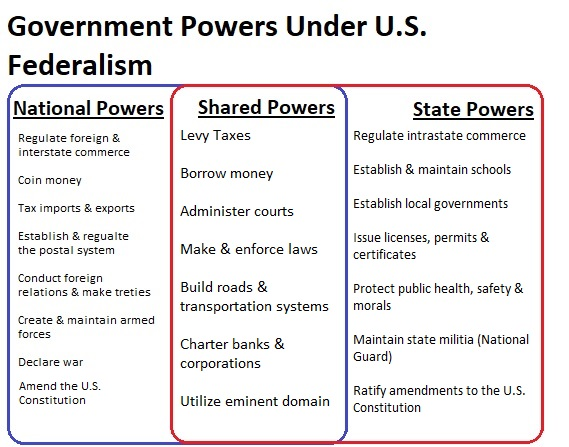
Venn diagram illustrating the division of powers in a federal system, separating federal-only powers, state-only powers, and concurrent (shared) powers. It clarifies how institutional design can expand or limit the practical influence of subnational governments across policy areas. Source
In more centralized systems, local authorities may mainly implement national policies.
In systems with strong checks and balances, leaders face institutional limits.
In more concentrated systems, decision-making may be faster and more personal.
Institutional design also affects who can block decisions. If many veto points exist, even powerful actors must bargain. If veto points are weak, actors at the center can act more freely.
State capacity
An actor’s formal authority only matters if the state can enforce decisions. In states with high administrative capacity, courts, regulators, and ministries can turn rules into action. In weaker states, local elites, armed groups, or patronage networks may reduce official power.
This means that two ministers with the same legal authority may have very different practical influence if one controls an effective bureaucracy and the other does not.
Legal protections and restrictions
Laws and constitutional protections shape how far actors can act.
A journalist in a system with strong free speech protections may investigate corruption openly.
A journalist in a more repressive setting may face censorship, surveillance, or arrest.
An NGO may operate freely in one country but be weakened in another by registration rules or foreign-funding restrictions.
The legal environment changes both actual power and public perceptions of legitimacy.
Resources and organization
Actors need more than legal authority. They also need money, expertise, networks, media access, and organizational capacity.
For example:
A local government with an elected mandate but no budget has limited influence.
A civil society group with strong research capacity and international funding may shape policy debates beyond its formal status.
A political leader backed by a disciplined party machine often has more effective power than one leading a divided coalition.
Same actor type, different political weight
Political leaders
A prime minister in a stable parliamentary majority may dominate the policy agenda. A prime minister in a fragmented coalition may spend more time bargaining than leading. In a personalist system, leadership power may depend less on institutions and more on loyalty networks or security forces.
Local and subnational governments
Governors and mayors vary greatly in significance. In some contexts, they are major policy actors with taxation powers and democratic mandates. In others, they are administrative agents of the center with little autonomy. Their legitimacy may also differ depending on whether citizens see them as genuine representatives or extensions of national power.
Civil society and media actors
The same NGO or media organization can be influential in one setting and marginal in another. Where civil liberties are protected, these actors may expose abuses, shape public opinion, and lobby effectively. Where repression is common, they may survive only through self-censorship, exile networks, or informal activism.
Power and perceived legitimacy do not always match
High power does not automatically create high legitimacy. Some actors maintain influence through coercion, patronage, or control of information rather than broad public support. These actors may appear strong, but their authority can be fragile if challenged by economic crisis, electoral defeat, or elite splits.
The reverse is also true. Some actors have high legitimacy but limited formal power. A protest movement, respected public figure, or indigenous community leader may be widely trusted without holding office. Such actors can still shift the political agenda by framing issues morally and mobilizing collective action.
Perceived legitimacy also varies by audience. An actor may be seen as legitimate domestically but not internationally, or vice versa. This matters because legitimacy is not a fixed quality; it is shaped by beliefs, identities, history, and political narratives.
How to analyze contextual differences in actor power
When comparing actor power across contexts, focus on a few core questions:
What formal powers does the actor have?
What practical constraints limit those powers?
Which institutions, elites, or social groups can support or block the actor?
What resources does the actor control?
Why do relevant audiences see the actor as legitimate, illegitimate, or contested?
Strong analysis avoids simple assumptions. The same category of actor may look similar on paper, yet function very differently in practice. In IB Global Politics, the key is to explain why context changes both power and legitimacy, not just to identify that differences exist.
Practice Questions
Identify two factors that can cause similar political actors to have different levels of power in different contexts. [2]
1 mark for each valid factor identified, up to 2 marks.
Acceptable answers include: institutional design, state capacity, legal restrictions, resource levels, party support, public trust, coercive environment, or media freedom.
Explain how perceived legitimacy can affect the power of a political actor across different political systems. [6]
Up to 2 marks for explaining how legitimacy affects compliance, cooperation, or resistance.
Up to 2 marks for explaining how context changes legitimacy, such as different laws, norms, histories, or political cultures.
Up to 2 marks for linking legitimacy to actual political influence, for example whether an actor can govern effectively, mobilize support, or withstand opposition.
To reach 5-6 marks, the response should include clear explanation and at least one relevant comparative example.
FAQ
Diaspora influence depends on whether governments see overseas communities as politically useful, economically important, or electorally relevant.
Remittances, dual citizenship rules, external voting rights, and access to lobbying channels can all increase diaspora power. Where states tightly control nationality or distrust exiled populations, diaspora actors usually have less legitimacy and less access.
Recognition can strengthen an actor’s legitimacy by signaling that outside states accept it as a valid representative.
It can also bring practical benefits: access to diplomatic platforms, frozen assets, aid, or negotiations. Without recognition, even a domestically supported actor may struggle to convert legitimacy into governing capacity.
Formal office shows who is supposed to decide. Patronage networks show who can actually reward allies, punish rivals, and move resources.
In some systems, business elites, military figures, party brokers, or family networks shape outcomes behind the scenes. This means a lower-profile actor may hold more real power than a higher-ranking official.
Yes. Temporary emergency powers can leave behind stronger executives, expanded security agencies, and weaker oversight.
This happens when legal precedents remain in place, opposition groups are weakened, or the public becomes used to exceptional rule. A short-term crisis can therefore produce long-term shifts in who has authority and who is seen as legitimate.
Digital platforms do not have one political effect. Their impact depends on surveillance capacity, internet access, platform popularity, and state strategy.
In open settings, activists may use them for rapid mobilization and agenda-setting. In more restrictive settings, the same platforms can expose networks to monitoring, disinformation, or targeted repression.