IB Syllabus focus: 'Hard power should be addressed explicitly as coercion, including examples such as military interventions and economic sanctions.'
Hard power is a central way political actors try to shape outcomes by raising costs, issuing threats, and using forceful tools to change another actor’s behavior.
Understanding hard power
In global politics, hard power focuses on the ability to pressure another actor into compliance. The key idea is not just possession of military strength or economic resources, but the ability to use those resources coercively. A state may have a powerful army or a large economy, yet hard power matters politically only when these capabilities can influence the decisions of others.
Hard power: The use or threat of material capabilities, especially military and economic tools, to make another actor do something it would not otherwise do.
Hard power is closely linked to coercion because it works by changing the costs of action and resistance.
Coercion: The deliberate use of threats, force, or penalties to alter another actor’s choices by increasing the costs of non-compliance.
Coercion can be direct, such as military force, or indirect, such as restricting trade, finance, or access to technology. In both cases, the target is pushed toward a preferred outcome rather than freely persuaded. This makes hard power especially important in moments of conflict, crisis, or strategic rivalry. It is most often associated with states, but international organizations and powerful regional blocs can also apply coercive pressure through sanctions or authorized force.
Military interventions as coercive hard power
A military intervention is the use of armed force by one state or a group of states in another state or territory to shape events or behavior. Intervention is one of the clearest examples of hard power because it uses immediate physical force or the credible threat of force. Forms of intervention can range from air strikes and troop deployments to full-scale invasions and naval blockades.
States use military intervention for several coercive purposes:
to stop a target from taking a specific action
to compel a government to change policy
to weaken an opponent’s military capacity
to signal resolve to domestic and international audiences
Military intervention can sometimes produce rapid effects because the costs are immediate and highly visible. However, it also carries major risks. Armed action can escalate conflicts, provoke nationalist resistance, cause civilian casualties, and create long-term instability. A militarily stronger actor does not always achieve political success. Winning battles is not the same as securing obedience or legitimacy. For IB analysis, it is important to distinguish between military capability and political effectiveness.
Economic sanctions as coercive hard power
Economic sanctions are another major form of hard power. Instead of using soldiers and weapons, states use economic pressure to punish or constrain a target.
Economic sanctions: Restrictions on trade, finance, investment, or access to goods and services imposed to force a change in another actor’s behavior.
Sanctions may be imposed by single states, regional organizations, or the United Nations.
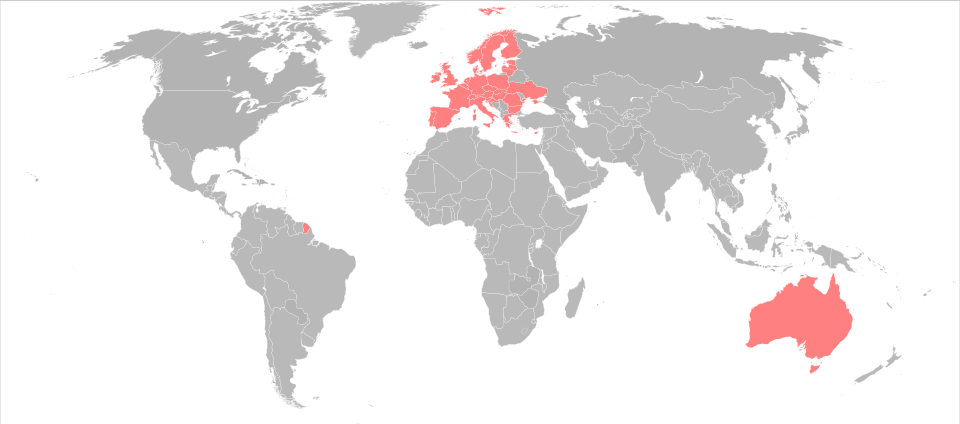
This map highlights a coalition pattern in sanctions implementation by showing which jurisdictions adopted a specific sanctions package (EU members plus partner states). It reinforces that sanctions are a tool of coercion whose impact often depends on coordinated participation across multiple economies and legal systems. Source
They can include:
trade embargoes
asset freezes
banking restrictions
travel bans on political elites
limits on technology transfers
arms embargoes
The logic of sanctions is coercive: they increase economic and political costs until the target decides that compliance is less costly than resistance. For example, sanctions may seek to pressure a state over nuclear activity, territorial aggression, or human rights abuses. Some sanctions are comprehensive, affecting large parts of an economy, while others are targeted, aimed at leaders, banks, or strategic sectors.
Sanctions are often attractive because they appear less immediately destructive than military intervention, but they also have limits. Governments may shift the burden onto ordinary citizens, use sanctions to fuel nationalist narratives, or find alternative trading partners. Sanctions can therefore be symbolically powerful without always being decisive. Their effectiveness depends on factors such as coordination among sanctioning states, the target’s economic dependence, and the clarity of the demands attached to the pressure.
When hard power is most effective
Hard power is more likely to work when coercive pressure is credible, specific, and sustainable. A threat must be believable, and the target must understand what change is demanded. If demands are vague or constantly shifting, coercion becomes harder to translate into compliance.
Several conditions shape effectiveness:
the coercing actor has sufficient military or economic capacity
the target is vulnerable to the pressure being applied
the desired outcome is limited and realistic
allies or international institutions reinforce the pressure
the coercing actor is willing to bear the costs of enforcement
Hard power is less effective when targets can absorb pain, gain external support, or frame resistance as a matter of survival or national pride. This is why weaker actors sometimes resist stronger ones for long periods.
Evaluating hard power in global politics
Hard power is significant because it can produce immediate pressure and sometimes rapid policy change. It can deter aggression, constrain adversaries, and show that political demands are backed by real consequences. In crises, this can give leaders options that are concrete and visible.
At the same time, hard power raises serious ethical and political questions. Military interventions may violate sovereignty or create humanitarian harm. Sanctions may formally target governments yet still damage living standards for civilians. Hard power can also create backlash, deepen hostility, and reduce the possibility of negotiation.
A strong IB response should therefore evaluate hard power, not just describe it. Useful questions include:
What behavior is being coerced?
What tool is being used: military intervention or economic sanction?
Is the threat or punishment credible?
Has the target changed behavior, or only adapted?
Who bears the main costs: leaders, armed forces, or civilians?
This keeps the focus on coercion as a political relationship, not just on the possession of force or wealth.
Practice Questions
Define hard power and identify one coercive hard power tool used in global politics.
1 mark for defining hard power as the use or threat of military or economic means.
1 mark for linking hard power to coercion or forcing compliance.
1 mark for one valid example, such as military intervention or economic sanctions.
Explain how military interventions and economic sanctions function as forms of hard power.
1 mark for recognizing that hard power operates through coercion.
1 mark for explaining that military interventions use or threaten armed force.
1 mark for explaining that military interventions raise security or physical costs to force behavioral change.
1 mark for explaining that sanctions use economic or financial restrictions.
1 mark for explaining that sanctions raise economic or political costs to force behavioral change.
1 mark for a developed point showing that both tools aim to change decisions through pressure, not voluntary agreement, or for a relevant real-world example.
FAQ
Deterrence tries to stop an actor from doing something in the first place. The message is: if you act, the costs will be severe.
Compellence tries to make an actor change behavior it is already carrying out. It is usually harder because the target must actively reverse course, not just remain inactive.
Secondary sanctions punish third parties for doing business with the main target of sanctions. This extends pressure beyond the original dispute.
For example, a state may threaten to cut off banks or companies in other countries if they continue trading with a sanctioned regime. This can greatly widen coercive reach, even without direct military force.
Yes, if they are used coercively to impose costs or disable capabilities. A cyberattack on banking systems, energy grids, or military communications can pressure a target in a very direct way.
The key test is not the technology itself, but the purpose. If cyber tools are used to force compliance through disruption, punishment, or threat, they fit the logic of hard power.
No-fly zones can limit an opponent’s air power without requiring a full ground invasion. They may be used when outside powers want coercive leverage but want to reduce troop exposure.
They can also signal resolve while keeping objectives narrower. However, they still require force to enforce them, including air patrols and the possible destruction of enemy defenses.
When legal trade becomes restricted, demand often shifts into informal or illegal channels. This can empower criminal groups, corrupt officials, and middlemen who profit from scarcity.
Over time, sanctioned states may build alternative networks that weaken future pressure. In that sense, poorly designed sanctions can create new survival systems instead of producing compliance.