

IB Syllabus focus: 'Training status, body composition, environment and sex differences, including hormonal phases, affect thermoregulation and the body's ability to maintain internal temperature during activity.'
During exercise, body temperature control is not identical for every athlete. Training status, body composition, environmental conditions, and sex-related hormonal variation all change how easily heat is gained, stored, or lost.
Why thermoregulation differs
Thermoregulation during activity depends on the balance between metabolic heat production and heat loss to the environment.
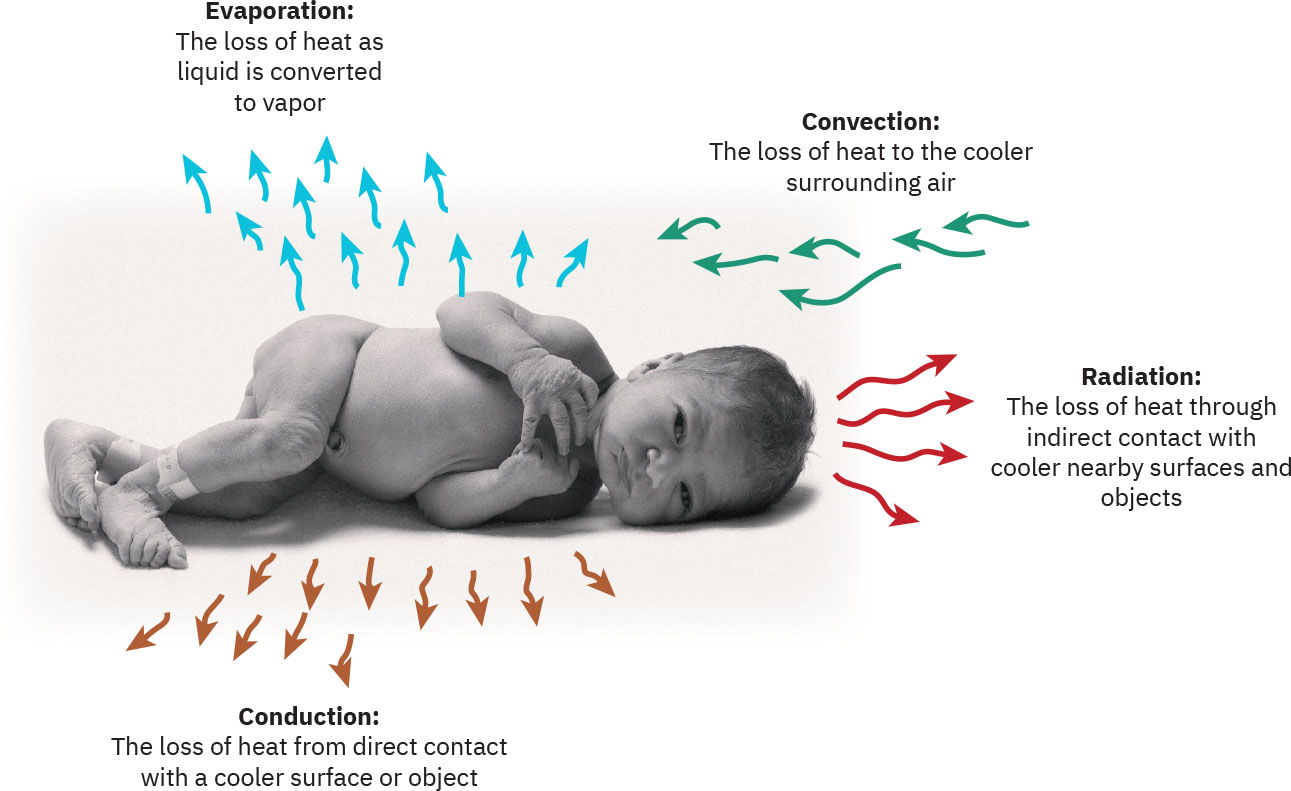
Diagram of the four main mechanisms of heat transfer between the body and the environment: radiation, convection, conduction, and evaporation. It helps you visualize which pathways dominate in different conditions (e.g., evaporation becoming critical during exercise). Source
When exercise intensity rises, muscles produce more heat. Whether that heat is removed effectively depends on the athlete and the conditions in which activity takes place.
Thermoregulation: The processes that help maintain internal body temperature within a safe range during rest and activity.
If heat gain is greater than heat loss, core temperature rises and physiological strain increases. If heat loss is too great, body temperature falls and performance may also decline. The same workout can therefore place very different thermal stress on different people.
Training status
An athlete’s training status affects how efficiently the body responds to heat stress. In general, better-trained individuals regulate temperature more effectively during exercise than untrained individuals performing the same relative workload.
Key effects of higher training status include:
Earlier onset of sweating, so evaporative cooling begins sooner
Higher sweat rate, which increases the potential for heat loss if sweat can evaporate
Greater plasma volume, which supports both skin blood flow and maintenance of blood pressure
Improved cardiovascular stability, allowing blood to be distributed to both working muscles and the skin more effectively
These changes reduce the rate at which core temperature rises during submaximal exercise, especially in warm conditions. However, training status does not make an athlete immune to thermal strain. Well-trained performers often work at higher absolute intensities, producing more total heat. This means their advantage can be reduced if pacing, environmental stress, or fluid loss are not controlled.
Training status is important because it improves the body’s capacity to respond, but it does not remove the challenge of regulating temperature during activity.
Body composition
Body composition influences how much heat is produced, stored, and exchanged with the environment. The most important features are body fat, muscle mass, and surface area relative to body mass.
A higher proportion of body fat tends to act as insulation. In hot environments, this can slow heat transfer from the body core to the skin, making heat loss more difficult. In cold environments, the same insulation can help reduce heat loss and support maintenance of internal temperature.
Body size also matters. Larger individuals usually have more total mass and can store more heat before body temperature changes markedly, but they also tend to produce more absolute heat during exercise. Smaller individuals often have a higher surface area-to-mass ratio, which can increase heat exchange with the environment.
This has different effects depending on conditions:
In the heat, a higher surface area-to-mass ratio may help with heat loss
In the cold, the same feature may increase unwanted heat loss
Greater muscle mass can increase heat production during exercise because active muscle is the main source of metabolic heat. Body composition therefore affects both heat generation and heat dissipation, making it a major factor in thermoregulatory ability.
Environment
The environment strongly affects thermoregulation because heat exchange depends on the gradient between the body and the surroundings. Different environmental features can either assist or oppose temperature control.
Air temperature and humidity
When air temperature is high, the body’s ability to lose heat by radiation and convection is reduced. If environmental temperature approaches or exceeds skin temperature, dry heat loss becomes very limited and the body depends more on evaporation of sweat.
Humidity is especially important because evaporation works best when the air is relatively dry.
In humid conditions, sweat does not evaporate efficiently. As a result, sweat may drip from the skin without providing much cooling, and core temperature may rise more quickly.
Wind and radiant heat
Air movement helps remove warm air from the skin surface and improves both convective and evaporative heat loss. Low wind, especially in still indoor spaces, makes heat storage more likely.
Radiant heat from direct sunlight or hot surroundings adds extra thermal load. This means an athlete can gain heat even when exercise intensity stays the same.
Cold conditions
In cold environments, the challenge is different. The body may lose heat rapidly to air, water, or wind. Thermoregulation then depends on limiting excessive cooling while still allowing exercise to continue. Cold, wet, and windy conditions are particularly demanding because they accelerate heat loss from the body surface.
Sex differences and hormonal phases
Sex differences can affect thermoregulation, but these are average trends rather than fixed rules for every individual. Differences in body size, surface area, body fat distribution, and sweating responses can all contribute.
On average, females often have a lower absolute sweat rate than males, especially when comparisons are made at the same absolute workload. This can reduce evaporative cooling in some settings. However, at the same relative intensity, differences may be smaller than expected, showing that workload and body size are important when interpreting sex differences.
Hormonal phases are also relevant. During the luteal phase of the menstrual cycle, progesterone is higher and resting core temperature is usually slightly elevated.
Starting exercise from a higher baseline temperature can increase thermal strain, particularly in hot conditions. In phases where progesterone is lower, resting temperature is often slightly lower, which may reduce that strain.
Responses vary substantially between individuals, so hormonal phase should be considered as a possible influence rather than a universal outcome.
Combined effects during activity
These factors rarely act alone. Thermoregulation during activity reflects the interaction between:
How much heat the body produces
How much heat the environment adds or removes
How effectively the individual can transfer heat to the skin and then to the surroundings
An untrained athlete with higher body fat exercising in hot, humid, still air may struggle to maintain internal temperature. A well-trained athlete with favorable body composition in cooler, moving air will usually regulate temperature more effectively. The important idea is that thermoregulatory ability is context-dependent, not identical across all performers.
Practice Questions
State two ways a higher training status can improve thermoregulation during exercise. [2]
Award 1 mark for each correct point, up to 2 marks.
Earlier onset of sweating
Higher sweat rate
Greater plasma volume
Improved skin blood flow
Slower rise in core temperature at the same relative intensity
Improved cardiovascular stability during heat stress
Explain how body composition, environment, and hormonal phases can affect an athlete’s ability to maintain internal temperature during activity. [6]
Award up to 6 marks for explained points. Accept equivalent wording.
Body fat acts as insulation, which can reduce heat loss in hot conditions. [1]
The same insulation can help reduce excessive heat loss in cold conditions. [1]
Surface area-to-mass ratio affects how quickly heat is exchanged with the environment. [1]
Hot air reduces the body’s ability to lose heat by radiation and convection. [1]
High humidity reduces evaporation of sweat, so cooling becomes less effective. [1]
Wind can improve heat loss, while radiant heat from the sun can increase heat gain. [1]
During the luteal phase, higher progesterone raises resting core temperature, which can increase heat strain during exercise. [1]
FAQ
Sweat only cools the body when it evaporates. If sweat drips off the skin or soaks into clothing, much less cooling occurs.
This is more likely when:
Humidity is high
Air movement is low
Clothing traps moisture
Sweat production is so high that evaporation cannot keep up
So, a very sweaty athlete is not always a well-cooled athlete.
Indoor spaces often have poor airflow and can trap humidity. That reduces both convective heat loss and evaporation of sweat.
Some indoor venues also contain extra heat sources, such as:
Warm lighting
Hot surfaces
Large groups of people
Limited ventilation
This creates a “stagnant” environment where body heat is harder to remove, even if the thermometer reading looks similar to outdoors.
Body fat percentage is only one part of body composition. Two athletes with the same percentage can still differ in:
Total body mass
Surface area-to-mass ratio
Muscle mass
Fitness level
Sweat pattern
Hormonal status
Their pace and exercise style matter too. One athlete may produce more metabolic heat because they are moving faster or working at a higher absolute intensity.
So, identical body fat percentages do not guarantee identical thermoregulatory responses.
Tracking cycle phase can help explain why heat sessions feel different from week to week. A slightly higher resting temperature in some phases may change thermal comfort, pacing, and recovery needs.
Useful things to monitor include:
Resting temperature trends
Perceived heat stress
Sleep quality
Training performance in warm conditions
This does not mean every athlete will show the same pattern. The benefit of tracking is that it helps identify the individual’s own response rather than assuming an average response.
No. A lean physique may help in some hot conditions because there is often less insulation and sometimes a higher surface area relative to mass.
However, being very lean can be a disadvantage in other settings:
Cold environments may cause faster heat loss
Low body mass can reduce heat storage capacity
Very low energy availability may impair normal physiological function
So, “leaner” is not automatically “better” for temperature control. The effect depends on the environment, exercise intensity, and the athlete’s overall health.
