

IB Syllabus focus: 'Regulation of blood glucose relies on insulin and glucagon. Exercise limits insulin release and facilitates glucose uptake to help regulate blood sugar levels.'
During exercise, working muscles need a steady fuel supply. Blood glucose regulation prevents harmful falls or rises in blood sugar by coordinating insulin, glucagon, and the direct effects of muscular activity.
Blood glucose: The concentration of glucose circulating in the blood, often called blood sugar, available for transport to tissues.
Why blood glucose must be controlled
During exercise, active muscle removes glucose from the blood more quickly than at rest. The body must keep enough glucose available to support working tissues and the brain, but it must also avoid unnecessary increases in blood sugar. This balance becomes especially important during prolonged or repeated activity, when demand remains high and can change rapidly.
Low blood glucose can reduce concentration, coordination, and exercise capacity. Effective regulation therefore depends on matching how much glucose enters the blood with how much is being taken up and used by tissues.
Hormonal control of blood glucose
Insulin
Insulin is the main hormone that lowers blood glucose after food intake.
Insulin: A hormone released by the pancreas that lowers blood glucose by promoting glucose uptake into cells and encouraging storage.
At rest, insulin is released when blood glucose rises, especially after eating carbohydrate. It promotes glucose movement into cells and encourages storage as glycogen, the stored form of carbohydrate in liver and muscle. This helps remove excess glucose from the blood and prevents large increases in blood sugar.
During exercise, insulin release is limited. This is a normal and useful response, not a malfunction. If insulin stayed high while muscles were also taking up glucose rapidly, blood glucose could fall too far. Lower insulin during exercise reduces the drive to store fuel and helps keep glucose available for immediate energy use.
Glucagon
Glucagon acts in the opposite direction to insulin.
Glucagon: A hormone released by the pancreas that raises blood glucose by stimulating glucose release from the liver.
Glucagon acts mainly on the liver. It promotes the breakdown of liver glycogen and the release of glucose into the bloodstream. In this way, it opposes the glucose-lowering effects of insulin.
During exercise, glucagon becomes more important because active muscles continuously remove glucose from the blood. As insulin falls and glucose demand rises, glucagon helps maintain blood glucose concentration by increasing the supply coming from the liver.
What changes during exercise
A major feature of this topic is that exercise itself facilitates glucose uptake. When muscles contract, their ability to take up glucose increases, so uptake can rise even though insulin levels are lower than at rest.
This means the body does not need high insulin concentrations to feed working muscles during activity. Instead, muscle contraction provides an alternative pathway that helps glucose enter active muscle cells.
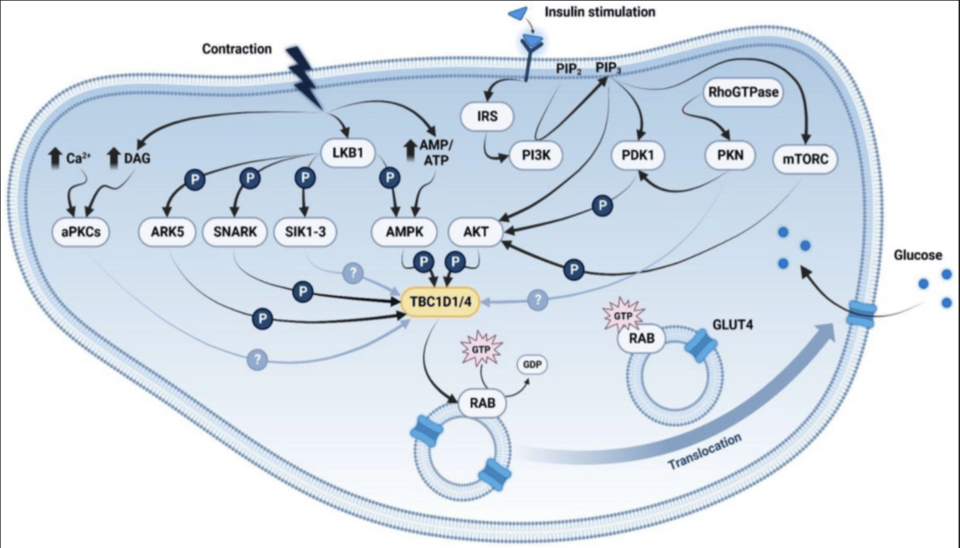
This diagram compares insulin-stimulated versus contraction-stimulated signaling pathways in skeletal muscle that both increase GLUT4 translocation to the cell membrane. It reinforces the idea that exercise can raise glucose uptake even when insulin levels are lower, because contraction activates parallel signaling routes. The figure is useful for explaining the mechanistic basis of “exercise-assisted uptake.” Source
Increased blood flow to the muscles also improves glucose delivery, helping supply match demand.
This exercise-assisted uptake is why physical activity can help regulate blood sugar levels. Glucose is cleared from the bloodstream efficiently by tissues that are actively using it for energy.
From rest to exercise
At rest, the body is more focused on storing fuel when blood glucose is high. Once exercise begins, control shifts toward keeping glucose available for use. This is why the pattern changes from relatively higher insulin action at rest to reduced insulin release and greater reliance on glucagon during activity.
At the start of exercise, muscle glucose use rises quickly. The control system must therefore adjust rapidly. If it did not, blood glucose would tend to fall as muscles continued extracting glucose from the bloodstream.
As exercise continues, maintaining blood glucose depends on continued coordination between hormone action and muscle uptake. The liver must keep releasing glucose at a rate that helps replace what active muscles are removing. Blood glucose regulation is therefore a dynamic process that changes with the demands of exercise rather than staying fixed.
How balance is maintained during activity
Blood glucose control during exercise depends on three linked responses:
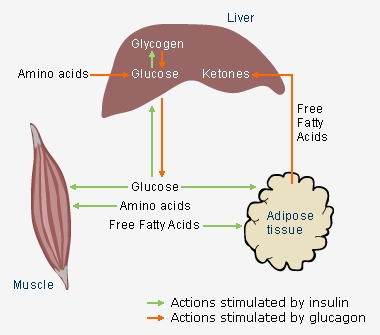
This organ-level schematic summarizes how insulin and glucagon exert opposing effects across the main target tissues (especially the liver) that determine whether blood glucose is stored or released. It helps connect hormonal signals to whole-body glucose handling rather than focusing on a single organ. Pair it with your exercise section to discuss how the same targets are regulated differently once activity begins. Source
Insulin release decreases, reducing unnecessary glucose storage and lowering the risk of excessive falls in blood sugar.
Glucagon supports liver glucose output, helping replace glucose removed from the bloodstream.
Muscle contraction increases glucose uptake, so working muscles can access fuel efficiently.
Stable blood glucose depends on these responses staying coordinated. If muscle uptake becomes greater than glucose release into the blood, blood glucose falls and performance may be impaired. If supply matches uptake, blood glucose remains relatively stable, which is the desired response during sustained activity.
Why this matters for performance
Well-regulated blood glucose supports energy availability, decision-making, and neuromuscular control during exercise. When regulation is effective, exercise can continue with a steadier fuel supply and less disruption to performance.
When blood glucose drops too much during activity, common effects include:
early fatigue
lightheadedness
reduced concentration
poorer skill execution
The key idea is that exercise does not simply “use up” blood glucose. Instead, exercise changes how blood glucose is controlled. Insulin release is limited, glucagon helps maintain supply, and muscle contraction directly facilitates glucose uptake. Together, these responses help keep blood sugar levels within a functional range during activity.
Practice Questions
State one role of insulin and one role of glucagon in regulating blood glucose during exercise. [2]
Insulin lowers blood glucose by promoting glucose uptake into cells or storage as glycogen. (1)
Glucagon raises blood glucose by stimulating glucose release from the liver or liver glycogen breakdown. (1)
Explain how exercise helps regulate blood glucose concentration during physical activity. [5]
During exercise, insulin release is reduced. (1)
Lower insulin helps prevent blood glucose from falling too much and reduces unnecessary glucose storage. (1)
Muscle contraction increases glucose uptake by active muscles. (1)
This increased uptake can occur even when insulin levels are lower than at rest. (1)
Glucagon helps maintain blood glucose by stimulating the liver to release glucose into the blood. (1)
FAQ
Liver glycogen can be broken down and released as glucose into the bloodstream, so it directly helps maintain blood glucose concentration.
Muscle glycogen mainly stays within the muscle that stored it and is used locally for energy. That means it helps the working muscle, but it does not directly stabilize blood glucose for the whole body.
Starting exercise after a carbohydrate-rich meal usually means blood glucose and insulin are already elevated.
Once exercise begins, insulin should fall, but the timing of the meal matters. If exercise starts very soon after eating, glucose may be taken up quickly at the start of exercise. This is why athletes often pay attention to meal timing before training or competition.
During long-duration exercise, the liver’s glycogen stores gradually decline. As those stores shrink, it becomes harder to keep releasing enough glucose into the blood.
If muscle use of glucose remains high and carbohydrate intake is low, the risk of low blood glucose increases. This is one reason endurance athletes often consume carbohydrate during prolonged events.
Yes. Continuous endurance exercise usually creates a steady demand for blood glucose, so regulation must support a sustained glucose supply.
Intermittent sports, such as soccer or basketball, create repeated rises and falls in demand. Resistance exercise can also change glucose use differently across sets and recovery periods. The overall control system is the same, but the pattern of demand differs.
Yes. After exercise, muscles are often more responsive to insulin and more ready to restore glycogen stores.
This means glucose can move into muscle more effectively during recovery, even without a large rise in insulin. For many people, this improves blood glucose control for hours after exercise, especially after regular training.
