

IB Syllabus focus: 'Macronutrients, including carbohydrates, proteins and lipids, provide energy for growth, rest and physical activity. Their relative contributions depend on body composition, age, sex differences and activity level.'
The body uses three major macronutrients to meet energy needs at rest, during growth, and in movement. Their contribution is not fixed, so fuel use changes between individuals and activities.
Macronutrients and energy
Carbohydrates, proteins, and lipids are the three energy-providing macronutrients. All three can supply energy, but they differ in storage amount, speed of use, and primary biological role. The body rarely relies on only one macronutrient; instead, it uses a changing mixture that matches current needs.
Macronutrients: Nutrients required in relatively large amounts that provide energy and support body functions, including carbohydrates, proteins, and lipids.
Energy from macronutrients supports:
growth, such as new tissue formation and development
rest, including breathing, circulation, and temperature control
physical activity, from light movement to intense exercise
Their approximate energy values are:
carbohydrate: 4 kcal per gram
protein: 4 kcal per gram
lipid: 9 kcal per gram
This means lipids are the most energy-dense fuel, while carbohydrates and proteins provide less energy per gram. The body must therefore balance immediate energy use with storage for later demands.
Carbohydrates as an energy source
Carbohydrates are an important and readily available energy source. They are found in foods such as grains, fruits, starchy vegetables, and dairy products. After digestion, they help maintain blood glucose and can also be stored for later use.
Glycogen: The storage form of carbohydrate in the body, found mainly in skeletal muscle and the liver.
Muscle glycogen supports the working muscles, while liver glycogen helps maintain blood glucose. Because carbohydrates can be used relatively quickly, they become especially important when energy demand rises and when tissues need a steady glucose supply.
Carbohydrates also support growth because adequate carbohydrate intake can reduce the need to use protein as an energy source. Carbohydrate stores are limited compared with fat stores, but carbohydrates remain a key fuel during many daily and sporting activities because they can meet changing energy demands efficiently.
Lipids as an energy source
Lipids, or fats, are the body’s most concentrated energy source. Since they provide about 9 kcal per gram, they are an efficient long-term energy reserve.
Most lipid is stored in adipose tissue, so the body usually has much larger fat reserves than carbohydrate reserves. Because fat stores are large, even relatively lean individuals carry substantial energy in lipid form. For this reason, lipids make a major contribution to energy supply during rest and during long periods when energy demand is lower or steadier.
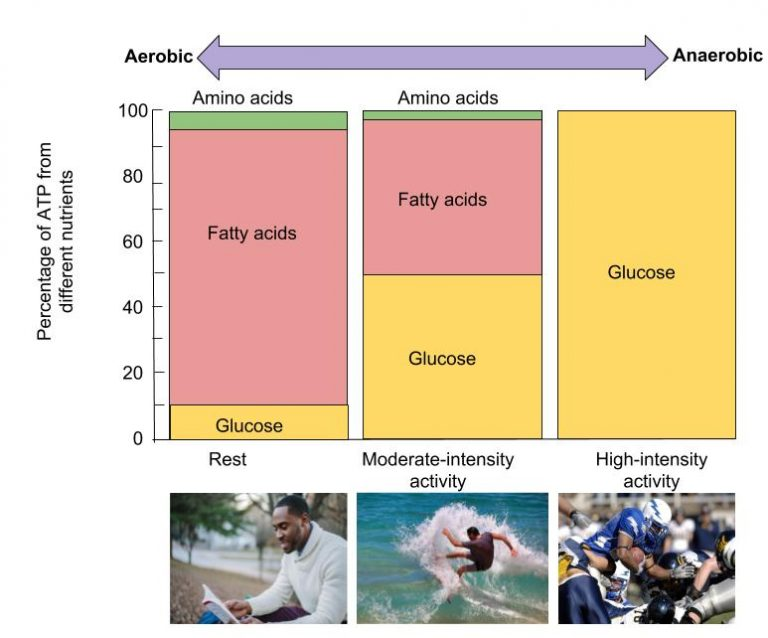
This figure summarizes the changing fuel mix across exercise intensities, highlighting that fat contributes more at rest while carbohydrate becomes increasingly dominant as intensity rises. It provides an at-a-glance link between exercise intensity and substrate selection that supports exam-style explanations. Source
Lipids also have non-energy functions, including:
insulation
protection of organs
formation of cell membranes
Although lipids are energy-rich, they are less suited to situations where energy must be supplied very rapidly. Their role is therefore major, but not always dominant.
Proteins as an energy source
Proteins are made from amino acids and are primarily associated with growth, repair, and body structure. This means protein is usually not the body’s preferred fuel.
Protein can still contribute to energy supply when:
overall energy intake is too low
carbohydrate availability is reduced
growth or repair demands are increased
Amino acids can be used for energy after the nitrogen-containing part is removed, but this is not their main function. Like carbohydrate, protein provides about 4 kcal per gram. However, because protein has essential structural and functional roles, using large amounts of it for energy is generally less desirable than using carbohydrate or lipid.
Factors affecting relative contribution
The relative contribution of carbohydrates, proteins, and lipids depends on the individual and the situation. The same person may rely on different proportions of each macronutrient across the day.
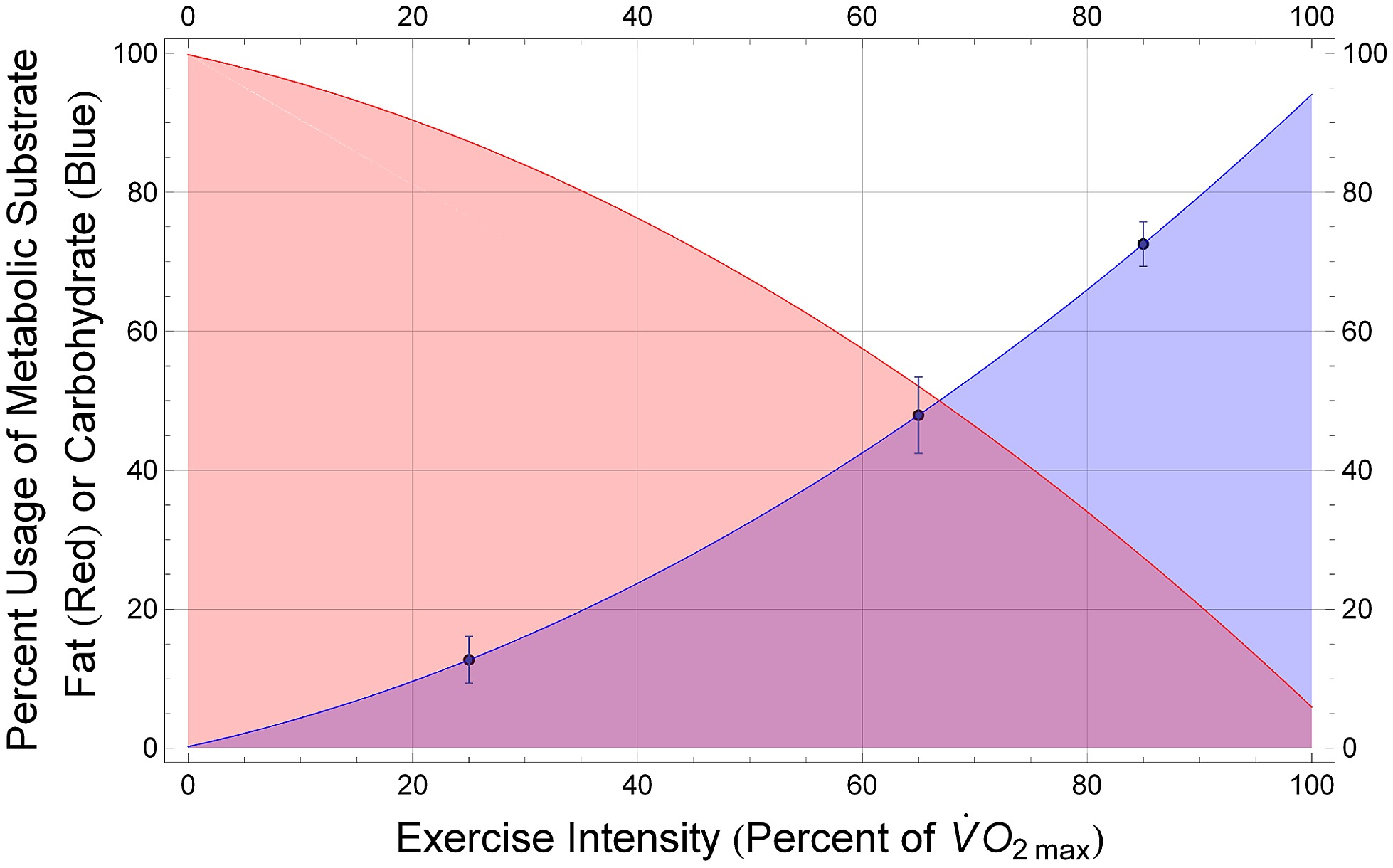
This research figure plots the fractional contribution of carbohydrate (including muscle glycogen and plasma glucose) and fat (including plasma free fatty acids and intramuscular triglycerides) across increasing relative exercise intensity. It adds detail to the crossover idea by explicitly showing which carbohydrate and fat sources are contributing to energy production at different intensities. Source
Body composition
Body composition affects both energy needs and available fuel stores.
More lean body mass usually increases resting energy demand because muscle tissue is metabolically active.
Higher body fat increases stored lipid reserves.
Greater muscle mass also increases potential glycogen storage.
Two people of the same body mass may therefore have different fuel availability and different energy requirements.
Age
Age changes why energy is needed and how much is required.
Children and adolescents need energy for normal body functions, activity, and growth.
Rapid growth phases also increase the importance of adequate protein and total energy intake.
In adults, growth demands are lower, so energy is directed more toward maintenance and activity.
In older adults, reduced lean mass and lower activity often reduce total energy needs, although protein remains important for maintenance.
Sex differences
Sex differences influence macronutrient use through average differences in hormones and body composition.
Males often have greater lean body mass, which can raise total energy expenditure.
Females often have a higher percentage of body fat, which affects stored fuel availability.
Hormonal variation may influence the balance between carbohydrate and lipid contribution.
These are population trends rather than strict rules for every individual.
Activity level
Activity level strongly changes fuel use.
At rest, a larger share of energy often comes from lipids.
As activity level rises, carbohydrates usually make a larger contribution because they can provide energy more rapidly.
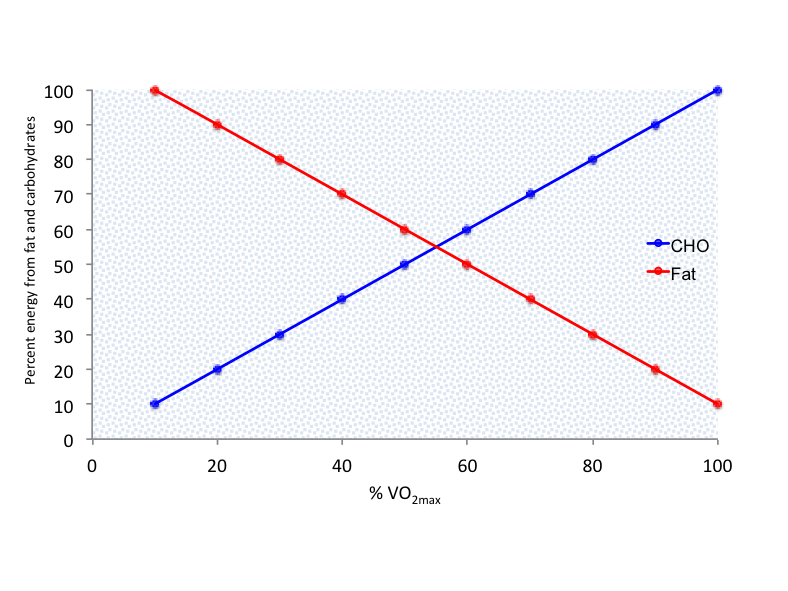
This graph illustrates the “crossover concept” in exercise metabolism: as exercise intensity increases, the relative contribution of carbohydrate rises while fat contribution falls. It visually reinforces why carbohydrates are better suited to higher-intensity work where rapid ATP production is required, while fat dominates more at lower intensities. Source
Protein usually remains a smaller contributor, but its role may increase if total intake is insufficient or demands are prolonged.
Low activity favors slower, steadier fuel use, whereas harder work increases the need for faster energy delivery.
Practice Questions
Identify the three macronutrients that provide energy in the human body. [3]
1 mark for carbohydrates
1 mark for proteins
1 mark for lipids or fats
Explain how body composition, age, sex differences, and activity level can affect the relative contribution of carbohydrates, proteins, and lipids as energy sources. [6]
Award up to 6 marks. Give 1 mark for each valid explained point, up to a maximum of 6. Answers may include:
greater lean body mass increases resting energy demand
greater muscle mass increases glycogen storage capacity
higher body fat increases stored lipid reserves
children and adolescents require energy for growth as well as rest and activity
older adults often have lower total energy needs because of reduced lean mass and activity
average sex differences in hormones and body composition can alter macronutrient contribution
at rest, a larger proportion of energy often comes from lipids
as activity level increases, carbohydrates contribute more because they supply energy more rapidly
protein is usually a smaller contributor, but may rise when intake is insufficient or demands are prolonged
FAQ
Fiber is chemically a carbohydrate because it is made of sugar units linked together. It is classified by its structure, not by how much energy humans can easily extract from it.
Human digestive enzymes cannot fully break down most fiber. Some fiber is fermented by gut bacteria, producing short-chain fatty acids and a small amount of energy, but far less than digestible carbohydrate.
Alcohol provides energy, at about 7 kcal per gram, but it is not one of the three macronutrients in this IB SEHS topic.
That is because alcohol is not an essential nutrient for growth or normal body function. It is better described as an energy-containing substance rather than a core macronutrient like carbohydrate, protein, or lipid.
Yes. Most dietary fats provide roughly 9 kcal per gram, regardless of whether they are saturated or unsaturated.
The important difference is their chemical structure and health effect, not their energy value. Unsaturated fats are generally considered more favorable for long-term health, while trans fats are associated with negative health outcomes.
Yes. Certain amino acids can be converted into glucose in the liver through gluconeogenesis when carbohydrate intake is low or glucose demand is increased.
However, this is not the body’s preferred approach. Protein is also needed for tissue repair, enzymes, and transport proteins, so heavy reliance on protein for glucose can reduce its availability for those functions.
Both are units of energy. Calories on labels usually mean kilocalories, while kilojoules are the standard SI unit used in many countries.
They describe the same energy content in different units. A useful comparison is that 1 kcal is about 4.2 kJ, so showing both makes nutrition information easier to compare across labels, textbooks, and scientific sources.
