

IB Syllabus focus: 'Cardiovascular drift is caused by body water loss or increased core temperature during prolonged steady-state submaximal exercise in thermoneutral and hot environments.'
During long periods of steady submaximal exercise, the cardiovascular response does not remain perfectly fixed. Even when workload stays constant, heart and circulation variables gradually shift as fluid loss and thermal strain increase.
Understanding cardiovascular drift
Cardiovascular drift is a time-dependent change in cardiovascular responses during prolonged steady-state submaximal exercise. The important feature is that the external workload remains constant, but the body’s internal cardiovascular response changes as exercise continues.
Cardiovascular drift: A gradual increase in heart rate and decrease in stroke volume during prolonged steady-state submaximal exercise, despite no increase in external workload.
In practice, this means an athlete can maintain the same speed, pace, or power output, yet their heart rate rises over time while the amount of blood pumped per beat falls. “Steady-state” means the exercise demand is kept relatively stable rather than repeatedly increasing. Cardiovascular drift is therefore not caused by working harder; it develops because the body is under increasing circulatory and thermal strain as time passes.
Main cardiovascular changes
Heart rate and stroke volume
The classic pattern of cardiovascular drift is:
heart rate increases
stroke volume decreases
cardiac output is often initially maintained because the rise in heart rate compensates for the fall in stroke volume
These changes are linked by the relationship between heart rate, stroke volume, and cardiac output.
= Cardiac output in liters per minute
= Heart rate in beats per minute
= Stroke volume in milliliters per beat
If stroke volume falls, the body can partly compensate by raising heart rate so that blood flow remains closer to what is needed for the same exercise intensity. This is why heart rate may continue to climb even when the athlete has not increased effort. If the drift becomes large, especially in hotter conditions, cardiac output may become harder to maintain and the same workload produces greater physiological stress.
Why cardiovascular drift occurs
Body water loss
One major cause is body water loss, mainly through sweating. During prolonged exercise, fluid is lost to help cool the body. As this continues:
plasma volume falls
total blood volume decreases
venous return to the heart is reduced
the heart fills less before each beat
stroke volume falls
A smaller blood volume means less blood returns to the heart between beats. This reduces ventricular filling and lowers the amount of blood ejected with each contraction. To help preserve circulation, heart rate increases. This explains why cardiovascular drift can occur even in a thermoneutral environment, where conditions are not especially hot but sweating and fluid loss still build up over time.
Increased core temperature
A second major cause is increased core temperature.
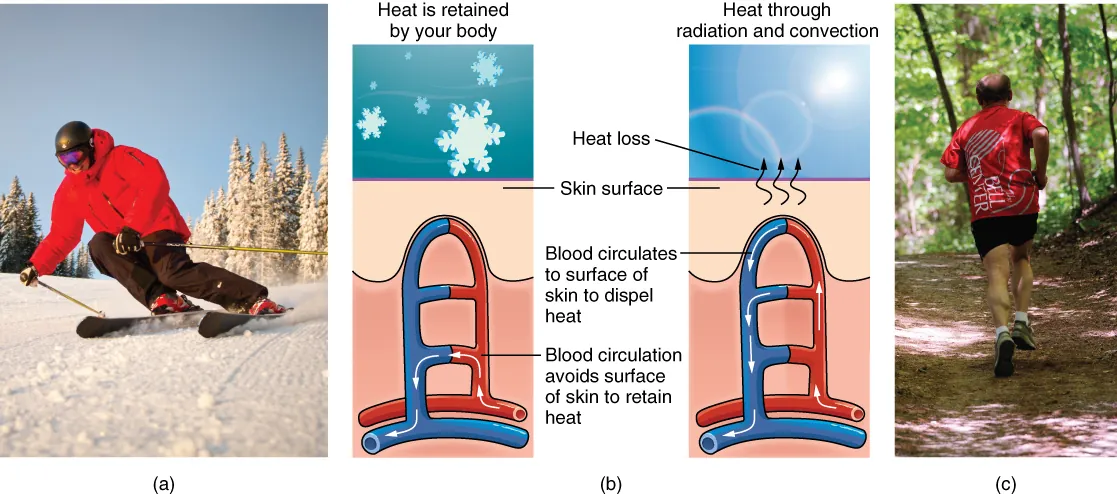
A schematic diagram contrasts cold versus hot conditions by showing how skin blood vessels constrict in the cold (limiting surface blood flow) and dilate in the heat (increasing surface blood flow for heat dissipation). This helps explain why rising core temperature during exercise increases the demand for skin blood flow, which can contribute to reduced central blood volume and a downward drift in stroke volume. It visually links thermoregulation to cardiovascular strain. Source
As body temperature rises during exercise, the body directs more blood toward the skin so heat can be transferred to the environment. This process is essential for temperature regulation, but it creates an extra demand on the circulation.
With more blood moving to the skin, less remains in the central circulation. This can reduce venous return and lower stroke volume further. At the same time, thermal stress is associated with a higher heart rate, adding to the upward drift. In hot environments, the need for both sweating and skin blood flow is greater, so the cardiovascular system is placed under more strain than in cooler conditions.
Body water loss and increased core temperature often act together, which is why cardiovascular drift is usually most noticeable during long exercise in the heat.
Exercise conditions linked to cardiovascular drift
Prolonged steady-state submaximal exercise
Cardiovascular drift is associated specifically with prolonged steady-state submaximal exercise. This means:
the exercise lasts long enough for fluid loss and heat build-up to matter
the intensity is below maximal
the workload stays relatively constant
This distinction is important. If pace or power output increases, heart rate would also rise, but that would reflect a higher workload rather than cardiovascular drift. Drift refers to the gradual cardiovascular change that occurs despite constant external work.
Thermoneutral and hot environments
The syllabus emphasizes that cardiovascular drift occurs in both thermoneutral and hot environments. The main difference is the magnitude and rate of the response.
In a thermoneutral environment, drift can still occur because prolonged exercise causes sweating, gradual fluid loss, and some increase in core temperature.
In a hot environment, drift is usually greater because sweating rates are higher and more blood must be directed to the skin for cooling.
As a result, the fall in stroke volume and the rise in heart rate tend to appear earlier and become larger in the heat.
Why cardiovascular drift matters
Physiological strain at the same workload
The main significance of cardiovascular drift is that internal load increases even when external load does not. An athlete may continue exercising at the same speed or power output, but the cardiovascular system must work progressively harder to support that effort.
Important implications include:
heart rate becomes less stable as an indicator of constant workload during long exercise
the same exercise may feel harder as time passes
prolonged exercise in the heat places a greater demand on circulation than the same exercise in thermoneutral conditions
Because of this, heart rate data from prolonged exercise should be interpreted alongside exercise duration and environmental conditions, not only by looking at workload.
Practice Questions
[2 marks]
State two cardiovascular changes that occur during cardiovascular drift in prolonged steady-state submaximal exercise.
1 mark for stating that heart rate increases
1 mark for stating that stroke volume decreases
[6 marks]
Explain how body water loss and increased core temperature cause cardiovascular drift during prolonged steady-state submaximal exercise in thermoneutral and hot environments.
Award 1 mark for each valid point, up to 6 marks:
cardiovascular drift occurs during prolonged steady-state submaximal exercise at a constant workload
body water loss occurs during exercise, mainly through sweating
body water loss reduces plasma volume or total blood volume
reduced blood volume lowers venous return or ventricular filling
lower filling leads to a decrease in stroke volume
increased core temperature increases blood flow to the skin for heat loss
greater skin blood flow reduces central blood volume or contributes to lower stroke volume
heart rate increases to compensate for the falling stroke volume or help maintain cardiac output
drift can occur in thermoneutral conditions but is usually greater in hot environments
FAQ
Running usually involves greater whole-body movement and often a higher heat load at the same relative intensity. That can increase sweating and skin blood flow demands, both of which promote drift.
Cycling also places the body in a more supported position, which may help venous return compared with upright running. The difference is not absolute, but running often shows a larger rise in heart rate over time.
Humidity reduces the rate at which sweat evaporates from the skin. When evaporation is less effective, the body has more difficulty losing heat.
That means core temperature can rise more quickly, even if air temperature stays the same. The result is often more skin blood flow, greater thermal strain, and a larger cardiovascular drift response.
Yes, heat acclimation often reduces cardiovascular drift during exercise in the heat. One reason is that acclimated athletes commonly have a larger plasma volume.
They also tend to regulate temperature more effectively, so core temperature and heart rate may rise less at the same workload. Drift may still occur, but it is often delayed or reduced.
Cooling strategies can help by lowering thermal strain before or during exercise. Examples include cold fluids, ice towels, shade, fans, or cooling vests.
These methods do not always eliminate cardiovascular drift, but they may slow the rise in core temperature and reduce the demand for skin blood flow. Their effect depends on exercise duration, environment, and how practical the strategy is during performance.
Endurance-trained athletes commonly have adaptations that improve cardiovascular stability during prolonged exercise. These include higher stroke volume, better plasma volume expansion, and more efficient temperature regulation.
As a result, they may tolerate prolonged submaximal work with a smaller rise in heart rate at the same workload. Fitness does not prevent drift completely, but it often makes the response less severe.
