

IB Syllabus focus: 'The body relies on the phosphagen, glycolytic and oxidative systems for ATP production. These systems have different fuel sources, recovery capabilities, benefits and limitations during physical activity.'
To understand performance, students must know how muscles resynthesize ATP. The phosphagen, glycolytic, and oxidative systems each provide energy differently, with distinct fuels, speeds, and practical uses.
ATP and why energy systems are needed
Muscle contraction depends on ATP, but only a very small amount is stored in muscle at any one time. Because ATP is used rapidly during movement, the body must constantly resynthesize it. This is the purpose of the three energy systems. They do not create energy from nothing; instead, they transfer energy from stored fuels into ATP that muscles can use immediately. Understanding these systems helps explain why some activities favor explosive power, others favor sustained effort, and why recovery time differs between repeated bouts of exercise.
ATP: Adenosine triphosphate, the immediate usable form of energy for muscle contraction and other cellular processes.
No single system is perfect.
Each one differs in speed of ATP production, amount of ATP available, and how quickly it can recover after hard effort.
Phosphagen system
Fuel and ATP production
The phosphagen system is the fastest way to resynthesize ATP. It relies on ATP already stored in muscle and on phosphocreatine (PCr), a high-energy compound kept in small amounts inside muscle fibers. This system does not require oxygen, so it is described as anaerobic.
Phosphagen system: An anaerobic energy system that rapidly resynthesizes ATP using stored ATP and phosphocreatine.
Its main role is to provide immediate energy for very short, explosive efforts such as a jump, throw, or sprint start. The major benefit of the phosphagen system is its very high power output. ATP can be supplied almost instantly, making it ideal for maximal movements that require speed and force.
Recovery, benefits, and limitations
The limitation of this system is its very low capacity. Muscle stores of ATP and PCr are small, so this system can only support a few seconds of maximal work before those stores become depleted.
Recovery of the phosphagen system is relatively fast during rest because phosphocreatine stores can be restored quickly, especially when oxygen is available after exercise. This makes the system especially useful in activities requiring repeated short bursts with recovery intervals. If recovery is too short, PCr stores are not fully restored and explosive performance declines.
Glycolytic system
Fuel and ATP production
The glycolytic system resynthesizes ATP by breaking down glucose in the blood or glycogen stored in muscle. It can work without oxygen, so it is also an anaerobic system, although it is slower than the phosphagen system. It becomes important when high-intensity activity lasts longer than the immediate phosphagen supply can support.
A major benefit of the glycolytic system is that it can produce ATP at a fast rate and sustain intense exercise longer than the phosphagen system. This makes it important in efforts such as repeated high-intensity runs, hard cycling bursts, or longer sprints.
Recovery, benefits, and limitations
Its limitations are linked to both capacity and fatigue. As glycolysis continues rapidly, acidity-related by-products accumulate and muscle function becomes less efficient. This contributes to the burning sensation and drop in power often seen during hard efforts. In addition, muscle glycogen stores are limited, so this pathway cannot support intense exercise indefinitely.
Recovery of the glycolytic system is slower than the phosphagen system. The body must restore glycogen and deal with the by-products associated with rapid glycolysis. Because of this, repeated intense efforts are harder to maintain without sufficient rest. Overall, the glycolytic system provides a useful balance between speed and duration, but it still cannot match the long-term sustainability of the oxidative system.
Oxidative system
Fuel and ATP production
The oxidative system resynthesizes ATP using oxygen. It mainly uses carbohydrates and fats as fuel, and in some circumstances a small amount of protein may also contribute. This system takes place largely in the mitochondria and is essential for prolonged exercise and everyday activity.
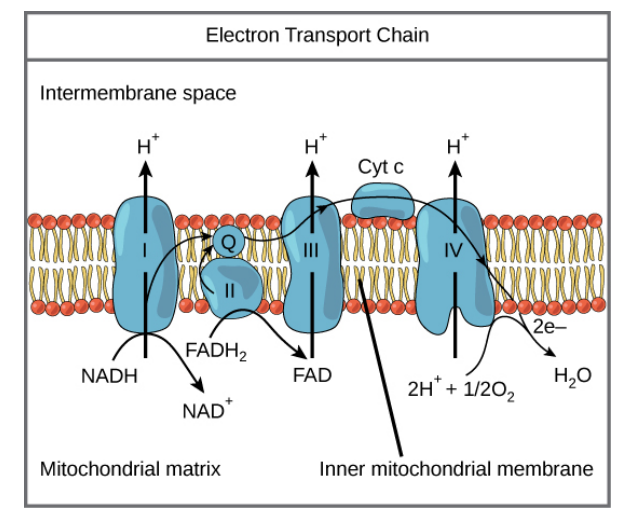
Labeled electron transport chain diagram showing how electrons from NADH and FADH move through membrane complexes (I–IV) in the inner mitochondrial membrane. The figure highlights proton (H) pumping that builds a gradient, linking oxygen-dependent oxidative metabolism to sustained ATP production during endurance exercise. Source
The main benefit of the oxidative system is its high capacity. It can keep producing ATP for long periods as long as fuel and oxygen remain available. It also produces much more total ATP from each fuel source than the anaerobic systems. This makes it the key system for endurance activity and for supporting lower-intensity movement over time.
Recovery, benefits, and limitations
Its main limitation is slow ATP production. Because oxygen delivery and aerobic reactions take time, the oxidative system cannot match the immediate speed of the phosphagen system or the rapid support of the glycolytic system during all-out exercise. For this reason, it is less effective on its own during maximal sprinting or explosive power activities.
Recovery linked to the oxidative system is mixed. It is essential for helping restore the body after exercise and for supporting phosphocreatine restoration, but after prolonged activity full recovery may take longer because glycogen stores can become reduced. Therefore, the oxidative system is excellent for long-duration work but less suited to activities demanding instant, maximal power.
Comparing the three systems
The three systems are best compared by fuel source, rate of ATP resynthesis, recovery, and practical use.
Phosphagen system
Fuel: stored ATP and phosphocreatine
Recovery: fastest
Benefit: immediate ATP supply
Limitation: very short duration
Glycolytic system
Fuel: glucose and glycogen
Recovery: moderate
Benefit: fast ATP production for intense work
Limitation: limited duration and fatigue-related by-products
Oxidative system
Fuel: mainly carbohydrates and fats, with minor protein contribution
Recovery: supports recovery, but full replenishment after long exercise can take time
Benefit: very large capacity for long activity
Limitation: slow ATP production rate
In physical activity, the most useful system depends on how much ATP is needed, how quickly it is needed, and how long the effort lasts.
Practice Questions
State two fuel sources used by the oxidative system.
1 mark for carbohydrates
1 mark for fats
Accept protein as an alternative valid fuel source
Compare the phosphagen, glycolytic, and oxidative systems in terms of ATP production rate, fuel source, recovery capability, and one benefit or limitation of each during physical activity.
Phosphagen system produces ATP the fastest
Phosphagen system uses stored ATP and phosphocreatine
Phosphagen system recovers quickly during rest
Phosphagen system is beneficial for explosive efforts but limited by low capacity
Glycolytic system produces ATP quickly but slower than the phosphagen system
Glycolytic system uses glucose or glycogen
Glycolytic system has moderate recovery compared with the other two systems
Glycolytic system supports intense activity longer than phosphagen but is limited by fatigue-related by-products
Oxidative system produces ATP more slowly than the other systems
Oxidative system uses oxygen
Oxidative system mainly uses carbohydrates and fats
Oxidative system has the greatest capacity for long-duration exercise
Oxidative system is limited for maximal explosive activity because ATP production is slow
FAQ
At the start of exercise, ATP demand rises immediately, but aerobic processes need time to increase.
This delay happens because:
heart rate and breathing must rise
blood flow to working muscles must increase
aerobic enzymes and mitochondrial activity must speed up
That is why faster energy pathways help cover the first part of exercise.
Endurance training increases the muscles’ ability to use oxygen efficiently.
Adaptations can include:
more mitochondria
greater capillary density
increased oxidative enzyme activity
better use of fat as a fuel
improved ability to spare glycogen
These changes help an athlete sustain exercise for longer and at a higher submaximal intensity.
Sprint and power training can improve the muscle’s ability to use the phosphagen system effectively.
Adaptations may include:
slightly greater stored ATP and phosphocreatine
faster ATP resynthesis from PCr
improved enzyme activity, especially creatine kinase
better recruitment of fast-twitch muscle fibers
This helps athletes perform short, explosive efforts more effectively and often improves repeated-sprint ability.
Fat is an excellent fuel for long-duration activity, but it is too slow for maximal sprinting.
Fat use requires:
oxygen
transport into mitochondria
multiple aerobic reactions before large ATP production occurs
During all-out sprinting, the demand for ATP is immediate and extremely high. Carbohydrate-based anaerobic pathways and phosphocreatine can supply ATP much faster, so they are favored instead.
Yes. Creatine supplementation can increase muscle phosphocreatine stores in some individuals.
Possible effects include:
improved repeated high-intensity performance
better recovery between short explosive bouts
a small increase in training quality for sprint or power athletes
Responses vary between individuals, and some weight gain may occur because creatine can increase water stored in muscle. Athletes should always use supplements carefully and within sport regulations.
