

IB Syllabus focus: 'During short, high-intensity periods and sudden increases in intensity, anaerobic ATP production through phosphagen and anaerobic glycolysis supports the body's functions.'
Explosive movement demands energy faster than oxygen-dependent pathways can deliver it. In these moments, the body relies on anaerobic ATP production to maintain force, speed, and movement when intensity rises sharply.
Why anaerobic ATP production is needed
All muscular work depends on ATP. During a maximal sprint start, jump, tackle, or rapid acceleration, ATP is broken down very quickly. However, the amount of ATP stored in muscle is very small, so it must be resynthesized almost immediately.
ATP: Adenosine triphosphate, the immediate energy source used for muscle contraction and other cellular processes.
At very high exercise intensities, the demand for ATP increases faster than the oxidative pathway can respond. This means the body must rely on pathways that can supply ATP rapidly without directly depending on oxygen availability. These are the phosphagen system and anaerobic glycolysis.
The phosphagen system
The phosphagen system provides the fastest rate of ATP resynthesis in the body. It is especially important at the start of explosive exercise and during any sudden rise in effort, such as accelerating past an opponent or driving out of the starting blocks.
Phosphagen system: An anaerobic energy pathway that rapidly resynthesizes ATP using phosphocreatine stored in muscle.
Muscle contains small stores of phosphocreatine (PCr).
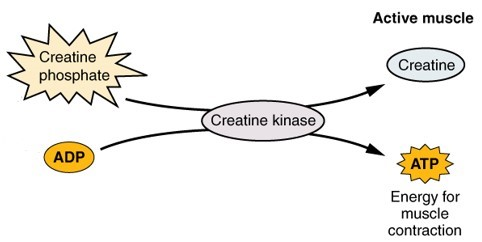
This diagram summarizes the ATP–PCr (phosphagen) reaction in active muscle. It shows phosphocreatine donating a phosphate to ADP to rapidly regenerate ATP, catalyzed by creatine kinase—explaining why ATP resynthesis is extremely fast at the start of maximal efforts. Source
PCr can quickly donate a phosphate to help reform ATP, allowing muscle contraction to continue for a brief period at very high power.
Main characteristics
Key features of the phosphagen system include:
Very rapid ATP production
No direct oxygen requirement
Useful for maximal or near-maximal efforts
Very limited capacity because PCr stores are small
This system is most important in movements such as:
sprint starts
jumps and throws
weightlifting
short bursts of speed in team sports
sudden increases in pace during an event
Its main benefit is speed of energy supply. Its main limitation is that it cannot sustain high power for long. As PCr stores fall, another anaerobic pathway must contribute more.
Anaerobic glycolysis
When high-intensity activity lasts longer than the immediate explosive phase, anaerobic glycolysis becomes increasingly important. This pathway breaks down glucose or muscle glycogen to resynthesize ATP quickly.
Anaerobic glycolysis: The rapid breakdown of glucose or glycogen to produce ATP without directly relying on oxygen, with lactate produced when glycolytic rate is very high.
Anaerobic glycolysis does not produce ATP as quickly as the phosphagen system, but it can continue for longer. This makes it important in activities such as a 200 m sprint, a long rally in racket sports, repeated hard efforts in games, or a surge during a race.
Main characteristics
Important characteristics of anaerobic glycolysis:
uses glucose or glycogen as fuel
produces ATP rapidly
supports short-duration high-intensity exercise
has a greater capacity than the phosphagen system
is associated with rising lactate and hydrogen ion levels during intense exercise
When glycolysis runs at a very high rate, pyruvate is converted to lactate.
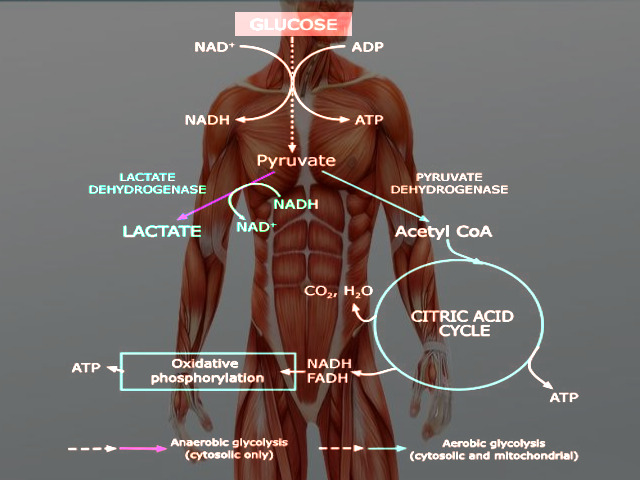
This figure traces carbohydrate breakdown to pyruvate and shows how, when oxygen delivery cannot keep up, pyruvate is converted to lactate via lactate dehydrogenase while regenerating NAD⁺ to sustain rapid ATP production. It also contrasts this with the aerobic route where pyruvate becomes acetyl‑CoA and enters the citric acid cycle. Source
This helps glycolysis continue briefly, but intense anaerobic work is also associated with an increase in hydrogen ions. The resulting drop in pH can interfere with enzyme activity and muscle contraction, contributing to fatigue and reduced power output.
How the two anaerobic pathways work together
The phosphagen system and anaerobic glycolysis do not switch on and off separately. They overlap and work together, but their relative contribution changes with time and intensity.
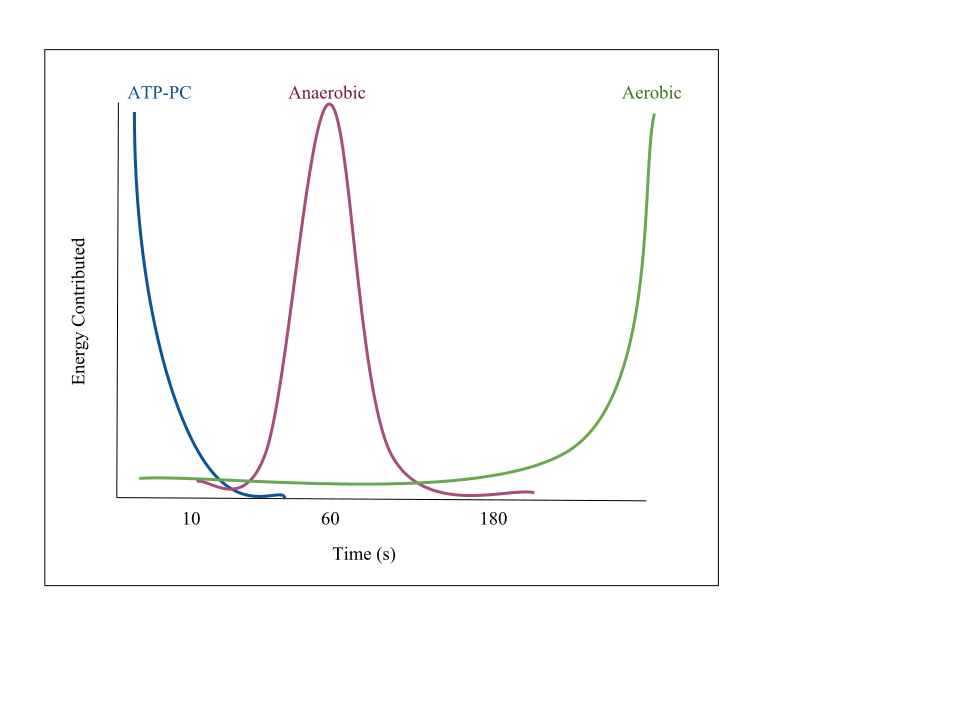
This graph illustrates the changing relative contribution of the phosphagen (ATP-PCr), anaerobic glycolytic, and aerobic systems as exercise continues. It visually supports the idea that the systems overlap, with rapid ATP-PCr contribution early, a larger glycolytic role as intensity is sustained, and increasing aerobic contribution over longer durations. Source
During short, explosive activity:
stored ATP is used first
the phosphagen system rapidly resynthesizes ATP
as the effort continues, anaerobic glycolysis contributes more
both pathways help maintain movement when demand is too high for slower aerobic ATP production
This is why anaerobic ATP production is crucial not only in all-out short events, but also in sports with repeated bursts, accelerations, and changes of pace. Even if an athlete is already moving at submaximal intensity, a sudden increase in work rate creates an immediate ATP demand that anaerobic pathways must support.
Performance implications in high-intensity activity
Benefits and limitations
Anaerobic ATP production allows athletes to:
produce explosive force
accelerate quickly
maintain speed for short periods
respond to tactical changes in intensity
continue functioning when ATP demand rises suddenly
However, performance is limited by:
small PCr stores
the short duration of maximal phosphagen support
the accumulation of metabolites during intense glycolysis
the difficulty of sustaining very high rates of ATP turnover
In practical terms, the phosphagen system is most important when power and immediacy matter most, while anaerobic glycolysis becomes more important as high-intensity work continues beyond the first brief burst. Together, these pathways provide the rapid ATP resynthesis needed for muscle contraction, ion pumping, and other cellular functions during intense exercise.
Practice Questions
State two characteristics of the phosphagen system during high-intensity activity. [2]
1 mark for each correct characteristic, up to 2 marks:
resynthesizes ATP very rapidly
uses phosphocreatine
does not directly require oxygen
supports short, explosive activity
has limited capacity because stores are small
Explain how anaerobic ATP production supports performance during the first 30 seconds of an all-out effort that begins with a sudden acceleration. [5]
Award 1 mark for each valid point, up to 5 marks:
ATP demand rises rapidly and stored ATP is limited
the phosphagen system provides immediate ATP resynthesis at the start
phosphagen relies on phosphocreatine and supports explosive acceleration
as the effort continues, anaerobic glycolysis contributes more ATP
anaerobic glycolysis uses glucose or glycogen
both pathways supply ATP without directly relying on oxygen delivery
lactate and hydrogen ion accumulation are associated with fatigue and reduced power output
FAQ
Creatine can increase muscle phosphocreatine stores in some athletes, which may improve very short, explosive efforts and repeated sprints. The biggest benefit is usually seen in activities that rely heavily on the phosphagen system.
It does not replace training, and not everyone responds equally. Some athletes also gain a small amount of body mass because extra water is stored with creatine in muscle.
Fast-twitch fibers are specialized for rapid force production. They typically have:
higher phosphocreatine availability
greater glycolytic enzyme activity
faster contraction speed
This makes them better suited to sprinting, jumping, and powerful accelerations. Athletes with a greater proportion of fast-twitch fibers often show higher anaerobic power, although training still matters a lot.
Not by itself. The burning sensation is more closely linked to the overall buildup of metabolites and the more acidic environment that develops during very intense exercise.
Lactate is often blamed, but it can also be reused as a fuel by other tissues. It is better understood as a sign that anaerobic glycolysis is working hard, rather than the only cause of discomfort or fatigue.
Repeated-sprint ability depends on more than maximum speed. Important factors include:
how quickly phosphocreatine can be restored between efforts
glycolytic enzyme activity
buffering capacity
muscle fiber type
training status
This is why two athletes with similar one-sprint times may perform very differently across multiple short, intense efforts.
Yes. Training can improve both anaerobic power and the ability to tolerate short, intense work. Useful methods include:
sprint training
repeated-sprint intervals
plyometrics
heavy resistance training
Adaptations may include greater phosphocreatine availability, higher glycolytic enzyme activity, better neuromuscular recruitment, and improved buffering of metabolites. The size of the benefit depends on the athlete, the program, and the sport.
