

IB Syllabus focus: 'Maximal oxygen consumption is influenced by age, sex differences, body composition, lifestyle factors and fitness. Endurance performance is affected by VO2 max and movement efficiency.'
Endurance exercise depends on the body’s ability to deliver and use oxygen. Understanding VO2 max helps explain why some athletes can sustain higher aerobic intensities for longer than others.
Understanding VO2 max
VO2 max refers to the greatest amount of oxygen the body can use during maximal exercise. It reflects how well the respiratory, cardiovascular, and muscular systems work together to supply oxygen to active muscles and use it for aerobic energy production.
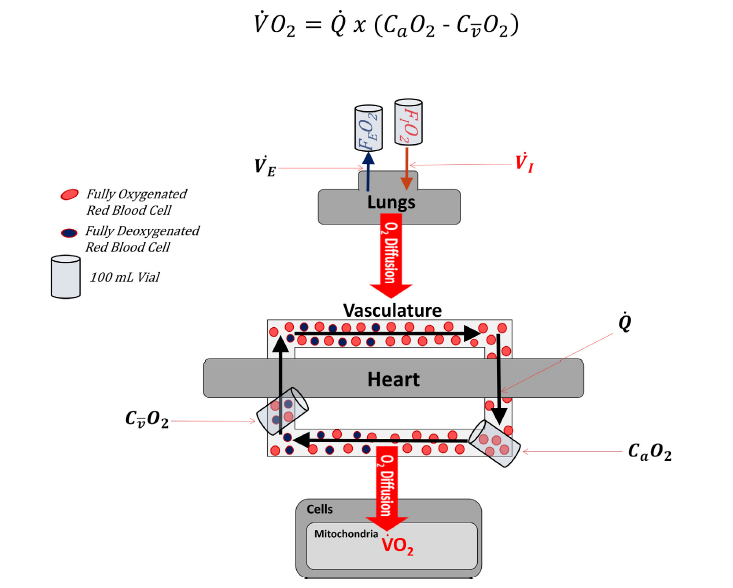
Oxygen transport “cascade” and the Fick principle for oxygen uptake. The diagram shows oxygen moving from the lungs into the blood, being convectively delivered by the heart and vasculature, and then diffusing into muscle where mitochondria consume it. It also maps where key terms in the Fick relationship (cardiac output and arterial vs. mixed-venous oxygen content) relate to whole-body . Source
VO2 max: The maximum rate at which the body can take in, transport, and use oxygen during intense exercise.
A higher VO2 max usually means a greater capacity for prolonged aerobic work. Because endurance events rely mainly on aerobic metabolism, VO2 max is especially relevant in activities lasting several minutes or more. In these events, a higher VO2 max can allow an athlete to exercise at a faster pace before fatigue becomes limiting.
VO2 max is often reported in absolute terms as liters per minute and in relative terms as milliliters per kilogram of body mass per minute. Relative values are especially useful when comparing athletes of different body sizes in weight-bearing activities.
VO2 max is an important indicator of aerobic fitness, but it is not the only determinant of endurance performance. Two athletes can have similar VO2 max values and still perform differently.
Factors influencing maximal oxygen consumption
The syllabus identifies age, sex differences, body composition, lifestyle factors, and fitness as key influences on VO2 max.
Age
VO2 max changes across the lifespan. In younger people, absolute VO2 max usually rises as the heart, lungs, and muscles grow and mature. It often reaches its highest levels in late adolescence or early adulthood.
After this period, VO2 max generally declines with age. This is linked to reductions in maximal heart rate, stroke volume, muscle mass, and habitual physical activity. Training can reduce, but not completely prevent, this age-related decline.
Sex differences
On average, males tend to record higher VO2 max values than females, especially when expressed in absolute terms. Common reasons include:
larger average heart size
greater blood volume
higher hemoglobin levels
lower average body fat percentage
greater average muscle mass
Relative values also tend to be higher in males on average, although there is major overlap between individuals. Well-trained female endurance athletes can achieve very high VO2 max values.
Body composition
Body composition strongly affects relative VO2 max. If two people use a similar amount of oxygen, the person with a greater proportion of body fat will usually have a lower value when VO2 max is divided by total body mass.
This matters most in activities where body weight must be carried. A higher proportion of lean body mass supports oxygen use in working muscles, while extra non-contributing mass can reduce relative aerobic capacity and increase the effort needed to move efficiently.
Lifestyle factors
Everyday habits can raise or lower VO2 max over time. Important lifestyle influences include:
regular participation in aerobic physical activity
smoking status
consistency of training
quality of recovery, including sleep
long-term health behaviors affecting the cardiovascular system
A sedentary lifestyle usually reduces aerobic capacity. Smoking can impair oxygen transport and utilization. Long periods of inactivity or poor health habits can also lower VO2 max, while an active lifestyle supports adaptations that improve oxygen delivery and use.
Fitness
Fitness is one of the most important modifiable influences on VO2 max. Endurance training can improve the body’s ability to transport and extract oxygen by increasing:
stroke volume
capillary density around muscles
mitochondrial content
oxidative enzyme activity
These adaptations allow more oxygen to reach the muscles and more oxygen to be used once it arrives. Improvements are often greatest when previously untrained individuals begin structured aerobic training, although trained athletes can still develop VO2 max further with effective endurance work.
VO2 max and endurance performance
VO2 max affects endurance performance because it sets an upper limit for aerobic energy production. An athlete with a higher VO2 max can usually sustain a higher aerobic workload than an athlete with a lower VO2 max.
However, endurance performance is also affected by movement efficiency.
Movement efficiency: The oxygen cost of performing at a given speed or power output; greater efficiency means less oxygen is needed to do the same work.
This means that two athletes with the same VO2 max may not perform equally.
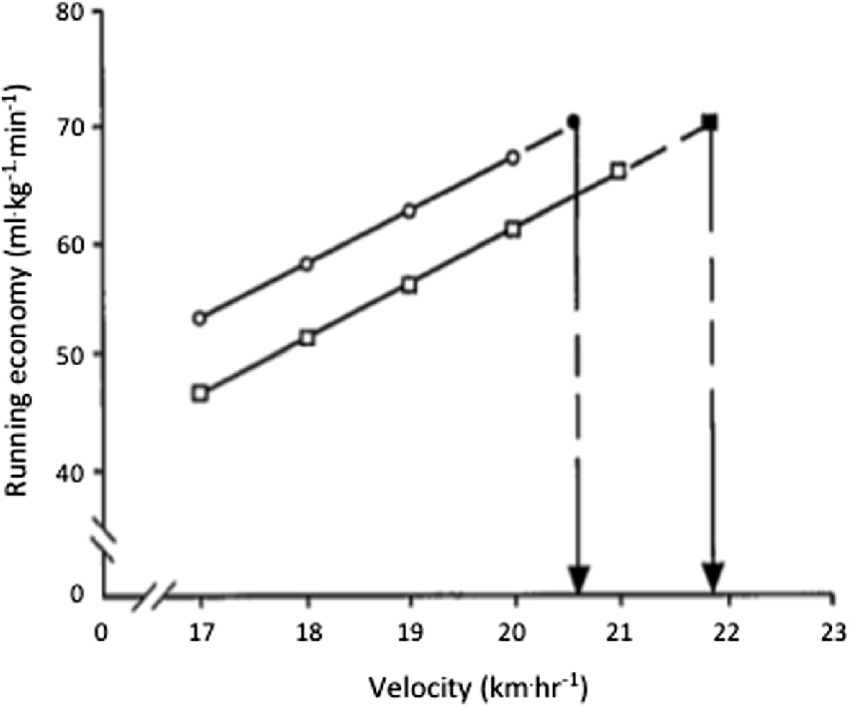
Running economy (movement efficiency) comparison at the same VO₂ max. The plot compares two runners who have equal VO₂ max but different steady-state oxygen consumption at the same running speeds. The lower curve represents better movement efficiency: less oxygen is required to maintain a given pace, reducing physiological strain and improving endurance performance. Source
If one athlete uses less oxygen at a given pace, that athlete experiences less physiological strain at that pace and can usually sustain it more effectively.
Movement efficiency is influenced by factors such as:
technique
biomechanics
coordination
training experience
equipment or environmental demands specific to the activity
For this reason, strong endurance performers often combine a high VO2 max with good movement efficiency. A high VO2 max increases the aerobic ceiling, while good efficiency lowers the oxygen cost of working below that ceiling.
Interpreting VO2 max in sport-specific contexts
When comparing athletes, relative VO2 max is usually more useful in weight-bearing endurance activities because body mass must be moved continuously. Absolute VO2 max can still matter when total oxygen delivery and overall external work are more relevant.
VO2 max values can also vary with the exercise test used. Athletes often achieve their best score in a movement pattern they are well trained in because they can recruit muscle more effectively and tolerate maximal effort longer. For this reason, VO2 max should be interpreted alongside movement efficiency and the specific demands of the endurance event.
Practice Questions
[2 marks] State two factors that influence VO2 max.
1 mark for each correct factor stated, up to 2 marks.
Accept any two of:
age
sex differences
body composition
lifestyle factors
fitness
[6 marks] Explain how VO2 max and movement efficiency affect endurance performance.
1 mark: VO2 max is the maximum rate at which the body can take in, transport, and use oxygen during intense exercise.
1 mark: a higher VO2 max allows a greater aerobic capacity or higher aerobic workload.
1 mark: this can allow an athlete to sustain a faster pace for longer in endurance activity.
1 mark: movement efficiency is the oxygen cost of working at a given speed or power output.
1 mark: better movement efficiency means less oxygen is needed for the same work or less physiological strain at the same pace.
1 mark: endurance performance depends on both high VO2 max and good movement efficiency, so VO2 max alone does not fully determine performance.
FAQ
VO2 max is usually measured with an incremental exercise test on a treadmill or cycle ergometer.
During the test:
exercise intensity increases step by step
the athlete wears a mask connected to gas analysis equipment
oxygen uptake is measured until maximal effort is reached
The result is the highest oxygen consumption recorded during the test. Heart rate, ventilation, and perceived exertion are often monitored at the same time.
Different exercise modes recruit different amounts of muscle mass and depend on different technical skills.
A treadmill test often produces a higher VO2 max than a cycling test in people who are more accustomed to running because:
more total muscle mass may be involved
local leg fatigue may limit cycling earlier
familiarity with the movement affects maximal effort
That is why test selection should match the athlete’s sport whenever possible.
No. VO2 max often improves most rapidly at the start of a training program, especially in less trained people.
Later, gains may slow or plateau because:
the athlete is closer to their current potential
the training stimulus is no longer strong enough
recovery, illness, or accumulated fatigue limit adaptation
Performance can still improve even when VO2 max changes very little, because technique, pacing, and event-specific fitness may continue to develop.
At altitude, the air contains less available oxygen per breath because oxygen pressure is lower.
This usually causes VO2 max to decrease, especially soon after arrival. As a result:
maximal aerobic power falls
high-intensity endurance performance becomes harder
athletes may need to reduce training intensity temporarily
Acclimatization can help the body adjust, but VO2 max at altitude usually remains lower than at sea level.
Yes. Several field and submaximal tests can estimate VO2 max when direct gas analysis is not available.
Common options include:
the Cooper 12-minute run
multistage fitness tests
submaximal cycling protocols
step tests
These methods are practical for schools and teams, but they give estimates, not direct measurements. Results can be affected by motivation, pacing, test conditions, and how closely the protocol matches the person’s sport.
