

IB Syllabus focus: 'The nervous system senses internal and external conditions. It coordinates physiological responses through the central and peripheral nervous systems, including somatic and autonomic pathways, with sympathetic and parasympathetic functions.'
The nervous system is the body's rapid control network, detecting change and organizing responses that support movement, protection, and internal stability. Its divisions explain how physiological control is achieved.
Nervous system as a control system
The nervous system receives information from the environment and from within the body, processes that information, and produces an appropriate response. It allows fast communication between receptors, the brain, the spinal cord, muscles, and glands. This makes it essential for immediate adjustments such as changing posture, reacting to danger, or altering organ activity to meet current demands.
Nervous system: The body's rapid communication and control system that detects stimuli, processes information, and coordinates responses.
Physiological control means regulating body functions so they match the situation. Some responses are voluntary, such as moving a limb, while others are involuntary, such as changing blood vessel diameter or gland secretion.
Central and peripheral nervous systems
The central nervous system includes the brain and spinal cord.
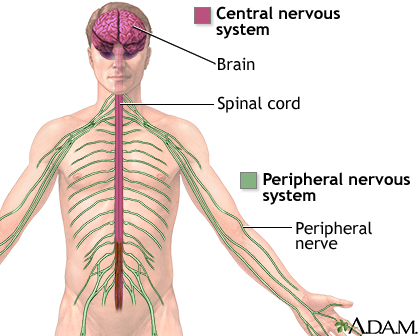
Diagram showing the central nervous system (brain and spinal cord) highlighted separately from the peripheral nervous system (nerves distributed throughout the body). This reinforces the structural boundary between CNS and PNS that underpins how sensory inputs reach the CNS and motor outputs leave it. Source
It is the main integration center. Sensory information arrives here, is interpreted, compared with previous information, and used to generate an output. The brain is responsible for higher processing, decision-making, and coordination, while the spinal cord acts as a communication pathway between the brain and the rest of the body and can organize rapid protective responses.
Central nervous system: The division of the nervous system made up of the brain and spinal cord, where information is processed and responses are coordinated.
Without the CNS, incoming information could not be coordinated into a purposeful response.
The peripheral nervous system includes all nerves outside the brain and spinal cord.
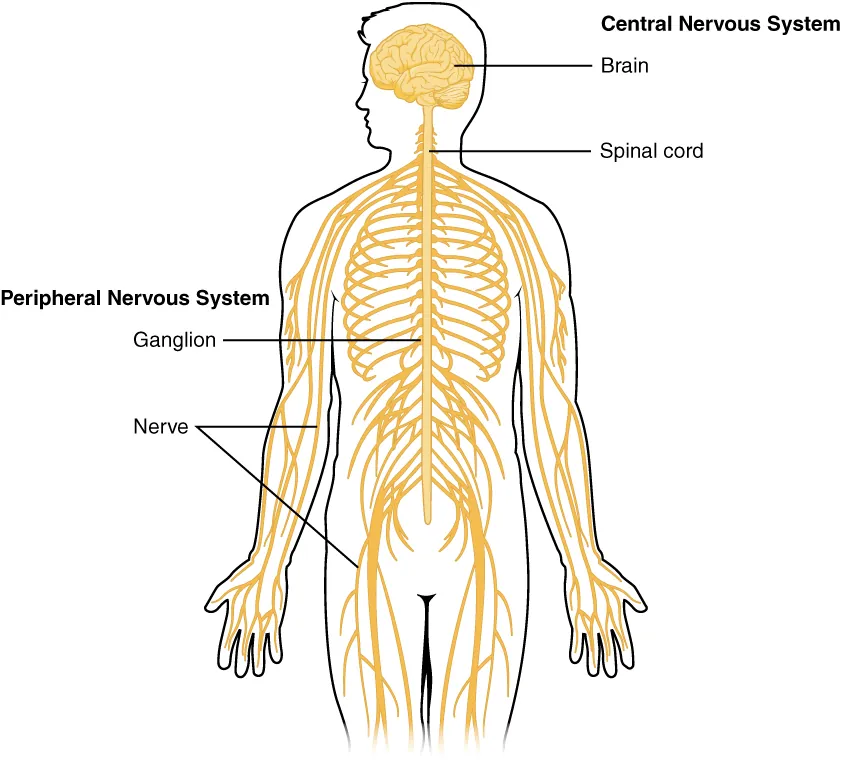
Overview figure showing the CNS (brain and spinal cord) alongside peripheral nerves and ganglia distributed through the body. It supports the idea that the PNS is the communication network linking receptors/effectors to central integration in the CNS. Source
It connects the CNS to the rest of the body. Sensory pathways carry information from receptors to the CNS, and motor pathways carry commands from the CNS to effectors such as muscles and glands. The PNS therefore forms the link between detection of a change and the body's response to it.
Peripheral nervous system: The division of the nervous system outside the brain and spinal cord that carries sensory information to the CNS and motor commands away from it.
Together, the CNS and PNS form a continuous communication system rather than separate working units.
Somatic and autonomic pathways
The PNS can be divided functionally into somatic and autonomic pathways.
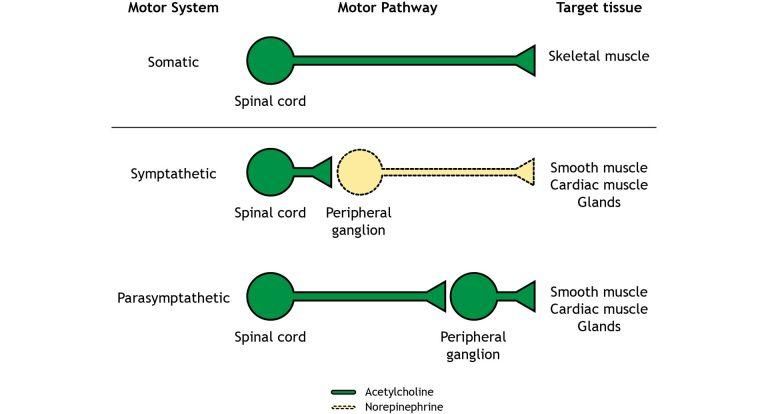
Comparative pathway diagram contrasting somatic motor output (a single motor neuron projecting from the CNS to skeletal muscle) with autonomic motor output (a two-neuron chain synapsing in a peripheral ganglion before reaching cardiac/smooth muscle or glands). This makes the key structural reason for “voluntary vs involuntary” control concrete: the efferent wiring differs, not just the target tissues. Source
The somatic nervous system is mainly associated with sensory input from the external environment and with control of skeletal muscle. It allows voluntary movement, posture, and skilled actions. During activity, somatic pathways help coordinate techniques, balance, and rapid adjustments in movement.
Somatic nervous system: The part of the peripheral nervous system that carries sensory information related to the external environment and controls skeletal muscles.
Somatic output targets skeletal muscles, so it is closely linked with conscious action. However, not every somatic response is fully deliberate at the moment it occurs. Highly practiced skills and withdrawal reflexes can be produced very quickly while still using somatic motor pathways.
The autonomic nervous system controls involuntary activity in cardiac muscle, smooth muscle, and glands. Its role is to regulate internal conditions automatically. This includes adjustments in organ activity that help the body respond to stress, conserve energy, or maintain stable conditions. Because it acts on internal organs, it is central to physiological control.
Autonomic nervous system: The part of the peripheral nervous system that regulates involuntary functions of internal organs, glands, and non-skeletal muscle.
Autonomic control is ongoing, even at rest, because organs need constant regulation rather than occasional commands.
Sympathetic and parasympathetic functions
The autonomic nervous system has two main divisions: the sympathetic and parasympathetic systems. These do not usually act as simple opposites that switch fully on and off. Instead, both may be active at the same time, with one becoming more dominant depending on the body's needs.
The sympathetic division prepares the body for action. It is often called the fight-or-flight response because it supports alertness and rapid performance. Typical sympathetic effects include:
increasing heart activity
widening airways
reducing digestive activity
redirecting resources toward tissues needed for immediate action
The parasympathetic division is often called rest-and-digest. It supports recovery, maintenance, and conservation of energy. Typical parasympathetic effects include:
slowing heart activity
promoting digestion
supporting glandular secretion
encouraging a return to resting conditions after stress or activity
Many organs receive input from both divisions. Physiological control depends on their balance, not just the action of one branch alone. For example, the same organ can be stimulated by sympathetic activity in one situation and moderated by parasympathetic activity in another.
Coordination of a nervous response
A nervous response generally follows a sequence:
a change in the internal or external environment is detected by a receptor
sensory information travels through peripheral pathways to the CNS
the CNS processes the information and selects an appropriate response
motor commands leave the CNS through the PNS
the response reaches an effector, either through a somatic pathway to skeletal muscle or an autonomic pathway to cardiac muscle, smooth muscle, or glands
This organization explains how the nervous system can both detect conditions and coordinate rapid, targeted physiological responses.
Practice Questions
State the two main divisions of the autonomic nervous system and identify one general function of each.
1 mark for sympathetic and one valid function, such as preparing the body for action or increasing readiness for immediate demands.
1 mark for parasympathetic and one valid function, such as promoting recovery, digestion, or energy conservation.
Explain how the nervous system coordinates a response to a change in internal or external conditions. Refer to the CNS, PNS, and the somatic and autonomic pathways.
1 mark: a change or stimulus is detected by receptors
1 mark: sensory information travels via the PNS to the CNS
1 mark: the CNS interprets or integrates the information
1 mark: motor commands leave the CNS through the PNS
1 mark: the somatic pathway controls skeletal muscle or voluntary movement
1 mark: the autonomic pathway controls cardiac muscle, smooth muscle, or glands, including sympathetic or parasympathetic control
FAQ
Speed depends on how far the impulse must travel and how many synapses are involved. Fewer synapses usually means less delay.
Other important factors include:
whether the neuron is myelinated
the diameter of the nerve fiber
whether the response is a simple reflex or a more complex processed action
A short, well-myelinated reflex pathway is usually faster than a response that requires more brain processing.
No. Many organs have dual innervation, but not all do.
For example:
most major organs receive both types of input
sweat glands are mainly controlled by sympathetic nerves
many blood vessels are influenced mostly by sympathetic activity
This means control is sometimes achieved by changing one branch more than the other, rather than balancing two equal inputs.
Vagal tone refers to the level of parasympathetic influence carried mainly by the vagus nerve. At rest, this nerve helps slow the heart and support recovery functions.
Higher vagal tone is often associated with:
a lower resting heart rate
faster recovery after stress or exercise
stronger parasympathetic control at rest
It is one reason well-trained individuals may show more efficient recovery between efforts.
The difference is based on where they leave the CNS.
Cranial nerves arise from the brain or brainstem.
Spinal nerves arise from the spinal cord.
Cranial nerves often serve the head, neck, and some internal organs, while spinal nerves mainly connect the spinal cord to the trunk and limbs. Both belong to the peripheral nervous system and can carry sensory, motor, or mixed signals.
A reflex can be processed at the spinal cord level without waiting for full conscious interpretation by the brain. This allows a very rapid protective response.
The sequence is usually:
a harmful stimulus activates receptors
sensory information enters the spinal cord
a motor response is sent out quickly
the brain becomes fully aware of the pain slightly later
This protects the body by reducing reaction time when immediate withdrawal is needed.
