

IB Syllabus focus: 'Examples of nervous system functions include cardiac function, breathing and ventilation, and temperature control. Students should understand extrinsic factors and how they work with intrinsic mechanisms controlling heart rate.'
The nervous system makes rapid adjustments during rest and exercise, allowing the body to match cardiovascular, respiratory, and thermal responses to changing internal and external demands.
Nervous control of heart rate
Heart rate is controlled by the interaction between the heart's own pacemaker tissue and nerve signals from outside the heart.
Intrinsic mechanisms
The heartbeat begins in specialized cardiac tissue, especially the sinoatrial (SA) node, which generates electrical impulses without nervous stimulation.
Intrinsic regulation: Control that originates within the organ itself. In the heart, this refers to the SA node and the heart's built-in ability to produce a basic rhythm.
Because of this intrinsic activity, the heart can beat even if all external nerve input is removed. However, the intrinsic rate is not usually the rate seen in daily life.
Extrinsic mechanisms
The brain modifies heart rate through the autonomic nervous system, mainly from centers in the medulla oblongata.
Extrinsic regulation: Control that comes from outside the organ. In heart-rate control, it refers mainly to nervous input that changes the activity of the SA node.
Extrinsic control works by acting on the intrinsic pacemaker. The SA node still starts each beat, but autonomic signals alter how quickly it fires.
Parasympathetic stimulation mainly travels through the vagus nerve and slows heart rate.
Sympathetic stimulation increases heart rate by making the SA node fire more quickly.
At rest, parasympathetic influence usually dominates. This is why resting heart rate is lower than the heart's intrinsic rhythm. During exercise, the balance shifts:
parasympathetic activity is reduced
sympathetic activity increases
heart rate rises so blood can be delivered faster to working tissues
At the start of exercise, heart rate can rise within seconds because vagal withdrawal is rapid. During recovery, parasympathetic activity gradually returns and sympathetic drive falls, so heart rate decreases again.
Important extrinsic factors that can change heart rate include:
exercise and movement
anticipation or emotional stress
pain
body position
environmental heat
These factors do not replace intrinsic control. Instead, they change the nerve signals reaching the SA node, so the intrinsic rhythm is adjusted to match the situation.
Nervous control of breathing and ventilation
Breathing is controlled mainly by respiratory centers in the brainstem, especially the medulla oblongata and pons.
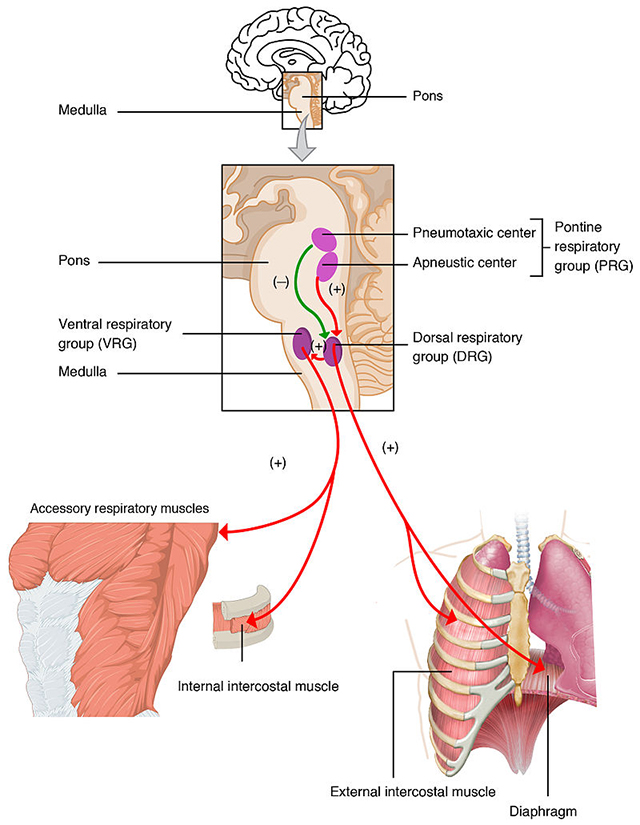
Anatomical diagram locating the major respiratory control centers within the brainstem (medulla and pons). It helps connect structure to function by showing where rhythmic respiratory drive is generated before motor output is sent to the respiratory muscles. Source
These centers send nerve impulses to the diaphragm and intercostal muscles, producing the mechanical act of ventilation.
Nervous regulation changes both:
breathing rate: how often breaths are taken
breathing depth: how much air moves in each breath
Together, these adjustments change ventilation so the body can meet changing demands.
During rest, breathing is automatic and rhythmic. During exercise, nervous output increases because the body needs faster removal of carbon dioxide and greater movement of oxygen into the lungs. This response becomes stronger as exercise intensity rises.
Breathing is influenced by several nervous inputs:
signals from the brain related to movement and effort
feedback from the body about the need for more or less ventilation
limited voluntary control from the cerebral cortex
Voluntary control means a person can briefly speed up, slow down, or hold breathing. However, automatic brainstem control quickly regains dominance if body conditions require normal ventilation to resume.
Neural control also coordinates speech, swallowing, and movement with breathing patterns. During hard exercise, breathing usually becomes deeper first, then faster as demand continues to rise.
This makes breathing different from heart rate. The heart cannot usually be consciously slowed or accelerated directly, but breathing can be voluntarily modified for short periods before involuntary control takes over.
Nervous control of temperature
Temperature is regulated mainly by the hypothalamus, which acts as the body's temperature control center. It receives information about body temperature and organizes nervous responses to keep temperature within a safe range.
When body temperature rises, nervous output promotes heat loss. Main responses include:
sweating, which increases evaporative heat loss
increased blood flow to the skin, which helps transfer heat from the core to the environment
When body temperature falls, nervous output promotes heat conservation and heat production.
Main responses include:
reduced blood flow to the skin, which decreases heat loss
shivering, which produces heat through repeated muscle contractions
Skin sensation can trigger anticipatory adjustments before core temperature changes greatly. Entering a hot or cold environment can therefore cause rapid autonomic changes before deep-body temperature fully shifts.
These responses are fast, automatic, and closely linked to activity and environment. During exercise, muscle activity produces extra heat, so the nervous system must increase heat-loss responses. In cold conditions, the nervous system may reduce heat loss and stimulate heat production instead.
Integration during exercise
Heart rate, breathing, and temperature control do not operate separately. The nervous system coordinates all three at the same time.
During exercise:
heart rate rises to increase blood delivery
ventilation increases to support oxygen delivery and carbon dioxide removal
temperature responses increase to limit excessive body heating or cooling
In warm conditions, the nervous system may need to support both exercise and cooling at once. In very intense exercise, these competing demands become more difficult to manage.
The key principle for heart rate is the interaction between intrinsic and extrinsic control. The heart has its own rhythm, but the nervous system continuously adjusts that rhythm so circulation matches the demands of rest, exercise, and the environment.
Practice Questions
State the effect of sympathetic input and parasympathetic input on heart rate. [2]
1 mark for stating that sympathetic input increases heart rate or increases SA node firing.
1 mark for stating that parasympathetic input decreases heart rate or slows SA node firing.
Explain how nervous control changes heart rate, breathing, and temperature regulation during exercise in a warm environment. [6]
1 mark for stating that the heart has an intrinsic rhythm generated by the SA node.
1 mark for stating that extrinsic control comes from the autonomic nervous system via the brain, especially the medulla.
1 mark for explaining that parasympathetic activity is reduced at the start of exercise, raising heart rate.
1 mark for explaining that sympathetic activity increases, further increasing heart rate.
1 mark for explaining that respiratory centers increase nerve impulses to the diaphragm and intercostal muscles, increasing breathing rate and/or depth.
1 mark for explaining that the hypothalamus increases heat-loss responses such as sweating and increased blood flow to the skin.
FAQ
Vagal tone is the normal background influence of the parasympathetic nervous system on the heart, mainly through the vagus nerve.
Higher vagal tone means stronger slowing of the SA node, so resting heart rate is lower. This is common in well-trained endurance athletes and also helps explain why heart rate can rise quickly at exercise onset when that vagal influence is withdrawn.
This is called an anticipatory response. The brain can increase sympathetic drive and reduce parasympathetic influence before movement begins.
Common triggers include:
excitement
anxiety
focus on the upcoming task
the pre-race environment
As a result, heart rate may rise even while the athlete is still standing still.
Voluntary breathing comes from the cerebral cortex, which can temporarily override automatic brainstem control.
You can:
hold your breath
breathe faster on purpose
slow breathing deliberately
However, this control is limited. If carbon dioxide rises too much, or if airway protection is needed, the automatic centers in the brainstem take over again.
Cold water on the face can trigger part of the diving response. Sensory input from the face activates autonomic pathways that increase parasympathetic influence on the heart.
This may cause:
a slower heart rate
brief changes in breathing pattern
blood flow to be redirected toward vital organs
It is a protective reflex and is usually stronger when the face is immersed suddenly in cold water.
Sweating can continue because body temperature does not return to normal instantly when movement stops.
After exercise:
muscles and blood may still be warm
stored heat continues moving from deeper tissues to the skin
the hypothalamus keeps heat-loss responses active until temperature falls enough
This is why an athlete may stop running but continue sweating for several minutes afterward.
