
Physical quantities
· A physical quantity is any measurable property of an object, event or system.
· Every physical quantity must include a numerical magnitude and a unit.
· Example: 5.0 m → 5.0 is the numerical magnitude, m is the unit.
· A number without a unit is usually incomplete in physics unless the quantity is dimensionless.
· A unit without a number is also incomplete because it gives no size of the quantity.
· Always write answers as: value + correct unit, e.g. 2.4 s, 0.80 kg, 12 N.
· In calculations, check that the final answer has a sensible unit and a reasonable size.
Magnitude and unit
· Magnitude means the size or amount of a quantity.
· Unit tells you the standard of measurement being used.
· The same quantity can be expressed using different units, but the physical meaning stays the same.
· Example: 0.75 m = 75 cm, but both describe the same length.
· In exam answers, do not just write “mass = 2.0”; write “mass = 2.0 kg”.
· Units help identify mistakes: an answer for time should not have a unit of m, kg or N.
· For CIE, use SI units unless the question clearly provides or requires another accepted unit.
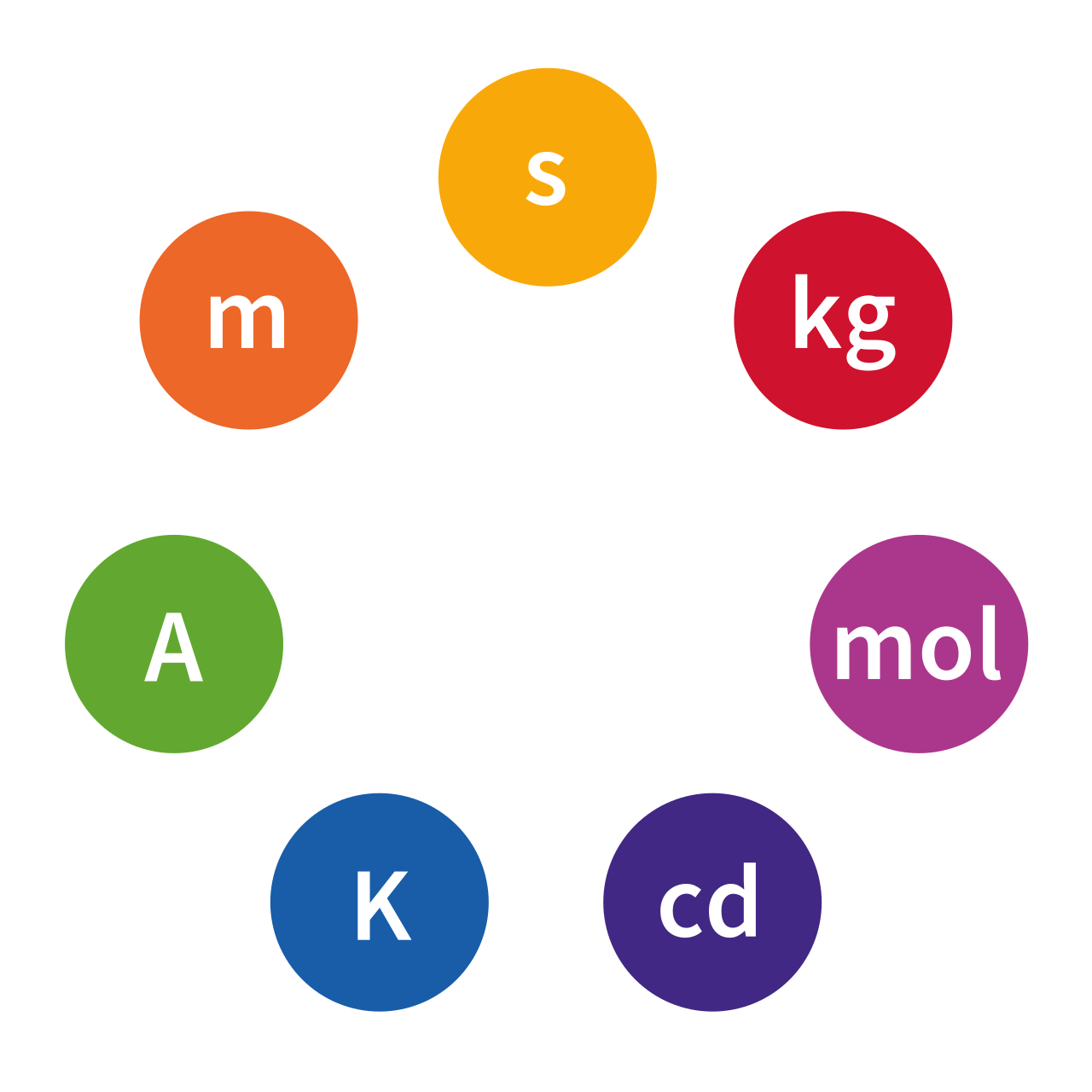
This diagram shows the standard SI base units that many physics units are built from. For 1.1, the key point is that physical quantities need a unit; detailed recall of base units belongs mainly to topic 1.2. Source
Writing physical quantities correctly
· Use a space between the number and the unit: 4.5 m, not 4.5m.
· Unit symbols are usually not pluralised: write 10 m, not 10 ms for “10 metres”.
· Be careful: ms means millisecond, not “metres”.
· Use standard symbols carefully: s = seconds, m = metres, kg = kilograms.
· Include units at every important stage if it helps avoid mistakes.
· Final answers should usually have a sensible number of significant figures, matching the data given.
· If a quantity is very large or very small, use standard form to keep the answer clear, e.g. 3.0 × 10⁸ m s⁻¹.
Reasonable estimates
· A reasonable estimate is an approximate value that is physically sensible, even if not exact.
· CIE expects you to estimate physical quantities from the syllabus, such as length, time, mass, speed, force, energy, power, current or voltage.
· Use familiar benchmarks:
· Human height ≈ 1–2 m.
· Mass of an apple ≈ 0.1 kg.
· Walking speed ≈ 1–2 m s⁻¹.
· Acceleration of free fall ≈ 10 m s⁻².
· Room temperature ≈ 300 K.
· An estimate should normally be within the correct order of magnitude.
Order of magnitude
· Order of magnitude means the nearest power of ten.
· It is used to compare or estimate quantities quickly.
· Example: 600 m ≈ 10³ m, so its order of magnitude is 10³ m.
· Example: 0.004 s = 4 × 10⁻³ s, so its order of magnitude is about 10⁻³ s.
· If your calculated answer is many powers of ten away from a reasonable estimate, it is probably wrong.
· For estimates, one significant figure is often enough, unless the question asks for more detail.
Common exam mistakes
· Giving a number only with no unit, e.g. writing 8.0 instead of 8.0 m s⁻¹.
· Using the wrong unit symbol, e.g. confusing m with ms.
· Giving estimates that are physically impossible, e.g. a human mass of 5000 kg.
· Copying calculator answers with too many digits instead of using appropriate significant figures.
· Forgetting that estimates should be approximate but sensible, not random guesses.
· Mixing units carelessly, e.g. using cm in one part and m in another without converting.
Checklist: can you do this?
· State that a physical quantity = numerical magnitude + unit.
· Identify the magnitude and unit in values such as 12.5 N or 0.20 s.
· Write physical quantities correctly using standard unit symbols.
· Make reasonable estimates for common syllabus quantities.
· Use order of magnitude thinking to check whether an answer is sensible.