
Scalars and vectors
· Scalar quantities have magnitude only.
· Vector quantities have magnitude and direction.
· Magnitude means the size or numerical value of a quantity.
· Direction must be stated for a vector answer to be complete, e.g. 12 N east, 5.0 m north-east, 3.0 m s⁻¹ upwards.
· In exams, missing direction for a vector can lose marks even if the magnitude is correct.
Common scalar and vector examples
· Scalars: distance, speed, time, mass, temperature, energy, work, power, density, pressure, charge.
· Vectors: displacement, velocity, acceleration, force, weight, momentum.
· Distance is scalar; displacement is vector.
· Speed is scalar; velocity is vector.
· Mass is scalar; weight is vector because weight is a force acting towards the centre of the Earth.
· A quantity is not a vector just because it has units; it must also have a direction.
Representing vectors
· Draw a vector as a straight arrow.
· Arrow length represents magnitude using a chosen scale.
· Arrowhead shows the direction.
· Use a clear scale, e.g. 1 cm = 5 N.
· Label vectors with the quantity and unit, e.g. F = 20 N, v = 12 m s⁻¹.
· Direction may be given as a compass direction, angle, or relative direction, e.g. 30° above the horizontal.
Adding coplanar vectors
· Coplanar vectors act in the same plane, usually on a 2D page.
· To add vectors graphically, use the tip-to-tail method.
· Place the tail of the second vector at the tip of the first vector.
· The resultant vector goes from the start of the first vector to the end of the final vector.
· The resultant is the single vector with the same overall effect as the vectors added together.
· Vector addition is different from scalar addition because direction matters.
· For perpendicular vectors, use Pythagoras to find the resultant magnitude: R² = A² + B².
· Use trigonometry to find the direction when needed.
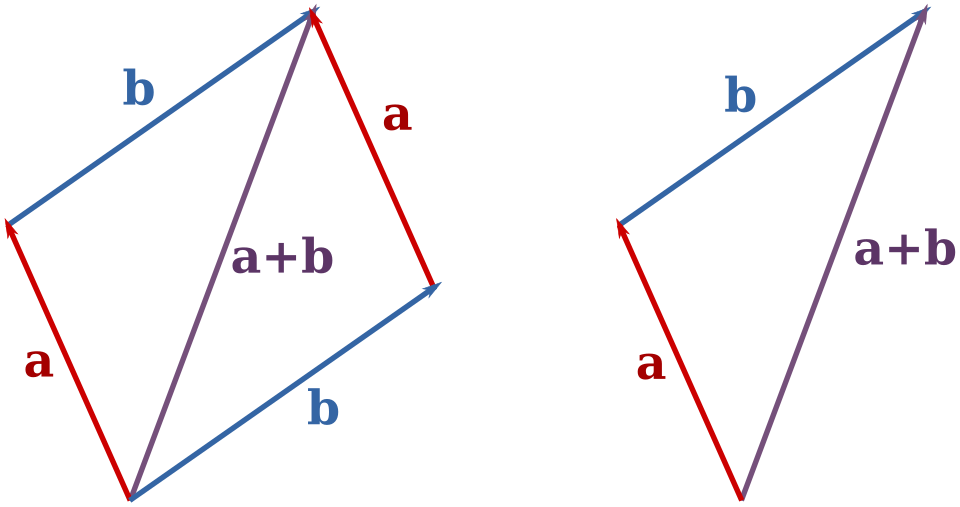
This diagram shows vector addition using equivalent geometric methods. The resultant depends on both magnitude and direction, not just numerical size. It is useful for visualising the tip-to-tail and parallelogram-style approaches. Source
Subtracting coplanar vectors
· To subtract a vector, reverse its direction, then add it.
· A − B = A + (−B).
· The vector −B has the same magnitude as B but acts in the opposite direction.
· Common exam mistake: subtracting magnitudes only, without reversing the vector direction.
· Always sketch the vector diagram before calculating if directions are not obvious.
Resolving a vector into perpendicular components
· A vector can be represented by two perpendicular components, usually horizontal and vertical.
· Components are useful because perpendicular directions can be treated independently.
· For a vector V at angle θ to the horizontal:
· Horizontal component = V cos θ.
· Vertical component = V sin θ.
· If the angle is measured from the vertical, the sine and cosine components swap.
· Components must include correct signs/directions, e.g. right/up positive, left/down negative.
· A vector is equivalent to the sum of its perpendicular components.
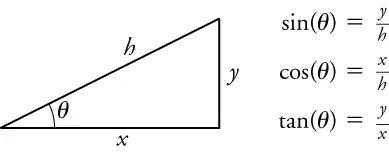
This diagram links vector components to right-angle trigonometry. The vector is treated like the hypotenuse, while the horizontal and vertical components form the other two sides. This supports resolving vectors into perpendicular components. Source
Exam method for vector problems
· First identify whether each quantity is a scalar or vector.
· Draw a clear vector diagram with arrows in the correct directions.
· Choose a sensible scale if using a graphical method.
· For non-perpendicular vectors, use tip-to-tail construction or resolve into perpendicular components.
· For perpendicular vectors, use Pythagoras for magnitude and tan θ = opposite / adjacent for direction.
· State the final answer with magnitude, unit and direction.
· Check whether the answer is physically sensible, e.g. a resultant should point between two vectors being added.
Common exam traps
· Writing only magnitude for a vector answer, e.g. “12 N” instead of “12 N east”.
· Confusing distance with displacement.
· Confusing speed with velocity.
· Adding vector magnitudes directly when the vectors act in different directions.
· Using sin θ and cos θ the wrong way round when resolving components.
· Forgetting that subtracting a vector means adding the opposite vector.
· Giving a direction without making clear what it is measured from, e.g. “30°” instead of “30° above the horizontal”.
Checklist: can you do this?
· Explain the difference between a scalar and a vector, with examples.
· Draw and label a vector showing magnitude and direction.
· Add and subtract coplanar vectors using correct vector diagrams.
· Resolve a vector into two perpendicular components.
· Give final vector answers with magnitude, unit and direction.