
SI Base Quantities and Units
· SI base quantities are the fundamental quantities used to build other physical quantities.
· For CIE A-Level Physics 9702, recall these five SI base quantities and units:
· Mass → kilogram (kg)
· Length → metre (m)
· Time → second (s)
· Electric current → ampere (A)
· Thermodynamic temperature → kelvin (K)
· Exam tip: symbols are case-sensitive: K is kelvin, k is kilo; A is ampere.
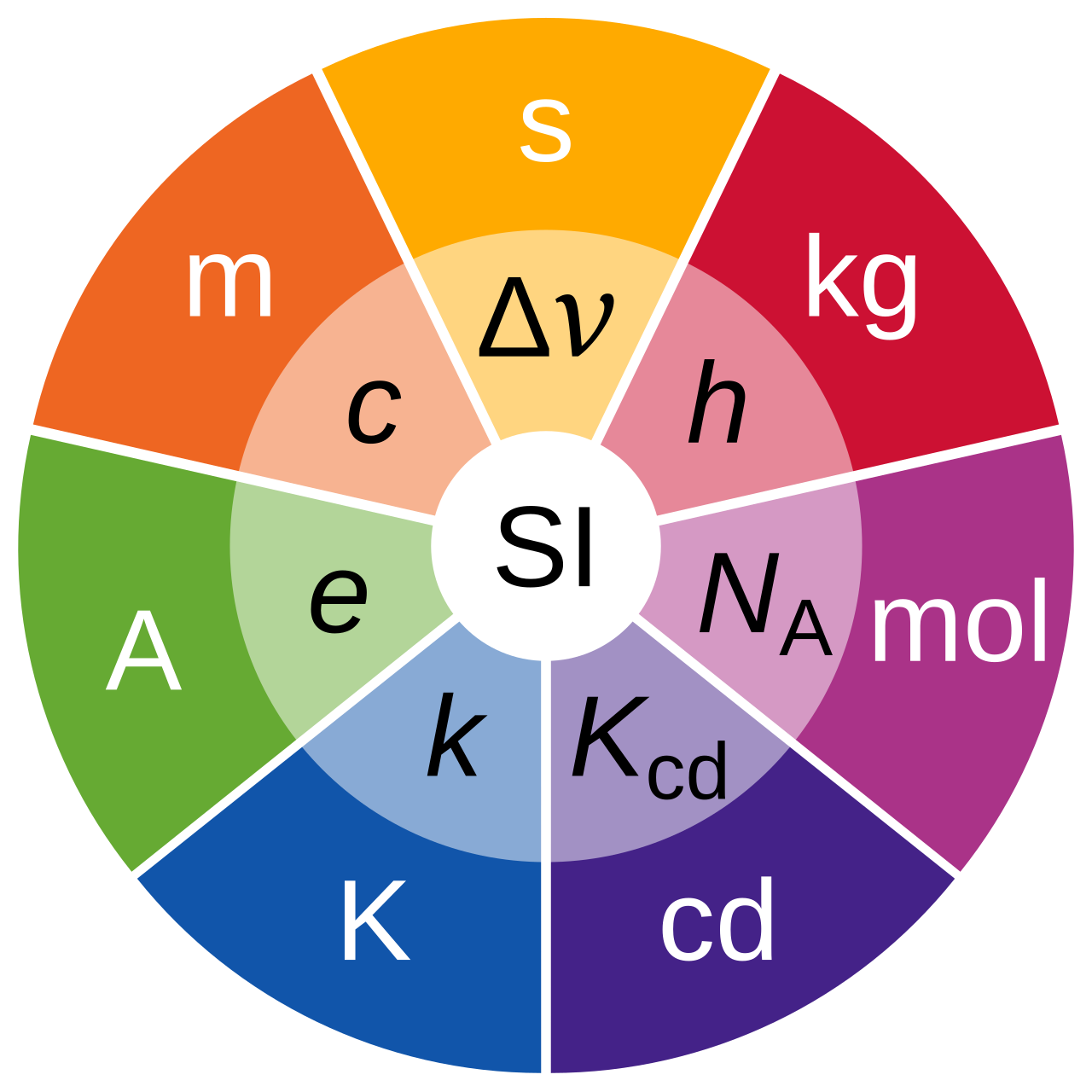
This diagram summarises the SI base units and shows that modern SI definitions are linked to fixed physical constants. For CIE 1.2, focus only on recognising the required base units: kg, m, s, A, K. Source
Derived Units
· Derived units are made by combining SI base units using multiplication and division.
· Always express derived units as products or quotients of base units when asked.
· Common examples:
· Velocity: m s⁻¹
· Acceleration: m s⁻²
· Force: N = kg m s⁻²
· Pressure: Pa = N m⁻² = kg m⁻¹ s⁻²
· Energy / work done: J = N m = kg m² s⁻²
· Power: W = J s⁻¹ = kg m² s⁻³
· Charge: C = A s
· Potential difference: V = J C⁻¹ = kg m² s⁻³ A⁻¹
· Resistance: Ω = V A⁻¹ = kg m² s⁻³ A⁻²
· Exam tip: never leave answers in mixed units unless the question allows it; convert to SI units before calculation.
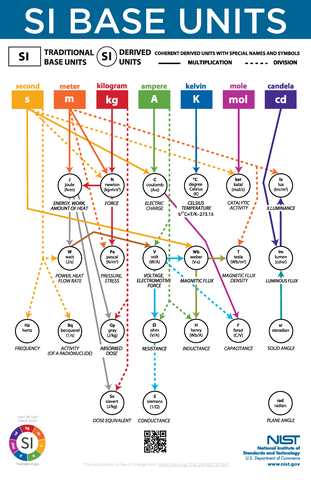
This poster shows how derived units such as newton, joule, watt, volt and pascal are built from SI base units. It is useful for practising how to rewrite units in base-unit form. Source
Checking Homogeneity of Equations
· A physical equation is homogeneous if every term has the same base units.
· To check homogeneity, replace every quantity with its SI base units.
· Example: s = ut + ½at²
· s has unit m.
· ut = (m s⁻¹)(s) = m.
· at² = (m s⁻²)(s²) = m.
· All terms have unit m, so the equation is homogeneous.
· Homogeneity can show an equation is definitely wrong, but it cannot prove an equation is definitely correct.
· Exam tip: constants such as ½ have no units.
SI Prefixes
· Prefixes show decimal multiples or submultiples of base or derived units.
· Memorise these CIE-required prefixes:
· tera (T) = 10¹²
· giga (G) = 10⁹
· mega (M) = 10⁶
· kilo (k) = 10³
· deci (d) = 10⁻¹
· centi (c) = 10⁻²
· milli (m) = 10⁻³
· micro (μ) = 10⁻⁶
· nano (n) = 10⁻⁹
· pico (p) = 10⁻¹²
· Exam tip: M means mega = 10⁶, but m means milli = 10⁻³. This is a common exam mistake.
· Exam tip: μ means micro; if handwriting is unclear, write it carefully to avoid confusion with m.
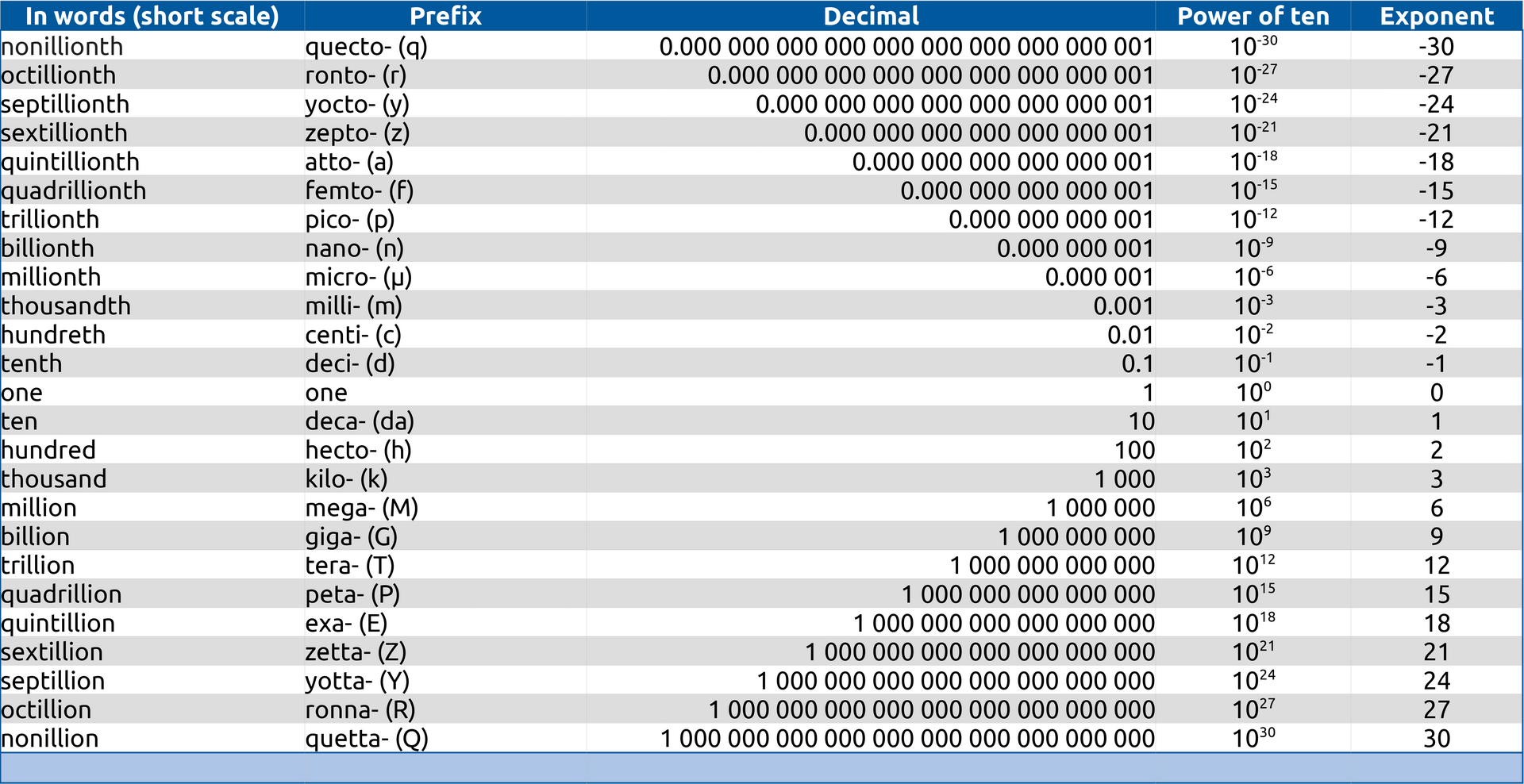
This table lists SI prefixes by symbol and power of ten. For CIE 1.2, focus on the required prefixes from pico (10⁻¹²) to tera (10¹²). Source
Using Prefixes in Calculations
· Convert prefixes into powers of ten before substituting into formulae.
· Examples:
· 5.0 km = 5.0 × 10³ m
· 3.2 ms = 3.2 × 10⁻³ s
· 450 μA = 450 × 10⁻⁶ A = 4.50 × 10⁻⁴ A
· 12 nm = 12 × 10⁻⁹ m = 1.2 × 10⁻⁸ m
· For compound units, apply the prefix before using powers: 1 cm² = (10⁻² m)² = 10⁻⁴ m².
· Exam tip: prefixes attached to squared or cubed units must also be squared or cubed.
Checklist: can you do this?
· Recall the required SI base quantities and units: kg, m, s, A, K.
· Convert between prefix notation and powers of ten.
· Express common derived units using SI base units.
· Check whether an equation is homogeneous using base units.
· Avoid common symbol errors such as M vs m, K vs k, and μ vs m.
Common Exam Traps
· Writing sec instead of s for seconds.
· Using degrees Celsius (°C) instead of kelvin (K) when thermodynamic temperature is required.
· Forgetting that kg is the SI base unit for mass, not g.
· Treating cm² as 10⁻² m² instead of the correct 10⁻⁴ m².
· Thinking a homogeneous equation must be correct; it is only dimensionally possible, not guaranteed correct.