
Elements, Compounds and Mixtures
Type | Composition | Key distinction | Separation |
|---|---|---|---|
Element | One type of atom | Cannot be chemically broken down into simpler substances | Not chemically decomposable |
Compound | Atoms of different elements | Chemically bonded in a fixed ratio | Components require chemical change to separate |
Mixture | More than one element and/or compound | No fixed ratio; components are not chemically bonded | Separated by physical methods |
Choosing Separation and Purification Methods
Solvation uses a suitable solvent to dissolve one component more readily than another.
Filtration separates an insoluble solid from a liquid; residue remains while the filtrate passes through.
Recrystallization purifies a dissolved solid by forming crystals while many impurities remain in solution.
Evaporation removes solvent to recover a dissolved solid when collecting the solvent is unnecessary.
Choose a method using properties such as solubility, physical state and volatility, and identify which component must be recovered.
Purifying a reaction product may require several separation stages.
Paper Chromatography
Paper chromatography separates soluble components of a mixture as a solvent travels through paper.
Place a small, concentrated sample spot on a baseline above the solvent level.
Allow the solvent to rise through the paper while carrying dissolved components.
Components move different distances and separate into distinct spots.
Keeping the original spot above the solvent prevents the sample from dissolving directly into the solvent reservoir.
Several separated spots provide evidence that the original sample contained multiple components.
Changes of State and State Symbols
Melting: ; freezing: .
Vaporization: and includes evaporation and boiling.
Condensation: .
Sublimation: ; deposition: .
Use state symbols in chemical equations: , , and .
Aqueous means dissolved in water and is not the same as the liquid state symbol.
Interpreting Changes of State
Within one state, heating normally raises the temperature, while cooling lowers it.
During a change of state of a pure substance at constant pressure, temperature remains constant while both states are present.
A heating or cooling graph therefore has sloping regions within a state and flat regions during a state change.
Use the direction of temperature change and the plateau to identify processes such as melting, freezing, boiling or condensation.
Observable evidence may include crystals forming during freezing, bubbling during boiling or droplets appearing during condensation.
A change of state is a physical change: the chemical identity of the substance remains unchanged.
Checklist: can you do this?
Can you distinguish between an element, compound and mixture?
Can you distinguish homogeneous and heterogeneous mixtures?
Can you choose between solvation, filtration, recrystallization, evaporation and distillation for a separation?
Can you explain how paper chromatography separates mixture components?
Can you use the kinetic molecular theory to distinguish solids, liquids and gases?
Can you name each change of state and use , , and correctly?
Can you convert between kelvin and Celsius and interpret temperature changes during a change of state?
Homogeneous and Heterogeneous Mixtures
A homogeneous mixture has a uniform composition throughout and appears as a single phase.
A heterogeneous mixture has a non-uniform composition, with distinguishable regions or phases.
Both are mixtures, so their components are not chemically bonded and can be separated physically.
The classification depends on how uniformly the components are distributed.
Distillation
Distillation separates or purifies a liquid using differences in volatility and boiling behaviour.
The mixture is heated so the more volatile liquid forms a vapour.
The vapour passes into a condenser, where cooling converts it back into liquid.
The collected liquid is the distillate.
A dissolved non-volatile solid remains in the flask when a solvent is distilled from a solution.
Choose distillation when the desired liquid can be vaporized and then condensed.
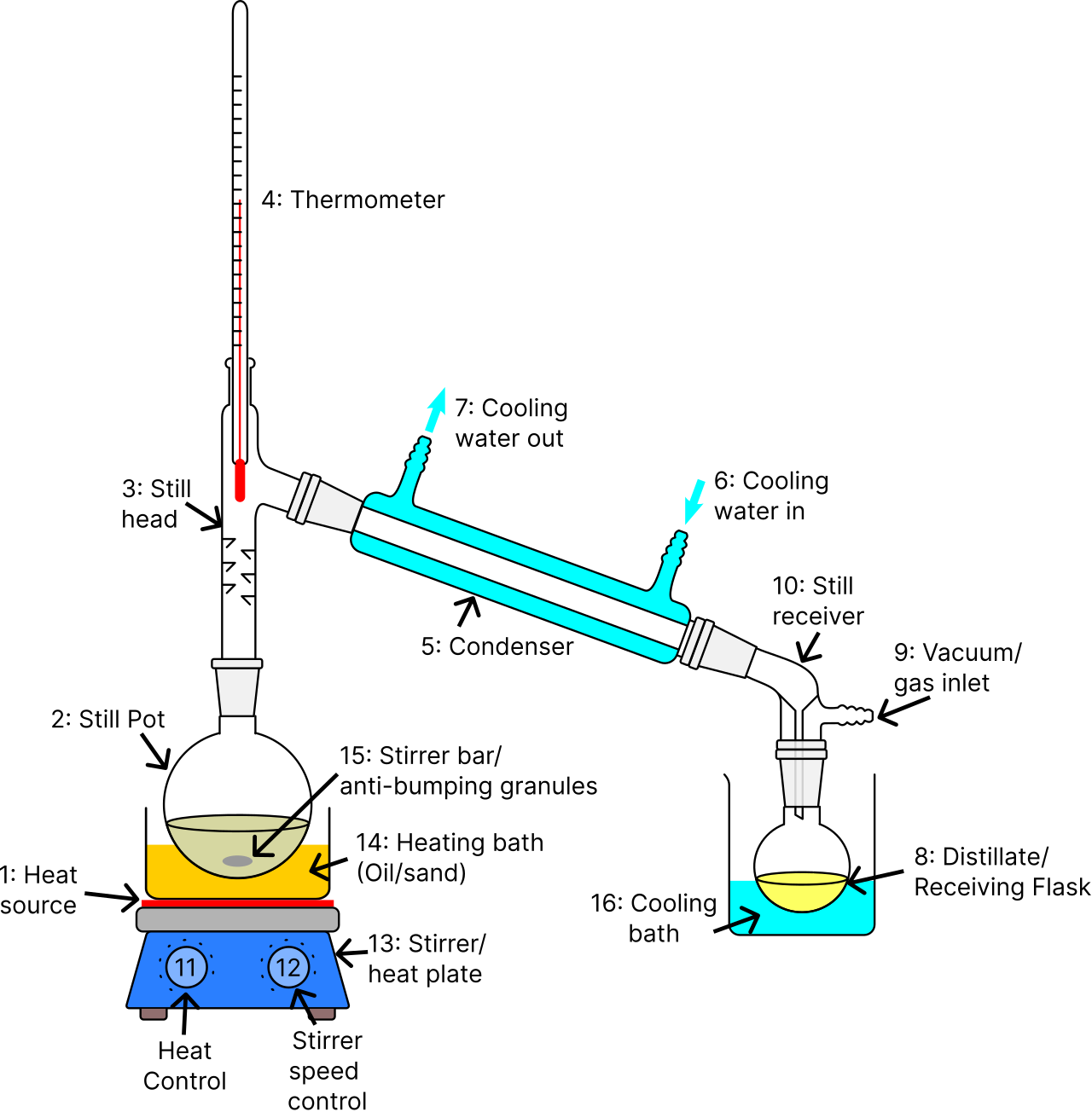
Follow the vapour from the heated mixture through the condenser to the receiving vessel. The apparatus shows how vaporization followed by condensation allows a liquid component to be collected separately. Source
Kinetic Molecular Theory
The kinetic molecular theory models the physical properties of solids, liquids and gases and their changes of state.
Solid: particles are closely packed and ordered, vibrating about fixed positions; solids have fixed shape and volume.
Liquid: particles remain close but are disordered and can move past one another; liquids have fixed volume but variable shape.
Gas: particles are widely separated and move freely; gases have neither fixed shape nor fixed volume.
Differences between states can be interpreted using particle arrangement, spacing and motion.
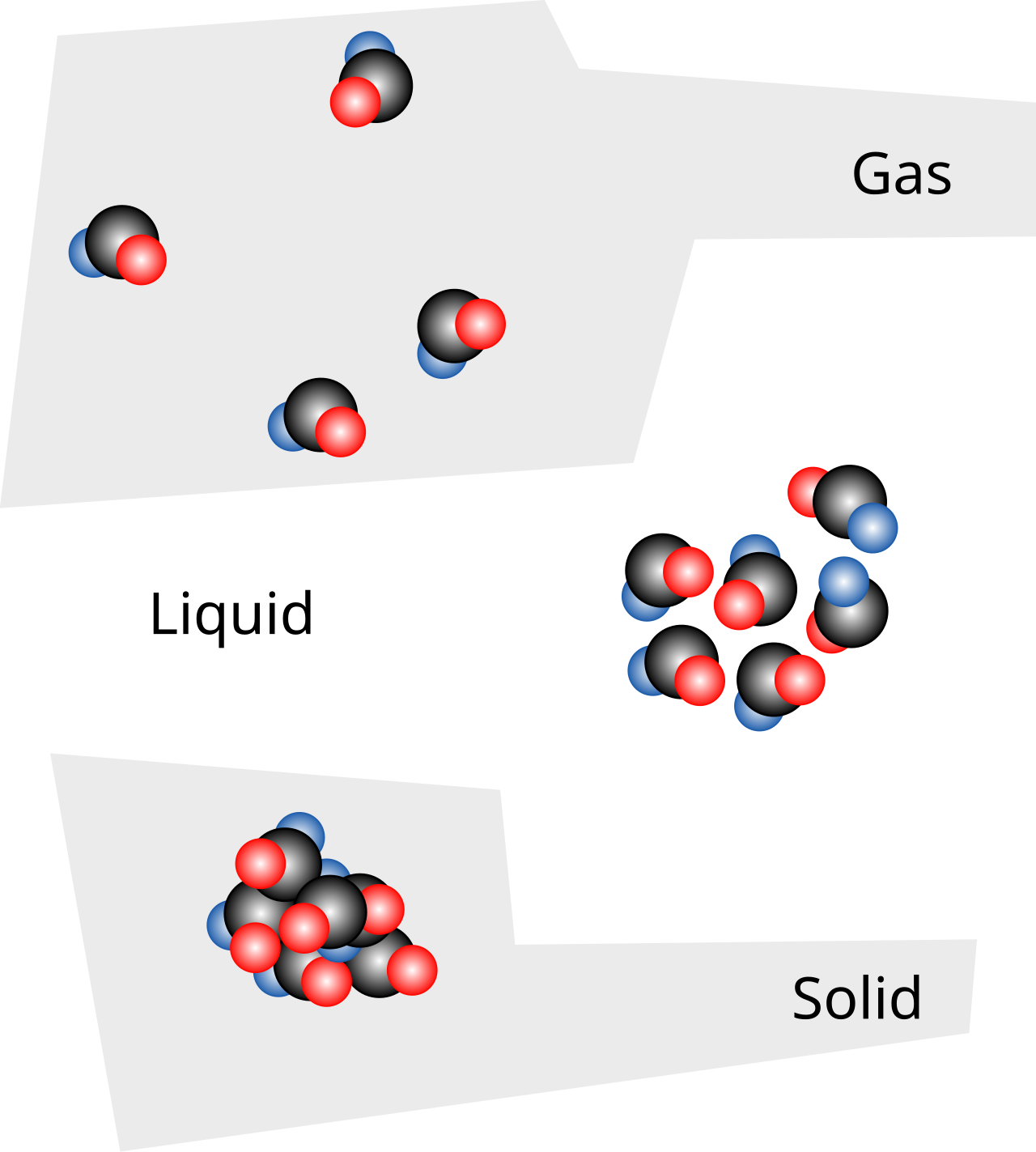
Compare the arrangement and spacing of particles in each state. Solids are closely ordered, liquids remain close but disordered, and gases have widely separated particles. Source
Temperature and the Kelvin Scale
Temperature in kelvin measures the average kinetic energy of particles.
A higher corresponds to a greater average of the particles.
The kelvin is the SI unit of temperature.
A change of has the same magnitude as a change of , but kelvin temperatures do not use a degree sign.