

OCR Specification focus:
“Design experiments to solve problems; select suitable apparatus, equipment and techniques for the proposed experiment; apply specification knowledge to the practical context.”
Introduction
Experimental aims and design fundamentals are crucial for any practical chemistry investigation. This subsubtopic covers the essential skills required to design experiments, focusing on selecting appropriate apparatus and techniques while applying theoretical knowledge to solve experimental problems.
The Importance of Experimental Design
Experimental design is the backbone of scientific investigation. In chemistry, a well-structured experimental design ensures that results are meaningful and reliable. Designing an experiment involves identifying the problem, formulating a hypothesis, selecting suitable equipment, and outlining the procedure.
Identifying the Experimental Problem
Before any experiment begins, the problem must be clearly defined. This is the first step in any successful experimental design. The problem statement forms the basis for the entire experiment, influencing what is being tested, how it will be tested, and what equipment will be needed. This step ensures that the experiment has a clear purpose, guiding all subsequent decisions.
Example Problem: Investigating how temperature affects the rate of a chemical reaction.
Setting Clear Experimental Aims
Once the problem is defined, the next step is to set clear experimental aims. These aims should outline what the experiment intends to investigate and what the expected outcomes are. Aims should be specific, measurable, and achievable within the constraints of the experiment.
Example Aim: To determine the relationship between temperature and reaction rate for a specific chemical reaction.
Experimental Aim: The primary goal or objective of the experiment, which defines what the experiment seeks to investigate or demonstrate.
Selecting the Apparatus and Techniques
Apparatus selection is critical to ensure the experiment is conducted effectively. Choosing the right tools and equipment ensures that data is collected reliably and that results can be analysed accurately. The apparatus should be selected based on the experimental aims, the nature of the chemicals used, and the level of precision required.
Considerations for Apparatus Selection:
Material Compatibility: Ensure the apparatus is chemically resistant to the substances being used.
Precision: Choose equipment that provides the level of accuracy required (e.g., using a burette for precise volume measurements).
Functionality: Ensure the equipment allows the intended reaction or measurement to take place under controlled conditions.
Techniques also need to be chosen to match the type of data being collected, whether qualitative (e.g., visual observations) or quantitative (e.g., measuring concentration or temperature).
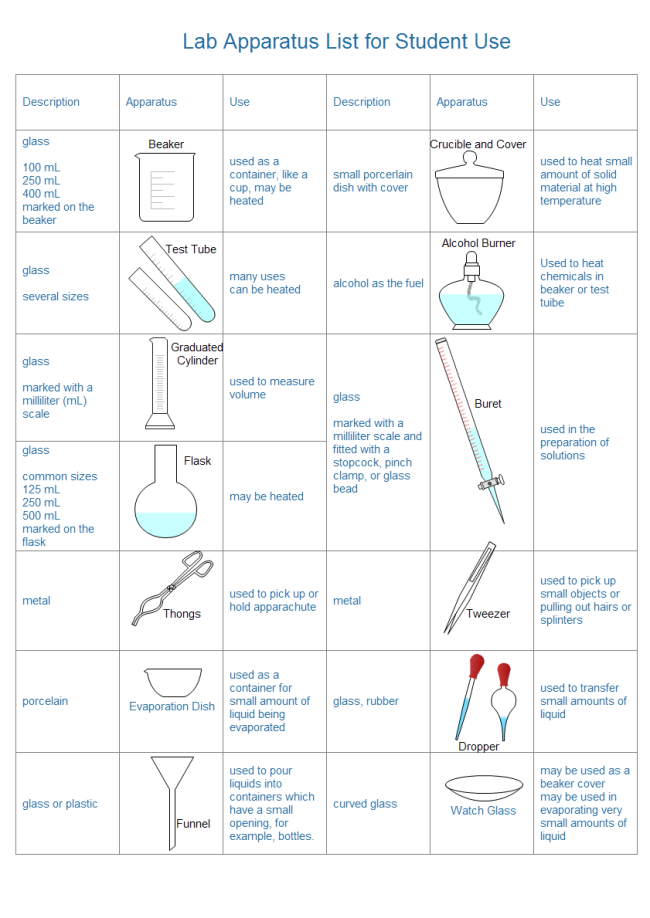
This chart displays various laboratory apparatus, detailing their uses and functions. It serves as a practical reference for selecting the appropriate equipment based on the experimental requirements, ensuring accurate and reliable data collection. Source
Applying Specification Knowledge to Design Decisions
To ensure that the design is appropriate for the experiment, prior chemical knowledge must be applied. This refers to using understanding from the OCR A-Level Chemistry specification to select methods, materials, and techniques that are appropriate for the experiment.
Example: If the experiment involves measuring the concentration of a solution, the design must reflect knowledge of titration techniques, including how to use a burette accurately and how to interpret the endpoint.
Specification Knowledge: The relevant concepts and theories from the OCR A-Level Chemistry specification used to inform and guide experimental design and decision-making.
Problem Solving in Experimental Design
An important aspect of experimental design is the ability to solve problems that arise during the planning phase. This could involve adjusting the aims, selecting new apparatus, or altering the method of measurement. For instance, if a chosen piece of equipment is unavailable or unsuitable for the experiment, the design must be adapted to use a different tool.
Example Solution: If a calorimeter is unavailable for measuring temperature changes, an alternative method such as using a thermometer or measuring the change in pressure could be considered.
Designing for Valid Results
To obtain valid results, experimental designs must control variables carefully. Validity refers to how well the experiment measures what it intends to measure, so it is crucial that the design includes specific strategies for controlling the independent, dependent, and controlled variables.
Independent Variable: The variable that is deliberately changed (e.g., temperature).
Dependent Variable: The variable being measured (e.g., rate of reaction).
Controlled Variables: Other factors that must be kept constant to avoid affecting the results (e.g., volume of reactants).
Tools for Evaluating Design
When designing an experiment, it is essential to evaluate the proposed methods to ensure they are the best possible options for achieving the desired results. This evaluation includes justifying the choices of apparatus and techniques and recognizing any limitations or potential sources of error.
Example Limitation: If a technique requires very high precision, but the available apparatus cannot provide this level of accuracy, this limitation should be acknowledged and addressed in the design phase.
Evaluation of Design: The process of assessing whether the selected methods and apparatus are suitable for achieving the desired experimental outcomes.
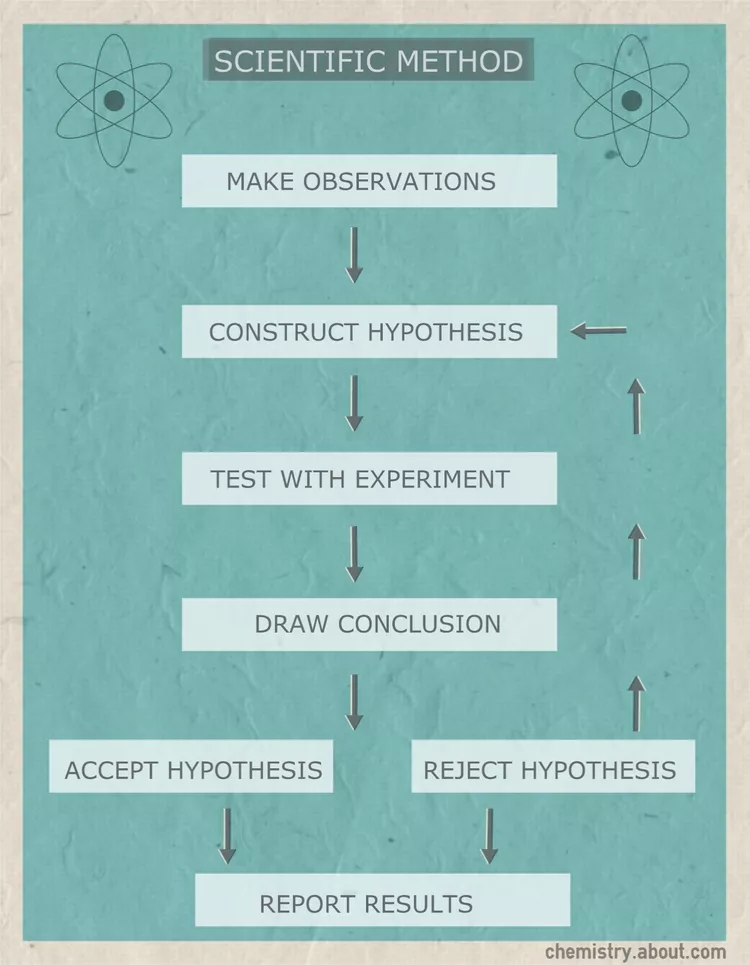
This diagram outlines the sequential steps of the scientific method, from posing questions to drawing conclusions. It underscores the iterative nature of scientific inquiry, highlighting the process of refining hypotheses and experimental designs based on ongoing analysis. Source
Conclusion
In summary, designing an experiment requires careful planning, appropriate equipment selection, and applying theoretical knowledge to the practical context. By ensuring the experiment is focused, well-resourced, and designed with validity in mind, students can lay the foundation for accurate and reliable data collection.
Practice Questions
Explain why it is important to select the correct apparatus when designing an experiment. (2 marks)
1 mark for stating that correct apparatus ensures reliable data collection.
1 mark for stating that the apparatus must be appropriate for the specific experimental conditions (e.g., accuracy, material compatibility).
Design an experiment to investigate the effect of temperature on the rate of a chemical reaction. In your answer, outline the following:
The apparatus and techniques you would use.
The variables you would control, including how you would control them.
The type of data you would collect and how you would ensure its accuracy.
(5 marks)
1 mark for describing appropriate apparatus and techniques (e.g., thermometer, stopwatch, reaction vessel, burette).
1 mark for stating how independent, dependent, and controlled variables would be identified (e.g., temperature as independent, rate of reaction as dependent, concentration of reactants as controlled).
1 mark for describing how controlled variables would be managed (e.g., keeping the concentration of reactants constant, ensuring the same surface area for solid reactants).
1 mark for explaining how accurate data would be collected (e.g., using a thermometer with precision, measuring reaction time accurately with a stopwatch, repeating the experiment for reliability).
1 mark for justifying the use of specification knowledge (e.g., using temperature control methods, considering the effects of temperature on reaction rate, applying relevant knowledge of reaction kinetics).
FAQ
When selecting apparatus, you need to consider:
Material compatibility with the chemicals used in the experiment.
Precision of the apparatus for the measurements required (e.g., using a burette for precise volume measurements).
Functionality to ensure it supports the experimental procedure, such as temperature control or mixing requirements.
Availability and practicality for the specific experimental set-up.
Independent variable: This is the variable you deliberately change or manipulate in the experiment (e.g., temperature, concentration).
Dependent variable: This is the variable you measure, which changes in response to the independent variable (e.g., rate of reaction).
Controlled variables: These are factors that must be kept constant to ensure valid results (e.g., concentration of reactants, pressure).
Controlled variables are factors that need to remain constant throughout the experiment to ensure that the effect of the independent variable is accurately measured.
To manage controlled variables, carefully monitor or standardise the conditions:
Use precise measurement equipment (e.g., measuring the volume of liquids accurately).
Conduct the experiment in consistent environmental conditions (e.g., room temperature).
Use identical equipment for each trial to minimise variation.
Justifying the selection ensures that:
The chosen apparatus will be effective in achieving reliable and accurate data.
The techniques chosen are suitable for the specific experimental conditions.
The experiment is conducted with appropriate safety measures and efficiency.
It helps avoid potential errors or limitations during data collection.
Prior chemical knowledge helps in:
Selecting the most suitable techniques for measuring or observing the desired reaction (e.g., using titration for acid-base reactions).
Understanding the chemical properties of substances to choose the right materials and avoid unwanted reactions.
Predicting how different factors (e.g., temperature, concentration) might affect the outcome of the experiment, ensuring realistic and reliable results.
