

OCR Specification focus:
'Identify independent, dependent and controlled variables; specify which variables must be controlled and how, where appropriate, to ensure valid results.'
Introduction
Identifying and controlling variables is crucial in designing experiments to ensure that the results are valid and that the experimental data can be interpreted accurately. Understanding the roles of different variables in an experiment is essential for obtaining reliable outcomes.
Types of Variables
When designing an experiment, it is important to recognise the different types of variables that influence the results. The three main types of variables in any experiment are independent variables, dependent variables, and controlled variables.
Independent Variables
Independent Variable: The variable that is deliberately changed or manipulated by the experimenter to observe its effect on the dependent variable.
The independent variable is what the experimenter controls or changes in the experiment. For example, in an experiment to test the effect of temperature on the rate of a chemical reaction, the temperature would be the independent variable.
It is important to change only one independent variable at a time to accurately observe its effect on the dependent variable.
Dependent Variables
Dependent Variable: The variable that is measured or observed in an experiment. Its value depends on changes made to the independent variable.
The dependent variable is what you are trying to measure or observe in the experiment. It is affected by the independent variable.
For example, if you are investigating how the temperature affects the rate of reaction, the dependent variable could be the reaction rate (e.g., the time it takes for a precipitate to form or the volume of gas produced).
Controlled Variables
Controlled Variables: Variables that must be kept constant throughout the experiment to ensure that the effect of the independent variable on the dependent variable is accurately measured.
Controlled variables are essential to the experimental design. If they are not controlled, the experiment may produce inaccurate or unreliable results.
Examples of controlled variables include:
Concentration of reactants in a reaction.
Volume of liquids used in titrations.
Pressure if the experiment involves gases.
Type of equipment used (e.g., type of beaker, thermometer, etc.).
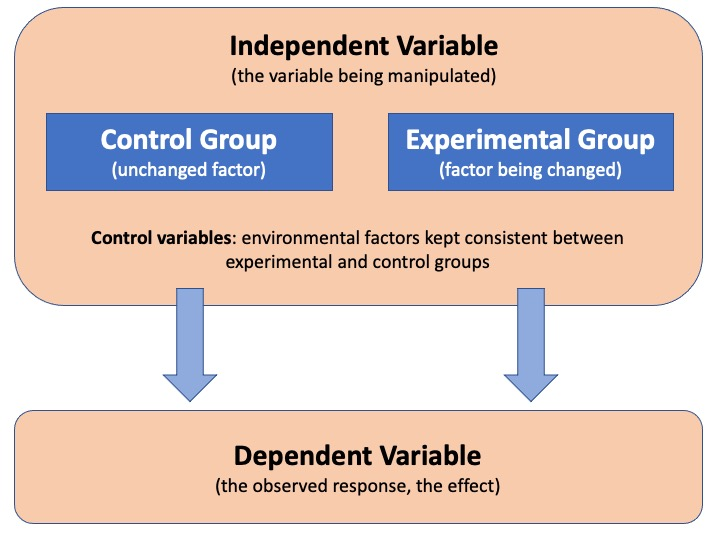
Diagram showing the independent, dependent, and controlled variables in a simple experimental set-up; although drawn for a biology context, the principle applies equally in chemistry, noting extra variables such as concentration and temperature are shown. Source
Importance of Identifying Variables
Identifying the correct variables and controlling them appropriately is fundamental in designing a well-structured experiment. This ensures that only the independent variable affects the dependent variable, allowing for meaningful results.
Ensuring Valid Results
To achieve valid results, the experiment must isolate the effect of the independent variable. By controlling other variables, you can ensure that any changes in the dependent variable are due solely to changes in the independent variable. Without proper control of variables, the results may be skewed by confounding factors, leading to incorrect conclusions.
How to Control Variables
Environmental control: Ensure that the experimental environment remains consistent. For example, if conducting a reaction at a certain temperature, it is crucial to ensure that the room temperature remains constant.
Apparatus control: Using the same equipment across all trials reduces variability. For example, if measuring volume, always use the same type of measuring cylinder.
Time control: Ensure that the timing of measurements is consistent. For example, if measuring the time it takes for a reaction to complete, start and stop the timer at the same points across all trials.
Specifying How Variables are Controlled
It is not enough to just identify controlled variables; it is necessary to specify how each variable is controlled. This may involve providing detailed instructions or procedures to ensure that the conditions of the experiment are kept constant throughout.
For example:
If controlling the temperature of a reaction, you could specify that the experiment should be conducted in a water bath at a constant temperature, using a thermometer to monitor and adjust the temperature as needed.
If controlling the concentration of reactants, you would specify the exact concentration of solutions used and ensure that the same volume of each solution is used in each trial.
By clearly stating the methods for controlling each variable, you can ensure that your experiment will yield valid, reproducible results.
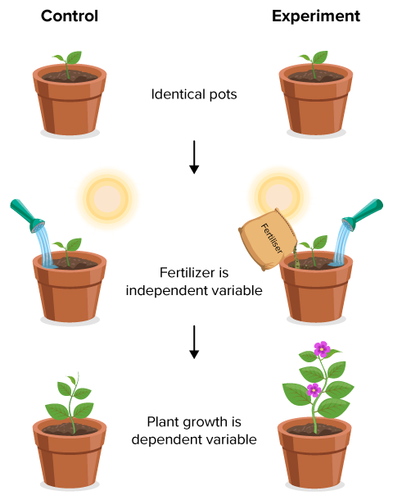
Illustration of a “control group vs experimental group” design where the independent variable (fertiliser added) is changed, the dependent variable (plant growth) is measured and other conditions (soil, pot size, light) are held constant; the extra context of plant growth is beyond the chemistry syllabus but clearly demonstrates the variable‑control principle. Source
Conclusion
Identifying and controlling variables is essential to the success of any experiment. By understanding the roles of independent, dependent, and controlled variables, and by ensuring that controlled variables are properly maintained, you can design experiments that yield accurate and reliable data. This is a crucial skill for achieving valid results and drawing meaningful conclusions from experimental data.
Practice Questions
In an experiment to investigate the effect of temperature on the rate of reaction, state the independent and dependent variables. (2 marks)
1 mark for correctly identifying the independent variable (temperature).
1 mark for correctly identifying the dependent variable (rate of reaction).
An experiment is conducted to investigate the effect of concentration on the rate of reaction. The concentration of one reactant is varied, while other factors, such as temperature, pressure, and volume, are controlled.
(a) State the independent variable in this experiment.
(b) Identify two controlled variables in this experiment and explain why they must be controlled.
(c) Suggest a method for controlling the temperature during the experiment.
(5 marks)
(a) 1 mark for stating the independent variable (concentration of the reactant).
(b) 2 marks for correctly identifying two controlled variables, with explanations for why they must be controlled.
Temperature – Must be controlled to ensure any changes in the rate of reaction are solely due to the concentration.
Pressure/volume – Must be controlled because changes in pressure or volume could affect the reaction rate, not the concentration.
1 mark for suggesting a method for controlling the temperature (e.g., using a water bath at a constant temperature).
FAQ
Identifying controlled variables is crucial because it ensures the experiment's results are valid. Without controlling variables, other factors could influence the dependent variable, leading to unreliable results. By keeping certain factors constant, any observed change in the dependent variable can be directly linked to the manipulation of the independent variable.
Controlled variables help maintain consistency across trials, ensuring that any differences in the results are due to the independent variable, not external factors. Without proper control, the experiment may yield inconsistent results, making it difficult to draw reliable conclusions about the relationship between the independent and dependent variables.
Yes, multiple controlled variables can be controlled in various ways. For example, temperature can be controlled using a water bath, while the concentration of reactants can be controlled by using pre-measured solutions. The key is to maintain consistency for each controlled variable throughout the experiment to ensure fair testing conditions.
Changing only one independent variable at a time allows you to isolate its effect on the dependent variable. If multiple variables are changed simultaneously, it becomes impossible to determine which one is responsible for the observed changes in the dependent variable, leading to unclear or misleading results.
Variables that could potentially affect the outcome of the experiment need to be controlled. For example, factors like temperature, pressure, and concentration can influence reaction rates and must be controlled to ensure that the observed effect is due solely to the manipulation of the independent variable. Identifying these variables involves understanding their relationship with the experiment’s outcomes.

