

AP Syllabus focus:
‘Prokaryotic cells lack internal membrane-bound organelles but possess specialized internal regions with distinct structures and functions.’
Prokaryotic cells (Bacteria and Archaea) are not “unorganized.”
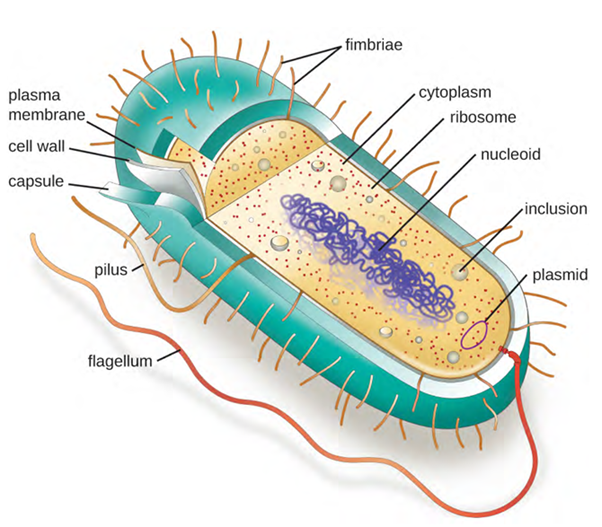
Diagram of a generalized prokaryotic cell with major internal regions labeled (nucleoid, plasmids, ribosomes, and inclusion bodies) alongside envelope and surface structures. This supports the idea that prokaryotes lack membrane-bound organelles yet still localize key functions to distinct cellular regions. Source
They lack membrane-bound organelles, yet they show clear internal structure that localises DNA, protein synthesis, metabolism, storage, and movement to specific regions.
Big picture: organisation without organelles
Prokaryotes generally do not partition functions into membrane-bound organelles. Instead, organisation emerges from:
Spatial arrangement of molecules within the cytoplasm (e.g., DNA concentrated in one region)
Protein scaffolds and cytoskeletal elements that position cellular components
Protein-based microcompartments and membrane specialisations that concentrate enzymes or reactions
This internal organisation increases efficiency by keeping related molecules close together and by separating incompatible reactions without relying on classic organelles.
Key internal regions and structures
The nucleoid and genome management
Nucleoid: A dense, irregular region of the prokaryotic cytoplasm containing the primary chromosome (usually circular DNA) and associated proteins; it is not surrounded by a membrane.
The nucleoid is functionally organised:
DNA is supercoiled and bound by nucleoid-associated proteins, helping compact the genome.
Different chromosome regions can occupy preferred positions, supporting coordinated gene expression and DNA replication.
Because there is no nuclear membrane, transcription and translation can be coupled, allowing ribosomes to begin translating an mRNA while it is still being transcribed.
Many prokaryotes also carry extra genetic elements that expand functional capacity.
Plasmid: A small, typically circular DNA molecule that replicates independently of the main chromosome and often carries accessory genes (e.g., antibiotic resistance).
Ribosomes and local protein synthesis
Prokaryotic ribosomes (70S) are dispersed in the cytoplasm but can become enriched where translation demand is high.
Coupled transcription–translation can create a functional “assembly line” near actively expressed genes.
Local translation supports fast responses to environmental change (e.g., rapid enzyme production when a nutrient appears).
Cytoskeleton and spatial positioning
Prokaryotes possess cytoskeletal proteins that help maintain shape and organise internal components.
Cytoskeletal filaments help position the chromosome during replication and cell division.
Division proteins assemble at mid-cell to coordinate cytokinesis and ensure genetic material is partitioned reliably.
Some proteins and signalling complexes localise to cell poles, creating cell polarity that supports directional movement or asymmetric division in certain species.
Storage inclusions and resource management
Many prokaryotes store materials in inclusion bodies (granules) that are distinct internal regions, often bounded by a protein shell rather than a lipid membrane.
Carbon storage (e.g., glycogen granules, polyhydroxyalkanoates)
Phosphate storage (polyphosphate granules)
Sulfur granules in sulfur-metabolising bacteria These inclusions allow rapid growth when resources fluctuate.
Protein microcompartments and localised metabolism
Some bacteria form protein-based microcompartments that concentrate enzymes and substrates.
They can improve pathway efficiency by channelling intermediates.
They can limit toxicity by sequestering reactive intermediates away from the rest of the cytoplasm. A key example is carbon-fixation microcompartments in some autotrophs, which increase local substrate concentration for enzymes.
Membrane specialisations (still not organelles)
Although prokaryotes lack membrane-bound organelles, some have internal membrane infoldings or specialised membrane regions that increase functional surface area.
Enhanced membrane area supports processes that occur on membranes (e.g., electron transport in respiration or photosynthesis in certain prokaryotes).
Spatial separation on membranes can cluster related protein complexes for more efficient energy conversion.
Organisation of movement and surface structures
Even structures that extend outside the cell have organised internal anchoring and assembly sites.
Flagella are anchored by a basal body spanning the cell envelope; placement can be polar or peritrichous depending on species.
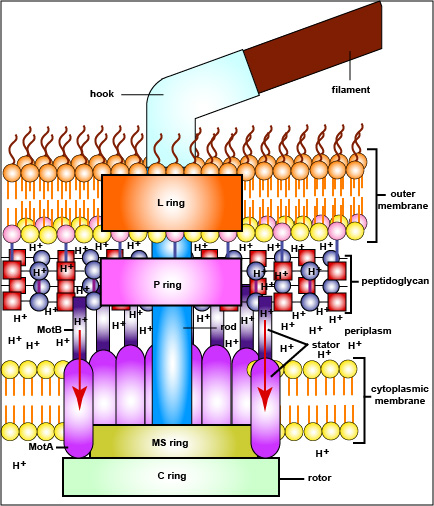
Labeled structural diagram of a Gram-negative bacterial flagellum showing the filament, hook, and basal body (rings/rod) spanning the outer membrane, peptidoglycan, and cytoplasmic membrane. The figure also indicates the motor components (stator/rotor), linking cell-envelope architecture to torque generation and rotary propulsion. Source
Pili and secretion systems assemble at defined membrane sites to enable attachment, DNA transfer, or protein export.
Chemotaxis signalling proteins can localise into clusters, improving sensitivity and coordination of movement.
Practice Questions
State two specialised internal regions or structures found in prokaryotic cells and give one function for each. (2 marks)
Names any valid specialised region/structure (e.g., nucleoid, plasmid, ribosomes, inclusion bodies, cytoskeleton, protein microcompartments, membrane infoldings) (1)
Gives an appropriate function matched to the named item (1)
Explain how prokaryotic cells can be internally organised despite lacking membrane-bound organelles. In your answer, refer to at least three distinct organisational features and link each to a functional advantage. (6 marks)
Clear statement that prokaryotes lack membrane-bound organelles but still have specialised regions/organisation (1)
Nucleoid organisation described and linked to genome management and/or efficient gene expression (1)
Coupled transcription–translation and linked advantage (rapid response/efficiency) (1)
Cytoskeletal proteins described with a role in positioning/division/shape and linked advantage (1)
Inclusion bodies described with storage role and linked advantage (resource buffering) (1)
Protein microcompartments or membrane specialisations described with linked advantage (enzyme concentration, toxic intermediate sequestration, increased membrane surface area for energy processes) (1)
FAQ
No. Some species have multiple chromosomes or linear chromosomes, and genome architecture varies widely. The “single circular chromosome” description is common but not universal.
Nucleoid-associated proteins bind and bend DNA, influencing supercoiling and gene accessibility. Different taxa use different sets of DNA-binding proteins, affecting chromosome compaction and regulation.
Inclusions are typically aggregates or granules, often with a protein boundary rather than a lipid bilayer. This allows rapid formation and mobilisation without vesicle trafficking.
Flagellar placement is controlled by localisation proteins and cell-cycle cues that mark specific membrane regions (often poles). This positioning affects swimming behaviour and surface attachment.
Yes. Some enzymes and RNAs form local clusters via weak interactions, creating functional microdomains. These assemblies can increase local concentration of pathway components and speed reaction sequences.
