

AP Syllabus focus:
‘Eukaryotic cells maintain extensive internal membranes that partition the cytoplasm into specialized regions for different functions.’
Eukaryotic cells are defined by their internal membrane network.
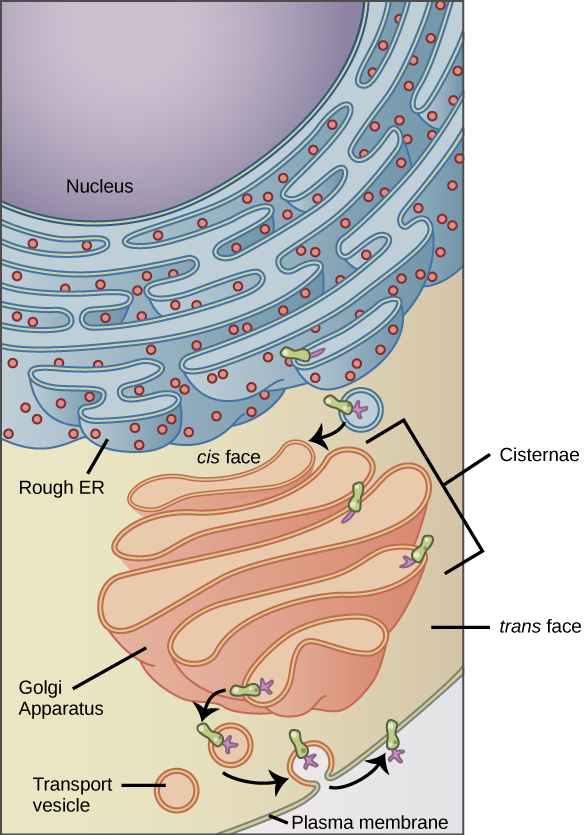
Diagram of the endomembrane system showing how internal membranes (rough ER, Golgi apparatus, and transport vesicles) form a coordinated trafficking network. The labels and arrows emphasize compartment-to-compartment transport, illustrating how membrane-bounded regions maintain distinct functions while exchanging materials in a regulated way. Source
These membranes create distinct chemical environments, organise reactions in space and time, and enable tight regulation of metabolism, signalling, and information flow.
Core idea: internal membranes create compartments
Eukaryotic internal membranes subdivide the cytoplasm into many functionally distinct regions. This compartmentalisation supports efficiency and control by separating incompatible reactions and concentrating the right molecules together.
Compartmentalisation: The separation of cellular processes into distinct membrane-bounded regions that maintain different chemical conditions.
A key principle is that membranes are not just barriers; they are reaction platforms. Many enzymes and molecular machines work best when embedded in, or tethered to, a membrane surface.
What “internal membranes” include (conceptual view)
Internal membranes are continuous or discrete lipid bilayers found throughout eukaryotic cells. At an AP Biology level, you should recognise the idea that these membranes:
Partition the cytoplasm into regions with different compositions
Provide distinct surfaces where proteins assemble into functional complexes
Enable controlled transport of materials between regions
Membrane sidedness matters
Each internal membrane has two distinct sides that remain chemically different.
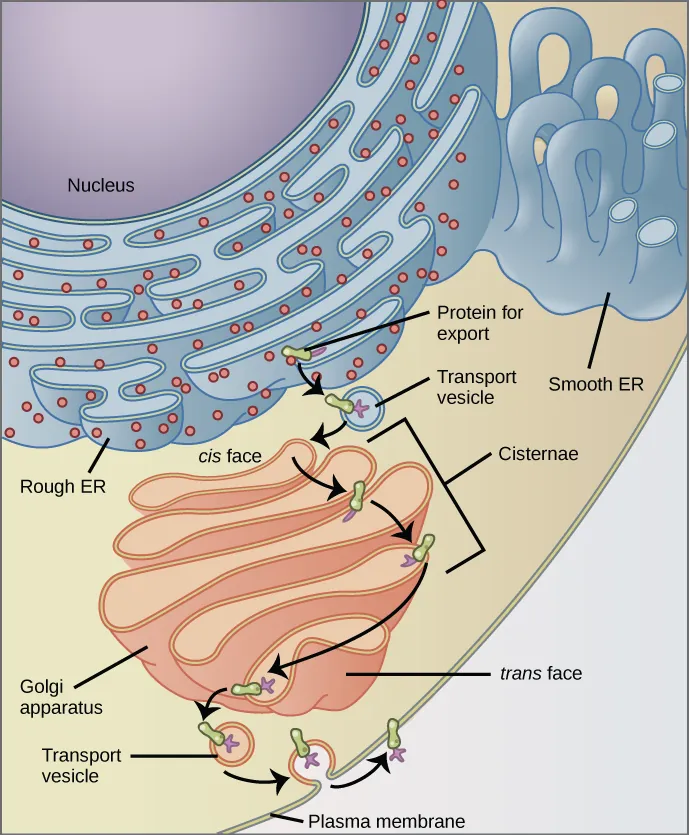
Schematic of a membrane/secretory protein moving from rough ER to Golgi and then to the plasma membrane via vesicles. The figure highlights membrane topology: the face that was luminal in the ER/Golgi becomes extracellular after vesicle fusion, explaining how cells preserve “sidedness” while trafficking cargo. Source
Membrane sidedness (topology): The consistent orientation of a membrane’s two faces, producing distinct “cytosolic” and “non-cytosolic” spaces that maintain different conditions.
This sidedness allows a cell to localise reactions. For example, a reaction may occur only on the cytosolic face of a membrane, while a different set of enzymes operates in the enclosed space on the other side.
How internal membranes support different functions
Internal membranes make it possible for eukaryotic cells to run many processes at once without destructive interference.
1) Separation of incompatible chemistry
Compartmentalisation helps prevent reactions that would disrupt each other if mixed in the same cytosolic space.
Separating hydrolytic (breakdown) reactions from vulnerable molecules
Isolating pathways that require unusual local conditions (for example, altered ion concentrations)
Keeping reactive intermediates near the enzymes that use them next
2) Formation of specialised microenvironments
Membrane-bounded spaces can maintain distinct internal conditions relative to the cytosol, such as:
pH differences
Specific ion concentrations
Distinct sets of soluble proteins and substrates
Because membranes are selectively permeable, the cell can maintain these differences and use them to regulate reaction rates and pathway direction.
3) Organisation and regulation of multi-step pathways
Many cellular processes are multi-step and benefit from having steps occur in a defined spatial sequence.
Enzymes can be positioned close together to enable efficient substrate “handoff”
Regulatory proteins can control access to a compartment, effectively switching pathways on or off
Signalling molecules can be produced locally and kept from diffusing indiscriminately
4) Controlled exchange via membrane trafficking
Although compartments are separated, eukaryotic cells coordinate them through regulated movement of materials.
Small molecules may cross using specific transport proteins
Larger cargo can be moved by vesicular transport (membrane-bound carriers)
Targeting mechanisms help cargo arrive at the correct compartment, preserving functional separation
This selective connectivity lets the cell integrate specialised regions into one coordinated system while still maintaining distinct internal environments.
Internal membranes are dynamic, not static
Internal membranes can change shape, fuse, and bud to meet cellular needs. This dynamism supports:
Rapid reorganisation during growth and division
Changes in compartment size or number when demand shifts
Local remodelling to support specialised tasks in particular regions of the cell
Internal membrane structure therefore underpins a central eukaryotic strategy: using physical separation to achieve simultaneous specialisation across many cellular processes.
Practice Questions
Explain how internal membranes in eukaryotic cells help different cellular functions occur efficiently. (2 marks)
Internal membranes partition the cytoplasm into distinct compartments (1)
Compartments maintain different conditions and/or separate incompatible reactions, improving control/efficiency (1)
Describe two advantages of internal membrane compartmentalisation in eukaryotic cells and explain how selective exchange between compartments can still occur. (5 marks)
Advantage 1 stated (e.g., separates incompatible reactions; creates distinct microenvironments; organises pathways) (1)
Explanation for advantage 1 linked to differing conditions/localisation of enzymes/substrates (1)
Advantage 2 stated (different from advantage 1) (1)
Explanation for advantage 2 linked to regulation/efficiency via spatial organisation (1)
Exchange explained via specific transport proteins and/or vesicular transport enabling regulated movement while maintaining separation (1)
FAQ
Budding and fusion conserve orientation: the cytosolic face stays cytosolic, and the non-cytosolic face remains inside the vesicle lumen.
This preserves compartment identity and prevents mixing of “inside” environments with the cytosol.
Proteins contain sorting information (often short amino-acid targeting signals) recognised by cellular machinery.
Correct targeting ensures proteins localise to the compartment where they function and helps maintain specialised chemistry.
Smaller enclosed spaces can concentrate enzymes and substrates, increasing effective collision frequency.
They also allow faster changes in local conditions (like ion levels), tightening regulation.
By co-localising sequential enzymes on or near the same membrane, intermediates travel shorter distances.
This can reduce loss to competing reactions and improve pathway throughput.
Cargo can be mislocalised, causing compartments to lose specialised composition.
This can lead to inefficient reactions, inappropriate mixing of enzymes/substrates, and failure to maintain distinct internal environments.
