

AP Syllabus focus:
‘Mitochondria and chloroplasts likely evolved from free-living prokaryotes that were engulfed and retained by ancestral eukaryotic cells.’
Endosymbiosis explains how complex eukaryotic cells acquired energy-transforming organelles.
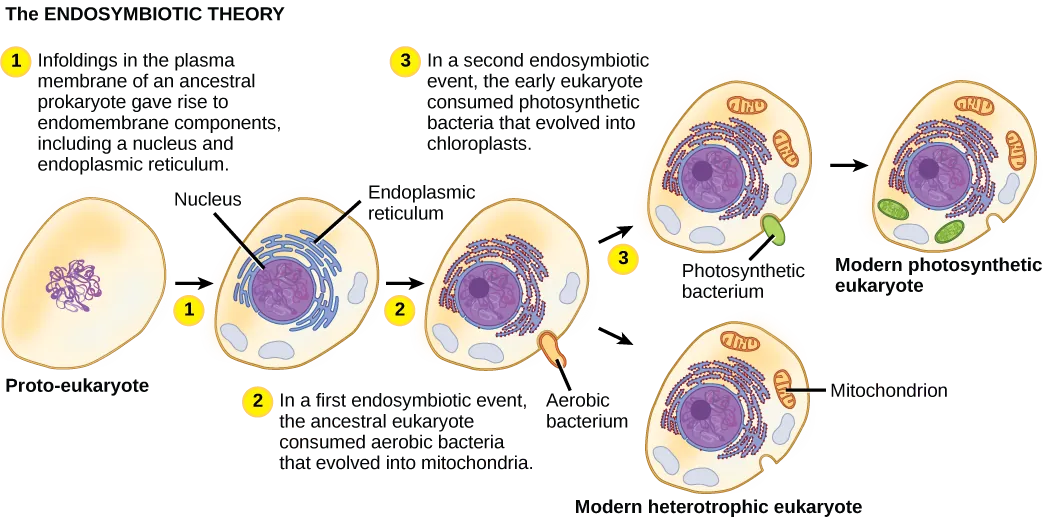
A stepwise diagram of the endosymbiotic theory showing how an ancestral host cell internalized an aerobic bacterium (leading to mitochondria) and, in some lineages, later internalized a photosynthetic bacterium (leading to chloroplasts). This visual reinforces the evolutionary logic of engulfment followed by long-term retention and integration into the host cell lineage. Source
AP Biology emphasises the evidence and logic linking modern mitochondria and chloroplasts to formerly independent prokaryotes.
Core idea: endosymbiosis as an origin of organelles
What endosymbiosis proposes
Endosymbiosis: A long-term relationship in which one organism lives inside another, with the internal partner providing functions that increase the host’s fitness.
The endosymbiotic theory proposes that early eukaryotic ancestors engulfed free-living prokaryotes but did not digest them. Instead, those internal cells were retained, producing a stable mutualism:
Host cell gained efficient energy conversion (ATP production or photosynthesis).
Internal prokaryote gained a protected environment and a steady supply of nutrients.
Over many generations, the relationship became obligate: the internal partner evolved into an organelle, losing the ability to live independently.
Two key organelles explained by the theory
Mitochondria: descended from an aerobic bacterium that could perform highly efficient oxidative metabolism; this supported larger genomes and more energy-demanding cellular processes.
Chloroplasts: descended from a photosynthetic prokaryote (commonly described as cyanobacterium-like), allowing the host lineage to capture light energy and build sugars.
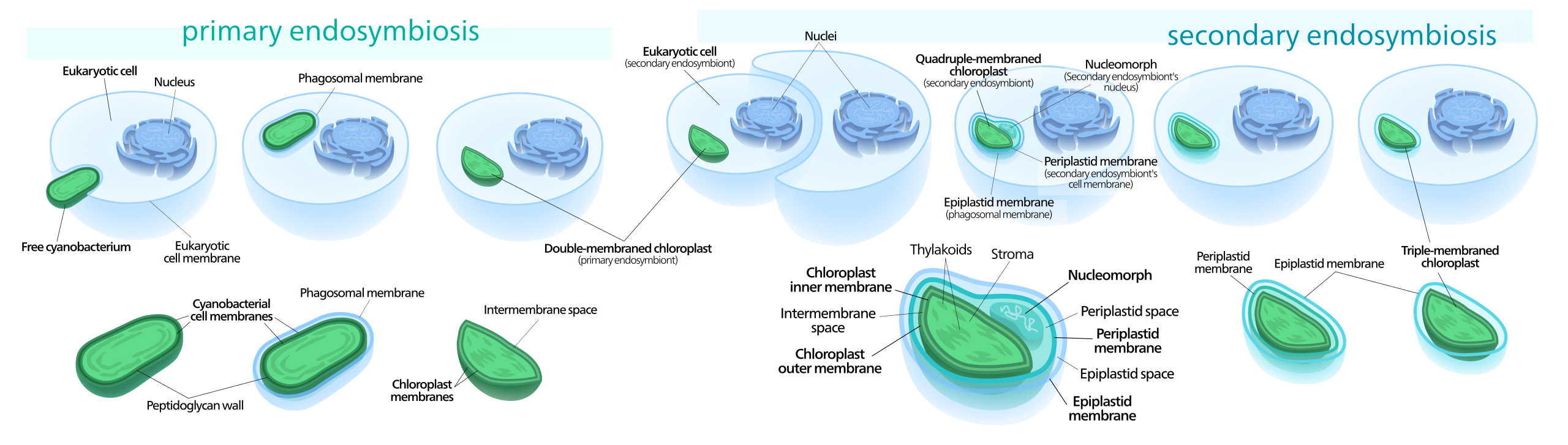
A labeled schematic of chloroplast endosymbiosis illustrating how a photosynthetic prokaryote becomes an internalized, membrane-bound organelle. The diagram supports the evidence-based claim that chloroplasts retain prokaryote-like features (notably multiple membranes and internal structures) consistent with an engulfment origin. Source
Steps in the evolutionary logic (high-level)
Engulfment to integration
Endosymbiosis is often described as a sequence of selective advantages rather than a single event:
Engulfment (phagocytosis-like uptake) brought a prokaryote into the host’s cytoplasm.
Failure to digest could occur if the prey resisted lysosomal breakdown or if digestion was incomplete.
Mutual benefit increased survival and reproduction of the combined system.
Genetic and metabolic integration evolved, making the host dependent on the internal partner’s pathways and vice versa.
Heritable retention occurred when internal cells were reliably passed to daughter cells during host reproduction.
Why “retained” matters
To match the syllabus wording, the critical claim is not only that prokaryotes were engulfed, but that they were retained across generations. Retention implies:
Stable coexistence inside the host.
Coordination with the host cell cycle so both partners persist after division.
Progressive conversion from “symbiont” to “organelle” through evolutionary time.
Evidence that mitochondria and chloroplasts were once prokaryotes
Structural and genetic evidence
Multiple, independent observations converge on a prokaryotic origin:
Double membranes: consistent with engulfment; an inner membrane resembles the original prokaryote’s membrane, while an outer membrane reflects the host-derived engulfing vesicle membrane.
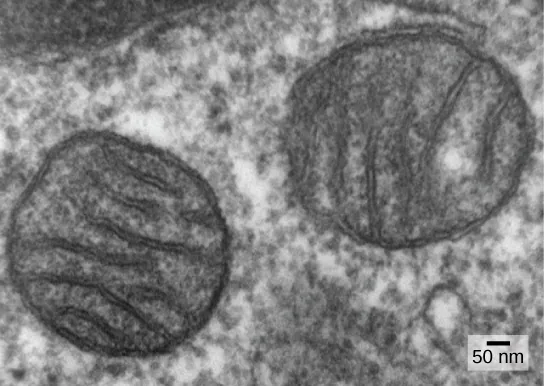
A transmission electron micrograph of mitochondria highlighting the cristae, the extensive infoldings of the inner mitochondrial membrane. The image helps connect mitochondrial membrane architecture to aerobic ATP generation and supports the idea that mitochondria retain distinct, bacteria-like membrane organization within eukaryotic cells. Source
Own DNA: mitochondria and chloroplasts contain circular DNA, a common prokaryotic genome form.
Ribosomes: organelles have prokaryote-like ribosomes (smaller than typical eukaryotic cytosolic ribosomes), supporting protein synthesis within the organelle.
Binary fission-like division: they replicate by a process resembling bacterial division rather than being built entirely from scratch by the host.
Phylogenetic signals: DNA sequence comparisons place mitochondrial genes close to bacterial lineages and chloroplast genes close to photosynthetic prokaryotes.
Functional evidence: energy conversion roles
The strongest selective advantage involves energy:
Mitochondria specialise in aerobic ATP generation, supporting larger, more complex cells.
Chloroplasts specialise in photosynthetic carbon fixation, enabling energy capture from light and autotrophic growth.
Consequences of endosymbiosis for modern eukaryotic cells
Gene transfer and dependence
A major evolutionary outcome is gene transfer to the nucleus, reducing symbiont independence:
Many genes originally in the endosymbiont genome moved to the host genome.
The organelle retained a smaller genome, keeping genes closely tied to organelle bioenergetics.
Host cells evolved targeting systems to import many nuclear-encoded proteins back into the organelle, deepening interdependence.
Common ancestry and diversification
Because mitochondria and chloroplasts are explained by acquisition events early in eukaryotic history, endosymbiosis supports:
A shared evolutionary origin for major energy-processing features of eukaryotes.
Divergence of lineages depending on whether photosynthetic endosymbionts were acquired and retained.
Practice Questions
State two pieces of evidence that support the endosymbiotic origin of mitochondria. (2 marks)
Any two distinct points, 1 mark each:
Mitochondria contain circular DNA.
Mitochondria divide by binary fission-like processes.
Mitochondria have prokaryote-like ribosomes.
Mitochondria have a double membrane consistent with engulfment.
Explain how endosymbiosis could lead from an engulfed prokaryote to a modern organelle such as a chloroplast, and describe evidence supporting this origin. (6 marks)
Engulfment of a free-living photosynthetic prokaryote by an ancestral eukaryote.
The engulfed cell is not digested and persists inside the host.
Mutual benefit: host gains photosynthesis/sugar production; symbiont gains protection/nutrients.
Retention across host cell divisions leads to stable inheritance.
Gene transfer from symbiont to host nucleus increases integration/dependence.
Evidence: double membrane.
Evidence: circular DNA.
Evidence: prokaryote-like ribosomes.
Evidence: division resembling binary fission.
Evidence: genetic similarity of chloroplast genes to photosynthetic bacteria.
FAQ
Endosymbiosis requires intracellular residence plus long-term heritable retention.
Key indicators include consistent inheritance through cell division and extensive genetic integration between host and internal partner.
Some genes remain where their products are needed immediately for energy conversion.
Local control may be favoured when rapid regulation of electron transport components is advantageous.
Yes; independent acquisitions are plausible if engulfment and retention provide a strong fitness advantage.
Comparative genomics can reveal whether organelles share a single origin or multiple origins.
Reduced digestion of the engulfed cell, improved metabolite exchange, and synchronisation with host division all increase stability.
Selection would favour host traits that capture benefits while preventing harm.
If many eukaryotes inherited mitochondria from an early acquisition event, shared mitochondrial features reflect descent from that ancestral host-symbiont lineage.
Differences among groups then reflect divergence after that acquisition.

