

AP Syllabus focus:
‘Cells coordinate multiple transport processes to regulate internal solute concentrations and support dynamic homeostasis.’
Cells survive by keeping internal conditions within workable limits despite changing external environments. This requires transport systems to work together, using gradients, energy, and regulation to control solute levels, water movement, and electrical conditions.
Coordinating Transport to Maintain Stable Internal Conditions
Dynamic homeostasis depends on integrated membrane transport
Dynamic homeostasis: The maintenance of relatively stable internal conditions through continuous, regulated adjustments that counter internal and external change.
Homeostasis is not achieved by one transporter acting alone. Cells coordinate multiple transport proteins and pathways so that:
Needed solutes enter at appropriate rates
Wastes leave efficiently
Ion concentrations remain within narrow ranges
Membrane voltage and osmotic balance stay compatible with cellular function
Transport processes that must be coordinated
To “regulate internal solute concentrations,” cells commonly integrate:
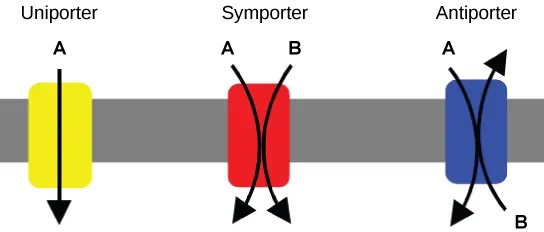
This diagram contrasts three common carrier modes: uniport (one solute), symport (two solutes same direction), and antiport (two solutes opposite directions). These transporter geometries are the “wiring patterns” that let cells couple fluxes—so one gradient-driven movement can be linked to another solute’s uptake or export. Source
Passive transport (down a gradient) through channels or carriers for rapid, selective movement
Primary active transport (against a gradient) using cellular energy to build and maintain gradients
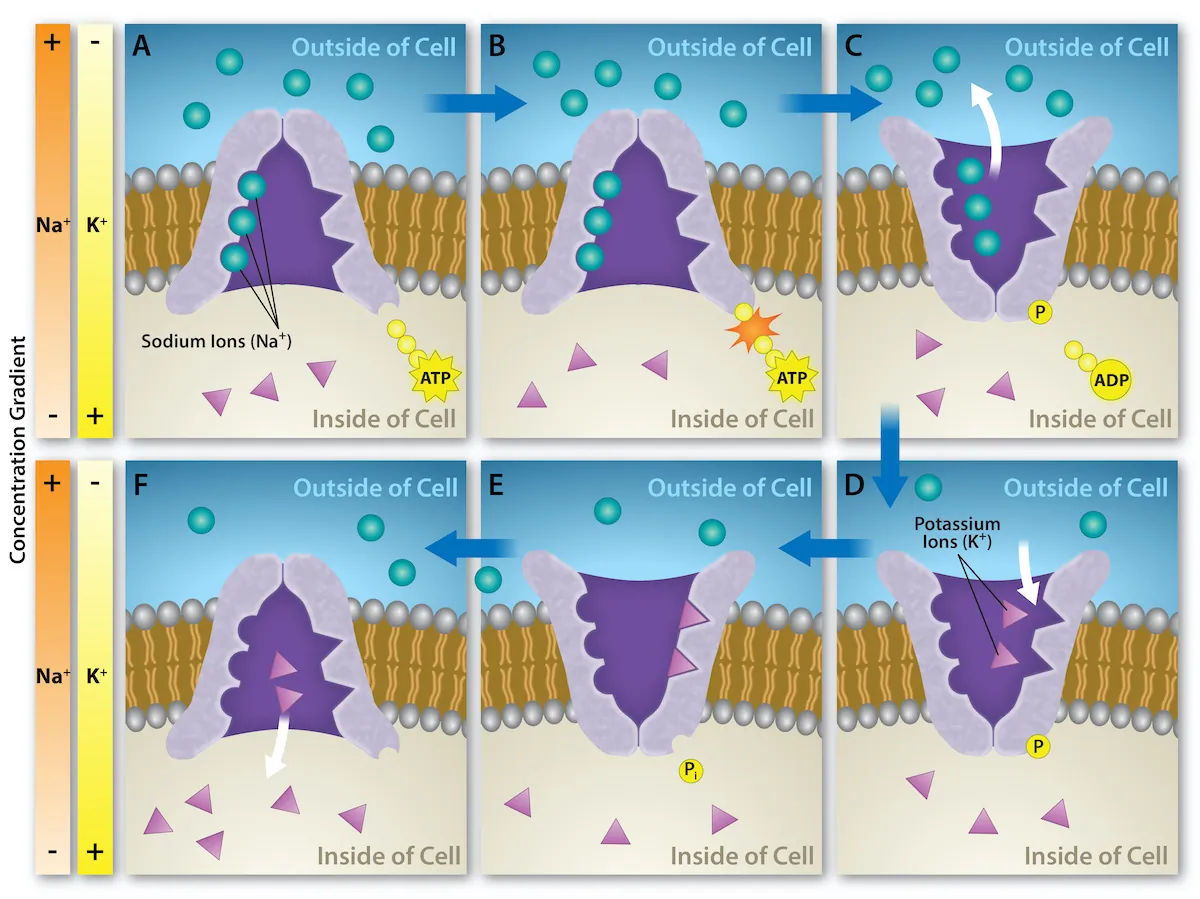
This diagram shows the sodium–potassium pump (Na+/K+ ATPase) cycling through conformational changes as it uses ATP to export 3 Na+ and import 2 K+. The net movement of positive charge helps create both a concentration gradient and an electrical gradient, which together form an electrochemical gradient that can power other transport processes. Source
Secondary active transport (cotransport) that uses an existing gradient to move a second substance against its gradient (linking two solutes’ movement)
Bulk transport (vesicle-based import/export) when large quantities or macromolecules must be moved without crossing the lipid bilayer directly
Coordination means these mechanisms operate in compatible directions and at matched rates so one pathway’s activity does not undermine another.
How Cells Link Gradients and Transporters
Gradients act as shared “currencies” for transport
Cells treat ion gradients as reusable resources:
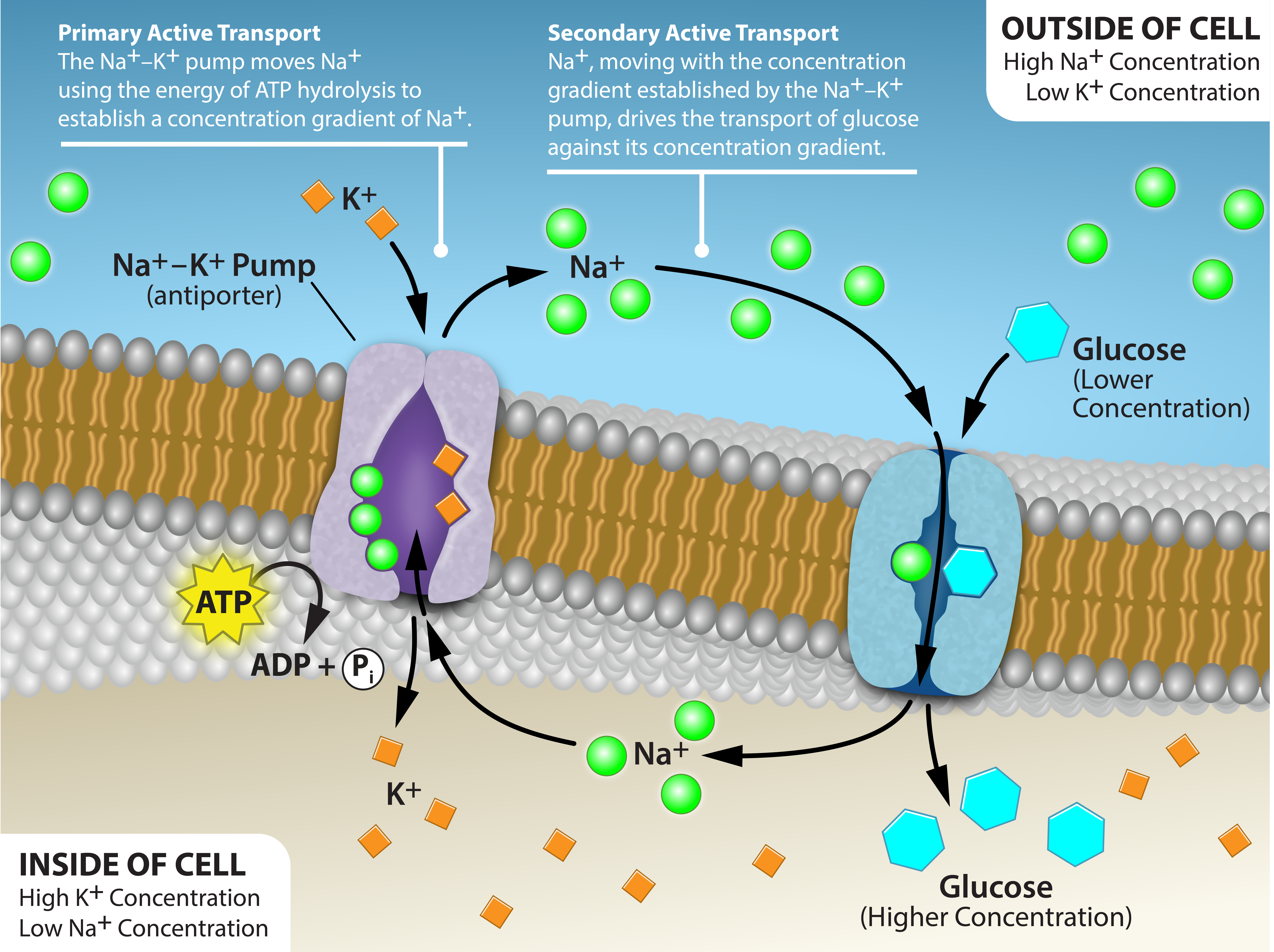
This diagram links primary active transport to secondary active transport by showing how ATP-powered Na+ pumping builds a Na+ electrochemical gradient. A symporter then “spends” that stored gradient energy to drive uphill transport of another solute (shown as glucose) into the cell, demonstrating how multiple transporters operate as an integrated system. Source
Active transport establishes gradients (high-to-low potential energy stored across the membrane)
Other transporters “spend” that gradient energy to move additional solutes
Key coordination principle:
If the gradient-producing transporter slows, gradient-driven uptake/export by other transporters also changes, so cells must adjust multiple components together.
Example logic of coupling (conceptual, not organism-specific)
A common coordinated pattern is:
An ATP-driven pump maintains low intracellular concentration of a particular ion
That steep gradient then drives cotransport to bring in nutrients or export other ions
Channels may provide controlled “leak” pathways to stabilise electrical conditions and prevent runaway charge buildup
This coupling allows efficient control of many solutes while limiting total ATP expenditure.
Regulation: Matching Transport to Cellular Needs
Feedback control and set points
Cells use sensing and feedback to keep solutes within functional ranges:
Negative feedback: deviation in internal concentration triggers responses that oppose the change
Transporter activity can be tuned by:
Changing the number of transporters in the membrane (insertion/removal)
Changing transporter activity (gating probability, conformational switching rates)
Changing driving forces (altering gradients through upstream pumps)
Avoiding conflicting fluxes
Without coordination, cells can waste energy or destabilise internal conditions, for example:
Increasing uptake of one ion without balancing counter-ions can shift membrane voltage and disrupt other transport
Moving solutes without coordinating water movement can alter cell volume and crowding, impairing reactions
Exporting one solute too quickly may collapse the gradient needed for coupled import elsewhere
Effective homeostasis requires transport systems to be co-regulated so net changes support a stable internal environment.
Coordinated Transport Supports “Dynamic” Stability
Responding to changing conditions
Dynamic homeostasis requires transport coordination across time:
Short-term adjustments: rapid opening/closing of channels or changing carrier cycling
Medium-term adjustments: trafficking transporters to/from the membrane to reset capacity
Longer-term adjustments: altering expression of transport proteins to match persistent conditions
System-level outcome
When transport is coordinated, the cell achieves the syllabus goal: multiple transport processes act together to maintain internal solute concentrations and preserve dynamic homeostasis even as external conditions or cellular demand shifts.
Practice Questions
Explain why cells must coordinate more than one transport process to maintain homeostasis. (2 marks)
States that homeostasis requires regulation of internal solute concentrations/conditions despite external change (1).
Explains that one transporter affects gradients/driving forces for others, so multiple processes must be adjusted together to stabilise net movement (1).
Describe how ion gradients can be used to coordinate transport of multiple solutes across a membrane to support dynamic homeostasis. (6 marks)
Identifies that a primary active transporter uses energy (e.g., ATP) to establish/maintain an ion gradient (1).
Explains that the ion gradient stores potential energy that can drive other transport processes (1).
Describes secondary active transport (cotransport) using the ion gradient to move a second solute against its gradient (2).
Describes the role of channels/carriers in allowing selective movement to balance charge and/or net flux (1).
Links coordination/regulation of these processes to stabilising internal solute concentrations (1).
FAQ
Cells use signalling pathways that detect internal demand (e.g., energy status) and external availability.
Common control points include transporter recycling rates, targeting signals, and regulated endocytosis/exocytosis.
Limits include membrane permeability, transporter turnover rates, ATP supply, and the time required to traffic proteins.
If gradients collapse too far, recovery may be slower because rebuilding driving forces takes time.
Failure can occur when regulation is mismatched: pumps run without sufficient counter-transport, channels remain open too long, or transporter numbers change in the wrong direction.
This can waste energy and destabilise voltage or solute balance.
Cells commonly regulate groups of transporters through shared signals so fluxes change together.
This reduces conflicting movements and provides a faster, more robust response than independent control.
Changes in lipid composition can alter membrane fluidity and microdomain formation, influencing transporter clustering and diffusion.
This can modify how efficiently pumps, channels, and cotransporters function as a coordinated system.
