

AP Syllabus focus:
‘Organisms integrate membrane transport mechanisms to move materials efficiently across tissues and organs in response to environmental changes.’
Whole-organism survival depends on coordinated transport: cells must be supplied with water, gases, nutrients, ions, and signals while removing wastes. Multicellular organisms integrate membrane transport with specialised tissues, bulk flow, and regulated exchange surfaces.
Core principle: linking membranes to body-wide transport
At the cellular level, selective membranes control what enters and leaves cells. At the organism level, transport networks connect many exchange sites to all tissues, allowing rapid distribution despite long diffusion distances.
Key integration challenges include:
Maintaining steep concentration gradients at exchange surfaces
Moving materials quickly over long distances
Adjusting transport rates as temperature, salinity, oxygen availability, hydration, and activity change
Bulk flow: long-distance transport by pressure
Diffusion alone is too slow across large organisms, so many systems use bulk flow to move fluids and dissolved solutes together.
Bulk flow: pressure-driven movement of a fluid (and its dissolved substances) through tubes or spaces over long distances.
Bulk flow is effective because organisms can:
Generate pressure differences (pumps, muscular contraction, or water potential differences)
Use branching networks to deliver materials close to cells, where diffusion completes the final short step
Animals: circulation couples delivery, exchange, and removal
In animals, circulatory systems integrate:
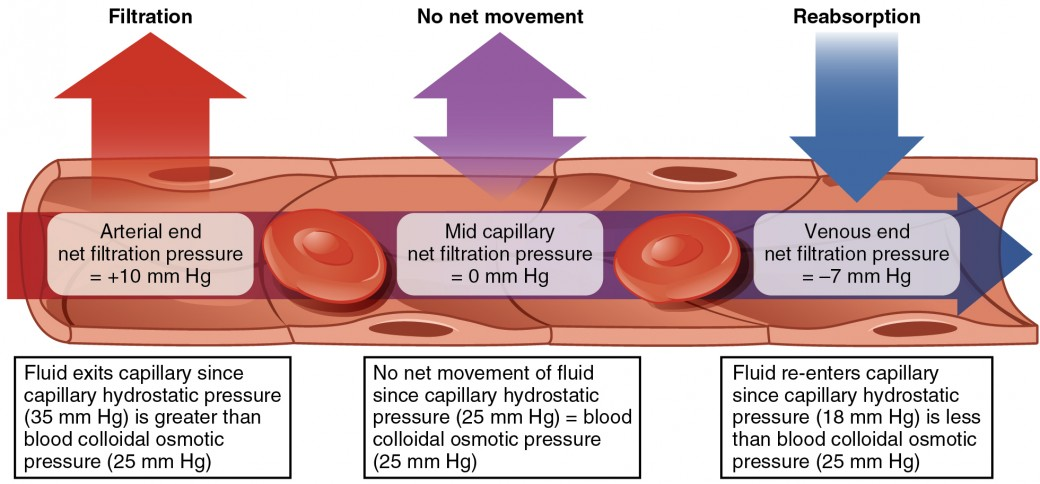
This figure summarizes capillary exchange by contrasting net filtration at the arterial end with net reabsorption at the venous end. It visualizes how hydrostatic pressure pushing fluid out and colloid osmotic pressure pulling fluid in shift along the capillary, producing directional bulk flow between blood and interstitial fluid. This provides a mechanistic bridge between “bulk flow” and “capillary exchange” in animal transport systems. Source
Convective transport (bulk flow of blood) for rapid distribution
Capillary exchange where thin walls enable diffusion of gases, nutrients, and wastes
Membrane transport in specific tissues (e.g., epithelia) to move ions and solutes directionally, shaping fluid composition
Important design features that improve efficiency:
Extensive capillary surface area near metabolically active tissues
Short diffusion distances from capillary to cell
Variable blood flow controlled by vessel diameter (redistributing resources during exercise, thermoregulation, or stress)
Plants: vascular transport links roots and leaves
In plants, transport must connect organs with very different functions:
Roots absorb water and mineral ions from soil
Leaves exchange gases and drive water movement while making sugars
Stems distribute resources between sources (photosynthetic tissues) and sinks (growing/storage tissues)
Integration across organs typically involves:
Directional uptake across root cell membranes (often requiring selective channels and transporters)
Long-distance bulk flow through vascular tissues
Regulated exchange at leaves (gas exchange while limiting water loss)
Exchange surfaces: maintaining gradients while meeting demand
Efficient organism-level transport depends on exchange surfaces that keep gradients steep:
Large surface area (folding/branching)
Thin barriers between fluid compartments and cells
Continuous renewal of external medium and internal transport fluid (ventilation and circulation)
Countercurrent systems maximise transfer
Some organisms arrange flows in opposite directions to maintain a gradient along the entire exchange surface.
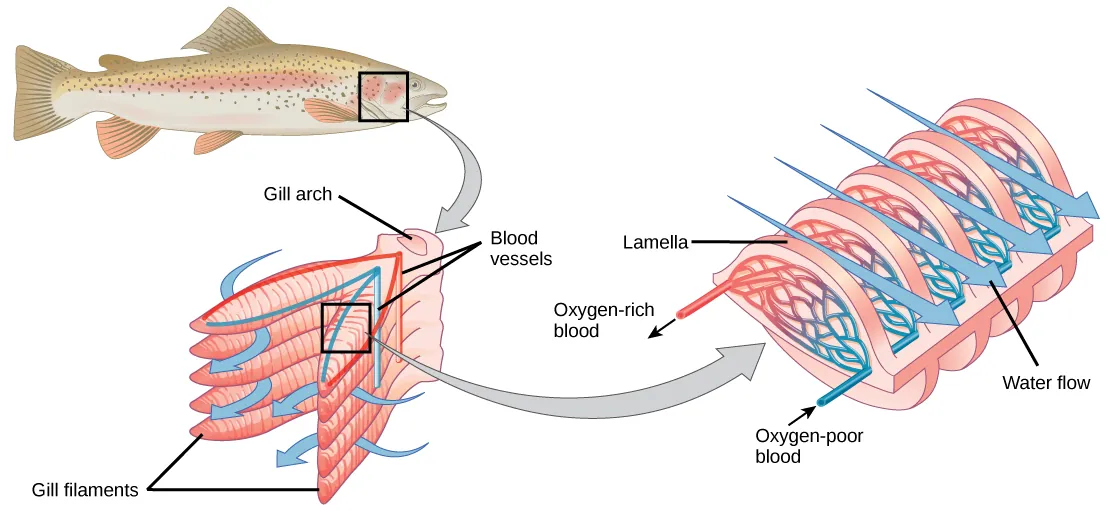
Countercurrent exchange in fish gills is illustrated by showing water flow over lamellae opposite to blood flow in capillaries. Because the two fluids move in opposite directions, a diffusion gradient for is maintained across the full length of the lamella, maximizing net oxygen uptake. The diagram also emphasizes how exchange surfaces (thin barriers + large surface area) integrate with bulk flow to support whole-organism transport. Source
Countercurrent exchange: a transfer system in which two fluids flow in opposite directions, maintaining a concentration gradient and increasing net movement of a substance.
A countercurrent design supports efficient uptake or retention because:
The gradient does not rapidly reach equilibrium at one end
Transfer can continue along the full length of the exchange region
Whole-organism delivery (bulk flow) and cellular uptake (membrane transport) work together to sustain performance under changing conditions
Coordinating transport in response to environmental change
To meet the syllabus emphasis on responding to environmental change, organisms regulate transport by altering:
Pump activity and transporter abundance in specific epithelia (adjusting ion and solute movement)
Permeability of membranes at key interfaces (changing how readily water or solutes cross)
Flow rates through organs (changing delivery and removal capacity)
Surface exposure at exchange sites (opening/closing structures to balance competing demands)
Examples of coordinated responses include:
Changing ventilation and perfusion to match oxygen demand
Redirecting blood flow to muscles during activity or to skin during overheating
Adjusting root uptake, vascular flow, and leaf exchange to balance carbon gain with water conservation during drought or heat
Practice Questions
State two differences between diffusion and bulk flow in whole-organism transport. (2 marks)
Diffusion moves individual molecules down a concentration gradient; bulk flow moves fluid and dissolved substances together due to a pressure gradient. (1)
Diffusion is effective over short distances; bulk flow enables rapid long-distance transport through vessels/tubes. (1)
Explain how a countercurrent exchange system improves uptake at a respiratory exchange surface, and describe how this integrates with bulk flow to supply body tissues. (5 marks)
Countercurrent flow maintains a concentration gradient along the entire exchange surface. (1)
This increases net diffusion/transfer compared with concurrent flow (less early equilibration). (1)
Large surface area/thin barrier features support rapid exchange. (1)
Bulk flow (e.g., circulation) carries absorbed material away, helping maintain the gradient at the surface. (1)
Bulk flow distributes the absorbed material efficiently to tissues where final diffusion to cells occurs. (1)
FAQ
Closed systems maintain higher pressure and faster bulk flow.
They allow more precise control of distribution to specific organs.
They return leaked interstitial fluid to the bloodstream.
They also transport absorbed lipids and support immune cell movement.
Matching maintains strong gradients for gas exchange.
Mismatch reduces uptake efficiency even if surface area is large.
They alter epithelial transporter activity to change net ion movement.
They also adjust drinking and excretion rates to stabilise internal fluids.
High tension in water columns can promote cavitation (air breaks).
Stomatal regulation can reduce flow, limiting delivery to some tissues.
