

AP Syllabus focus:
‘Membrane transport mechanisms, including diffusion and active transport, help conserve energy while maintaining necessary concentration gradients.’
Cells must move substances across membranes while keeping ATP demand low. This page focuses on how transport mechanisms are selected and coupled so cells conserve energy yet preserve concentration gradients needed for normal function.
Energy as a constraint on membrane transport
Moving solutes can be energetically “free” or energetically costly depending on whether movement is down or against an existing gradient. Cells tend to use mechanisms that:
exploit concentration gradients and electrochemical gradients whenever possible
spend ATP only when gradients must be built, restored, or tightly controlled
couple energy-releasing processes to energy-requiring movement
Passive transport conserves energy
When a solute moves down its gradient, the process can occur without direct ATP input.
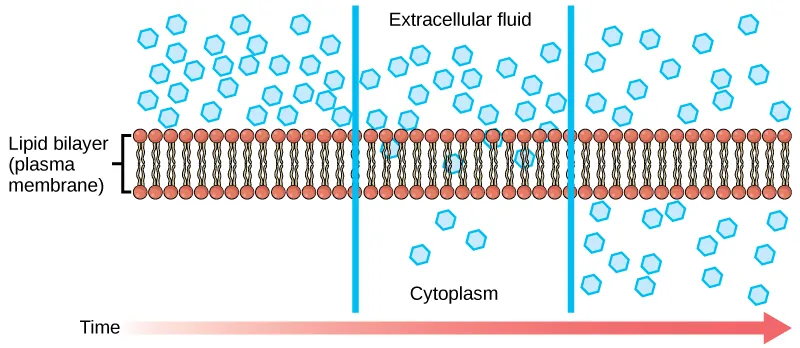
Diffusion across a permeable membrane proceeds from high to low solute concentration, producing a net flux until concentrations equalize (dynamic equilibrium). The diagram makes the key idea explicit: the concentration gradient itself supplies the driving force, so no ATP is required for net movement in passive transport. Source
Passive transport: Net movement of a substance across a membrane down its concentration or electrochemical gradient without direct cellular energy (ATP) expenditure.
Passive routes conserve energy because the gradient itself represents stored potential energy. Key implications for energy use:
diffusion proceeds spontaneously when membrane permeability and gradient permit
using existing gradients reduces the need for ATP-driven pumping
cells can regulate rate (for example, by changing channel opening) without necessarily paying ATP for each molecule moved
Active transport spends energy to create or oppose gradients
Cells often must move solutes from low to high concentration, or move charged solutes against membrane voltage. This requires an energy source.
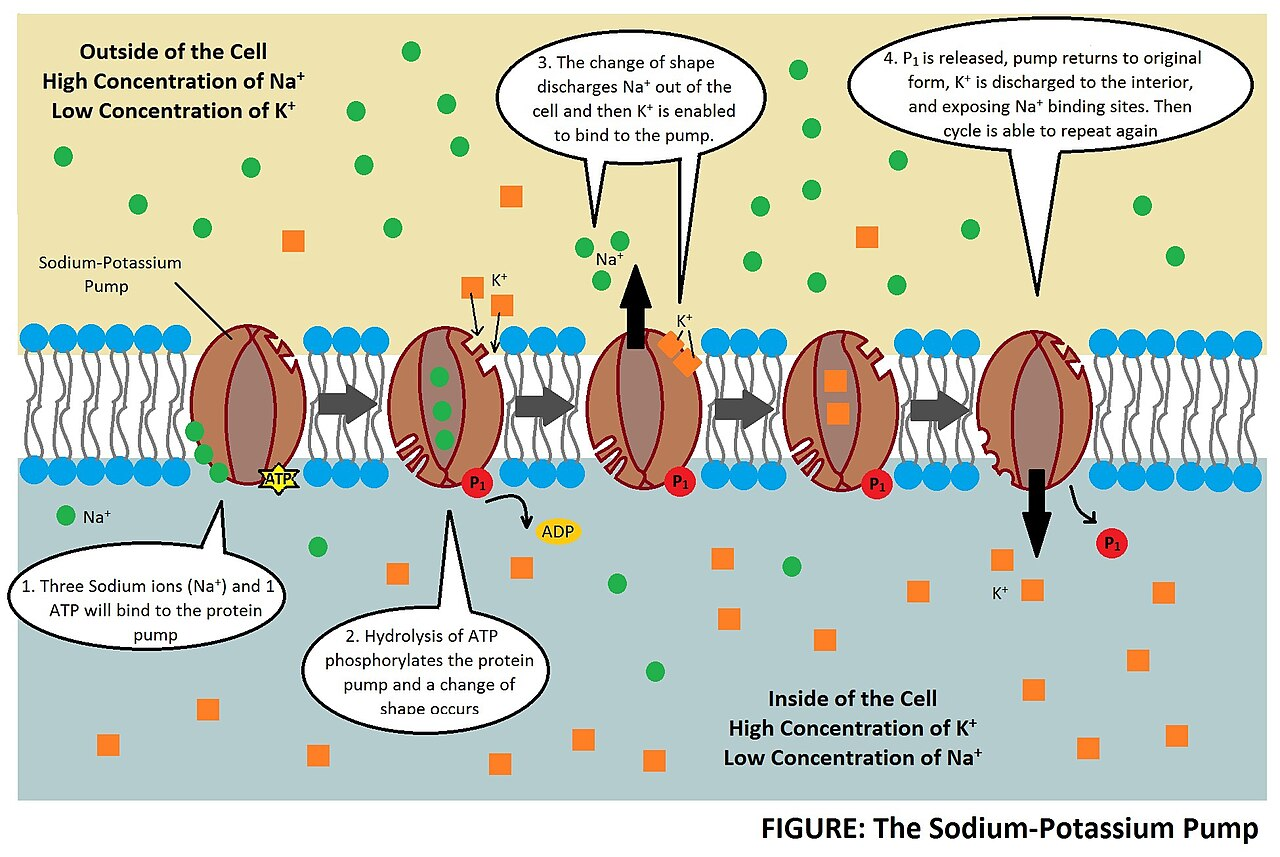
The sodium–potassium pump (Na⁺/K⁺-ATPase) uses ATP to export 3 Na⁺ and import 2 K⁺ against their gradients, generating and maintaining an electrochemical gradient. The sequence of conformational changes shown here clarifies how ATP-driven pumping is coupled to ion movement, explaining why primary active transport is energetically costly but physiologically essential. Source
Active transport: Movement of a substance across a membrane against its concentration or electrochemical gradient, requiring energy input (often from ATP hydrolysis or coupling to another gradient).
A core reason active transport is essential—despite its cost—is that many physiological conditions depend on stable, non-equilibrium gradients (for nutrients, ions, and pH).
Maintaining necessary concentration gradients (and why it costs ATP)
Gradients are constantly threatened by:
passive leakage (especially of small ions through channels)
changing external conditions that shift equilibrium points
ongoing cellular reactions that consume or produce solutes
To maintain gradients, cells invest energy strategically:
primary active transport uses ATP directly to move solutes and establish steep gradients
secondary active transport uses the potential energy stored in one gradient to drive uphill transport of another solute, reducing direct ATP spending per transported molecule
How gradients support energy efficiency overall
Although ATP-powered pumping costs energy, it can reduce total cellular expenditure by:
enabling secondary transport so multiple solutes are moved using one established gradient
preventing disruptive ion equilibration that would force costly corrective responses
supporting reliable intracellular conditions so enzymes operate near optimal ranges, avoiding inefficiencies elsewhere in metabolism
Energy-saving design principles cells use
Cells balance ATP budgets by coordinating permeability and pumping rather than maximising transport at all times.
Selective permeability reduces unnecessary pumping
Energy conservation improves when the membrane is less permeable to solutes the cell wants to keep unevenly distributed. This limits “back-diffusion,” so pumps do less corrective work.
Regulation matches transport to demand
Cells reduce wasted energy by tuning transporter activity:
altering transporter number in the membrane (insertion/removal)
modulating protein activity (gating, phosphorylation states)
adjusting driving forces by changing internal solute usage rates
Coupling and trade-offs
Transport choices reflect trade-offs between speed, control, and ATP cost:
using existing gradients is ATP-efficient but depends on having those gradients available
building gradients costs ATP but creates a reusable energy source for other transport tasks
tight homeostatic control may require continuous ATP investment, especially for ion balance
Practice Questions
Explain why passive transport is considered energy-conserving compared with active transport. (2 marks)
Passive transport moves substances down a concentration/electrochemical gradient without direct ATP use (1).
Active transport moves substances against a gradient and therefore requires energy input (e.g., ATP hydrolysis or coupling) (1).
Describe how cells can conserve ATP while still maintaining necessary concentration gradients across the plasma membrane. (5 marks)
Use passive transport where possible by exploiting existing gradients (1).
Use ATP-driven pumps (primary active transport) to establish/restore key gradients (1).
Use secondary active transport to harness energy stored in one gradient to move another solute uphill, reducing direct ATP expenditure (1).
Reduce membrane permeability/leakage of key solutes to limit back-diffusion and pump workload (1).
Regulate transporter activity/abundance to match transport rates to cellular demand and avoid unnecessary ATP use (1).
FAQ
Secondary transport is favoured when a strong pre-existing gradient can provide sufficient driving force.
Primary transport is required when no usable gradient exists or when gradients must be rebuilt.
Efficiency depends on stoichiometry (ions moved per ATP), membrane voltage, and how steep the opposing gradient is.
Heat loss and leakiness reduce net efficiency.
Higher permeability increases passive leak.
Pumps must then work more to restore gradients, raising ATP use even if the leak itself is passive.
By increasing transport capacity only when needed and reducing it when demand is low.
This lowers futile cycling (simultaneous pumping and leaking).
Yes—cells may prioritise membrane potential, pH, or ion balance needed for survival.
In such cases, ATP use remains high even under limited resources.

.jpg)