

AP Syllabus focus:
‘Eukaryotic cells contain membranes and membrane-bound organelles that compartmentalize intracellular metabolic processes and specific enzymatic reactions.’
Eukaryotic cells are organized into membrane-defined spaces that localize chemical reactions.
This compartmentalization increases efficiency, protects the cytosol from harmful chemistry, and enables specialised functions to occur simultaneously inside one cell.
Core idea: membranes create functional compartments
Membrane-bound organelles divide the cytoplasm into distinct environments with different enzymes, substrates, pH, ion concentrations, and redox conditions. By separating reactions, cells can:
Concentrate reactants near the right enzymes to increase reaction rates
Maintain unique chemical conditions required by particular enzymatic reactions
Prevent incompatible reactions from interfering with each other
Isolate potentially damaging reactions or molecules from the rest of the cell
Compartmentalization is therefore a structural strategy that supports intracellular metabolic processes (the network of chemical reactions that sustain life) by controlling where those reactions occur.
Compartmentalization: The organisation of cellular functions into distinct membrane-bound spaces that create different local chemical conditions for specific biochemical reactions.
A key AP Biology emphasis is that these compartments are defined by lipid bilayers that act as selective barriers and reaction platforms, not just “storage spaces.”
How membranes enable specialised reactions
Selective environments inside organelles
Membranes help establish internal conditions that differ from the surrounding cytosol. This supports enzyme function because enzymes are sensitive to their environment.
pH control: Many enzymes have a narrow optimal pH; an organelle can maintain that pH to maximise activity.
Ion gradients: Local ion concentrations can regulate enzyme activity and transport, and influence protein interactions.
Redox conditions: Some reactions require more oxidising or reducing conditions than the cytosol provides.
Enzymes and substrates are co-localised
Membrane boundaries keep relevant enzymes and substrates in the same place, improving efficiency.
Enzyme pathways can be organised so that the product of one reaction is immediately available as the substrate for the next.
Local concentration effects reduce reliance on random diffusion through the entire cytosol.
Membranes provide surfaces for reactions
Many metabolic processes are organised on or within membranes.
Embedded proteins can act as enzymes, anchors, or scaffolds that assemble multi-step pathways.
Membrane curvature and surface area contribute to how many protein complexes can be positioned in a region.
Major membrane-bound organelles as compartments (conceptual roles)
The AP goal here is not exhaustive organelle detail, but recognising how organelles function as compartments for specific reactions.
Nucleus: genetic compartment and reaction control
The nucleus separates DNA from the cytosol and provides a controlled environment for genome-associated processes.
Helps regulate which gene products are produced by controlling access to DNA and nuclear contents
Supports enzymatic reactions associated with nucleic acids by maintaining nuclear conditions distinct from cytosol
Organelle: A specialised structure within a eukaryotic cell, usually membrane-bound, that performs a specific function by maintaining a distinct internal environment.
Endomembrane compartments: distributed processing spaces
Connected or interacting membrane compartments create multiple “stations” where different enzymes act in sequence.
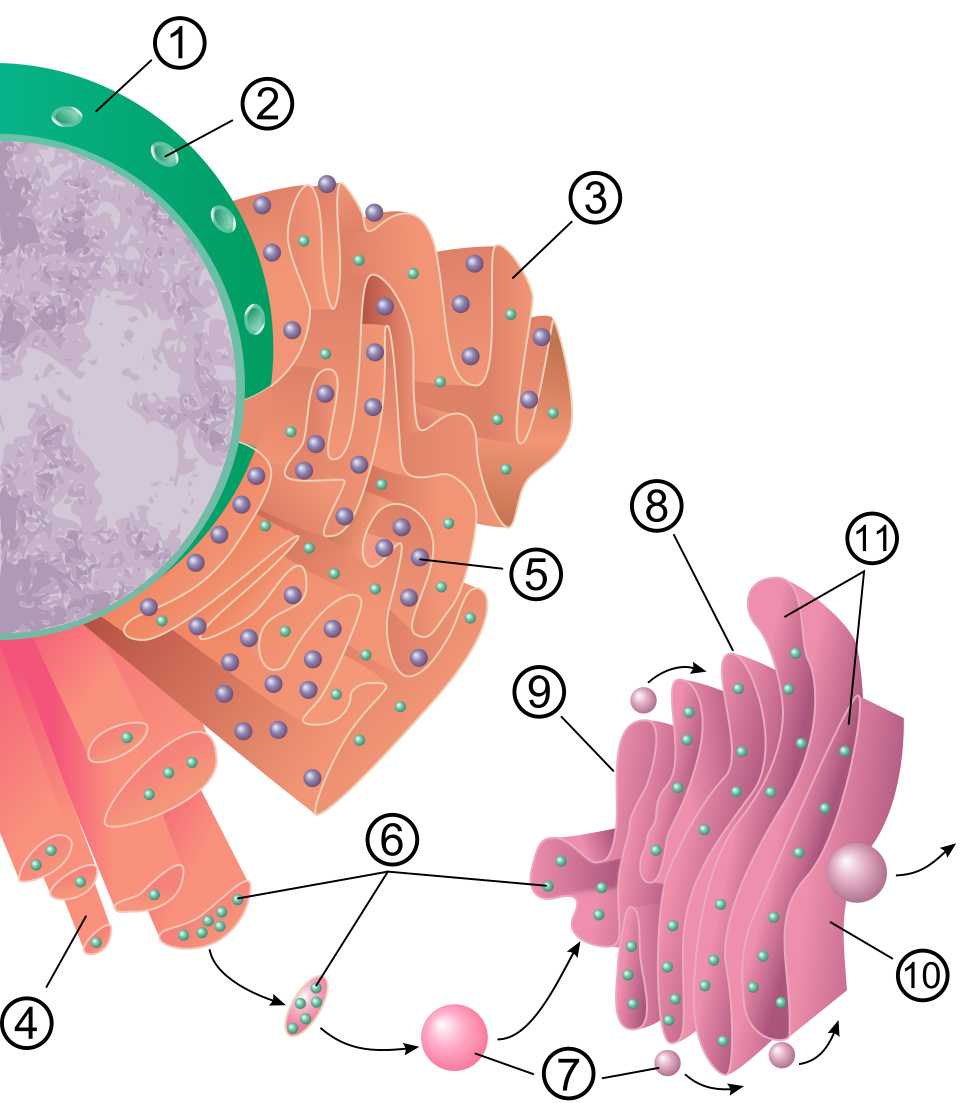
Secretory pathway (endomembrane system) diagram showing the nucleus/nuclear envelope, rough and smooth ER, transport vesicles, and the Golgi apparatus with cis and trans faces labeled. It illustrates how membrane boundaries enable sequential processing, sorting, and directed trafficking rather than uniform mixing in the cytosol. Source
The key compartmentalization idea is:
Different compartments can contain different enzyme sets, so the same molecule can be modified in steps as it moves between compartments.
Membrane boundaries enable sorting—molecules are directed to specific destinations rather than mixing uniformly.
Energy-related compartments
Some organelles maintain internal microenvironments optimised for enzyme systems that manage cellular energy transformations.
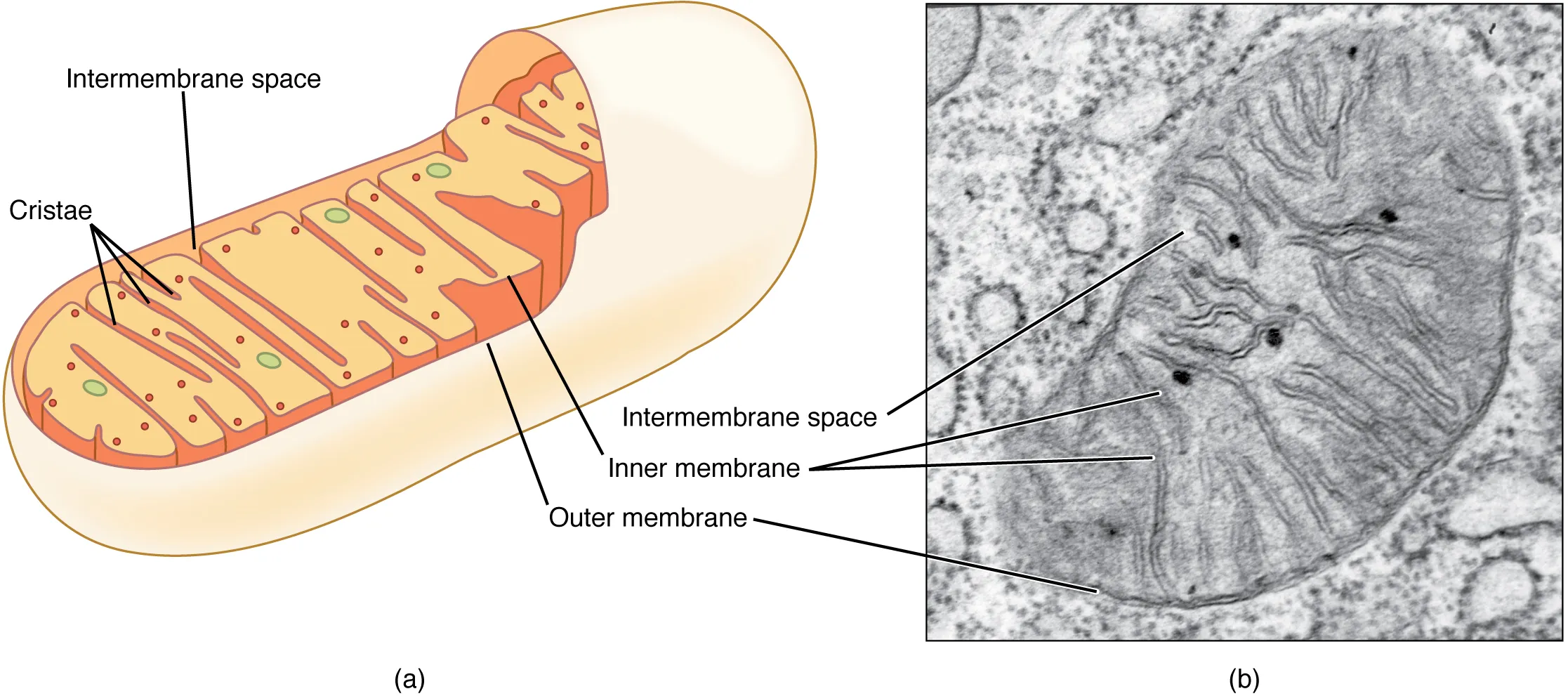
Labeled mitochondrion structure diagram highlighting the outer membrane, inner membrane, cristae, and intermembrane space (often shown alongside an electron micrograph). This supports the idea that membranes create microenvironments and surfaces where energy-transforming enzyme systems are organized and regulated. Source
Membranes separate spaces so that different steps can occur under different conditions and remain coordinated.
Spatial organisation helps prevent energy-rich intermediates from dissipating into the cytosol.
Degradative and storage compartments
Some compartments specialise in breakdown or sequestration.
Isolation protects the cytosol from reactive by-products and uncontrolled digestion.
Keeping degradation chemistry contained allows the cell to recycle components efficiently while minimising damage elsewhere.
Movement and coordination between compartments
Compartmentalization requires controlled exchange so that inputs reach the correct site and products are delivered where needed.
Selective transport across membranes regulates which molecules enter or exit a compartment.
Targeting signals on proteins and other molecules help ensure they reach the correct organelle, supporting proper metabolic routing.
Dynamic membrane processes allow compartments to interact without losing their unique internal conditions.
Critically, membranes do not merely separate; they coordinate. The cell’s metabolic network depends on balancing isolation (to maintain specialised conditions) with communication (to link pathways).
Why compartmentalization improves metabolic efficiency and safety
Efficiency gains
Reduced diffusion distance between sequential enzymes within the same compartment
Higher local concentrations of enzymes and substrates
Ability to run multiple pathways at once without competition for the same space
Safety and control
Separation prevents incompatible reactions from occurring in the same environment
Potentially harmful reactions or molecules can be isolated from sensitive cellular components
Regulatory control is enhanced because transport into/out of compartments becomes a control point
These principles directly reflect the syllabus focus: eukaryotic membranes and membrane-bound organelles compartmentalize intracellular metabolic processes and support specific enzymatic reactions by creating distinct internal environments.
Practice Questions
Explain what is meant by compartmentalisation in eukaryotic cells and give one advantage. (2 marks)
Defines compartmentalisation as separation of cell into membrane-bound organelles/regions with distinct conditions (1)
States one advantage linked to metabolism/enzymes, e.g. allows different enzymatic reactions to occur efficiently/simultaneously or maintains optimal pH/ion conditions or isolates harmful reactions (1)
Describe how membrane-bound organelles support intracellular metabolic processes by enabling specific enzymatic reactions. (5 marks)
States that organelle membranes create distinct internal environments separate from cytosol (1)
Explains that different conditions (e.g. pH/ion concentration/redox state) optimise particular enzyme activity (1)
Explains co-localisation: enzymes and substrates concentrated together increases reaction rate/efficiency (1)
Explains separation prevents incompatible reactions interfering and allows simultaneous pathways (1)
Explains selective transport across membranes regulates substrates/products, coordinating pathways between compartments (1)
FAQ
They use membrane proteins that move ions across organelle membranes, especially proton pumps and proton-coupled transporters.
Key ideas:
Active pumping of $H^+$ changes acidity inside the compartment
Counter-ion movement maintains electrical balance
Buffering molecules inside compartments stabilise pH fluctuations
Proteins often contain targeting information in their amino acid sequence or chemical tags added after synthesis.
Common mechanisms:
Signal sequences recognised by transport machinery
Receptor-mediated docking at the correct membrane
Import through membrane pores in an unfolded or partially folded state (depending on organelle)
Many reactions require conditions the cytosol cannot safely or stably provide.
Examples of constraints:
Needed pH may disrupt cytosolic proteins
Reactive intermediates could damage DNA or membranes
Competing enzymes in the cytosol could consume substrates or products, reducing pathway control
It can increase “metabolic throughput” by keeping pathway components close together and reducing diffusion losses.
Ways it helps:
Substrate channelling between enzymes
Higher effective concentrations of intermediates
Reduced side reactions because intermediates are less exposed to unrelated enzymes
Yes; cells can form membrane-less compartments via phase separation, but they differ from membrane-bound organelles because they lack a lipid bilayer barrier.
Key differences:
Exchange with cytosol is faster and less selectively gated
Organisation depends on weak interactions and concentration thresholds
They can assemble/disassemble rapidly in response to cell conditions

