

AP Syllabus focus:
‘Compartmentalization increases membrane surface area, providing more space for membrane-associated reactions and transport processes.’
Cells boost efficiency by building many internal membranes. These membranes create additional surfaces where enzymes and transport proteins operate, allowing more reactions and faster, better-regulated movement of molecules within the same cell volume.
Core idea: more membrane = more working space
Compartmentalization in eukaryotic cells is not only about separating chemicals; it also increases total membrane surface area, expanding the “workspace” for proteins that must sit in membranes to function.
Compartmentalization: the organization of cellular activities into distinct membrane-bound regions that create specialized microenvironments and additional membrane surfaces for specific reactions and transport.
Many essential cellular processes are membrane-associated, meaning key enzymes or electron carriers are embedded in a lipid bilayer rather than floating freely in cytosol.
How cells increase membrane surface area
Cells raise membrane area primarily by adding internal membrane systems and shaping them to maximize surface without dramatically increasing volume.
Internal membranes as surface area multipliers
Multiple organelles and membrane networks add large amounts of bilayer area beyond the plasma membrane.
Each membrane provides two usable faces (cytosolic side and lumen/external side), enabling directional reactions and vector transport across a boundary.
Folding and stacking
Folds, tubules, and flattened sacs pack membrane into a small space.
Increasing membrane area allows more membrane proteins (enzymes, carriers, channels) to be embedded at once, raising potential throughput.
Why membrane location matters
Many proteins require:
A hydrophobic environment to maintain structure
A defined “sidedness” (inside vs outside of the compartment) to control where products go
A stable platform to position sequential enzymes close together for rapid handoffs
Why increased membrane surface area improves reaction efficiency
Greater membrane area increases efficiency in two linked ways: reaction capacity and transport capacity.
More room for membrane-associated reactions
Enzyme density can be higher when more membrane is available, increasing maximum reaction rate for pathways that occur on membranes.
Pathways often involve multi-protein complexes; more surface permits more complexes to assemble simultaneously.
Membranes help maintain localized conditions (pH, ion concentration, redox state) that tune enzyme activity and improve coupling between steps.
More room for transport processes
Transport relies on membrane proteins; increased area supports:
More transporters operating in parallel
Faster establishment and maintenance of concentration differences between compartments
Improved control via selective placement of transporters in particular membranes
Efficient transport also supports efficient reactions: substrates can be delivered and products removed quickly, reducing bottlenecks and limiting interference from competing molecules elsewhere in the cell.
Key cellular examples to recognise (surface area focus)
The AP idea is the surface-area benefit, not detailed organelle biochemistry. Look for these features:
Highly folded membranes
Inner mitochondrial membrane folds increase area for embedded protein complexes involved in energy-related reactions.
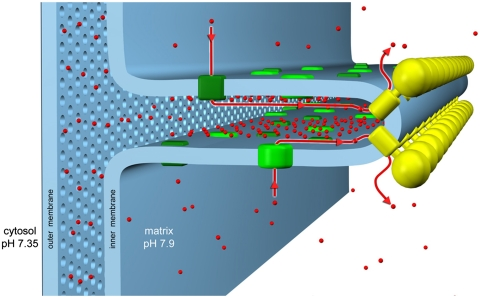
Segmented diagram of mitochondrial cristae showing how the folded inner membrane creates distinct regions that concentrate different membrane protein complexes. ATP synthase (yellow) is arranged along highly curved cristae tips, while electron-transport proton pumps such as complex I (green) occupy adjacent flatter regions, emphasizing how added membrane area supports more simultaneous membrane-associated reactions. The figure also highlights vector transport: protons (red) move across the membrane and back through ATP synthase to drive ATP production. Source
Thylakoid membrane stacks in chloroplasts increase area for light-driven membrane reactions.
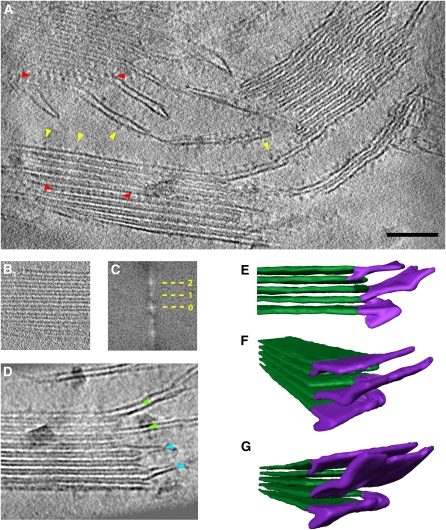
Electron-tomography figure showing chloroplast thylakoid architecture, with stacked grana membranes and connecting stromal lamellae. The image highlights that ATP synthase complexes protrude from specific thylakoid regions, illustrating how extensive internal membranes create large, specialized surfaces for membrane-bound energy-conversion reactions. This supports the idea that membrane organization increases both reaction capacity (more complexes) and directional transport across the thylakoid membrane. Source
Extensive membrane networks
Endoplasmic reticulum provides large continuous membrane area for membrane-bound enzymes and for insertion/processing of membrane and secreted proteins.
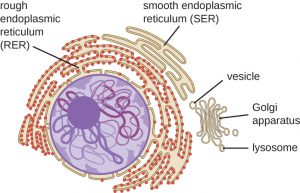
Labeled diagram of the endoplasmic reticulum (ER) showing rough ER (ribosome-studded) and smooth ER (tubular), emphasizing the ER as an extensive internal membrane network. By adding large areas of lipid bilayer inside the cell, the ER increases the available surface for membrane-associated enzymes and for the insertion and processing of membrane/secreted proteins. The continuity of ER membranes also helps explain how cells route molecules through compartmentalized pathways efficiently. Source
Golgi stacks and transport vesicles add surface area devoted to sorting and moving molecules via membrane fusion and budding.
Compartment boundaries enable directional flow
Transport across each membrane can be regulated independently, allowing cells to route molecules through a sequence of compartments while maintaining distinct internal conditions in each.
What to emphasise in diagrams and explanations
When interpreting cell diagrams or experimental descriptions, connect structure to efficiency by stating:
Increased internal membranes → greater total membrane surface area
Greater surface area → more membrane-bound enzymes and transport proteins
More proteins in place → higher reaction throughput and transport capacity
Distinct membranes → better control of where reactions occur and where molecules move
Practice Questions
Explain how compartmentalisation can increase the efficiency of membrane-associated reactions in a eukaryotic cell. (2 marks)
States that internal membranes increase total membrane surface area (1)
Links increased surface area to more membrane-bound enzymes/complexes operating at once, increasing reaction rate/throughput (1)
A student compares two cell types with similar volumes. Cell A has minimal internal membranes; Cell B has extensive folded internal membranes. Explain how Cell B could show higher rates of both membrane-associated reactions and transport processes. (5 marks)
Internal membranes/folds increase total membrane surface area without large volume increase (1)
More surface area allows a greater number/density of membrane proteins to be embedded (1)
More membrane-associated enzyme complexes increases maximum pathway capacity/throughput (1)
More transporters/channels increases rate/capacity of transport across membranes (1)
Compartment membranes allow distinct local conditions and directional transport that improves coordination/efficiency (1)
FAQ
Common approaches include stereology on electron micrographs and 3D reconstructions.
Some methods infer area from membrane-specific fluorescent labelling calibrated to standards.
More membrane requires more lipids and proteins, increasing biosynthetic cost.
Crowding can reduce mobility of proteins and limit access of substrates on the membrane surface.
Curvature can favour proteins with curved shapes or specific lipid interactions.
Some proteins preferentially localise to highly curved regions, altering local reaction and transport capacity.
Yes; more membrane sites can increase receptor/effector numbers and create more signalling microdomains.
However, compartment boundaries can also slow diffusion of signalling molecules between regions.
Targeting signals in the protein and vesicle trafficking pathways direct delivery.
Retention and recycling mechanisms maintain distinct protein compositions for each membrane type.
