AP Syllabus focus:
‘Rearrange tangent, cotangent, secant, and cosecant expressions using trigonometric identities so that derivative rules can be applied efficiently and correctly.’
Preparing trigonometric expressions before differentiating helps simplify structure, reduce algebraic complexity, and ensure accurate application of derivative rules using identities that rewrite functions into more manageable equivalent forms.
Using Identities to Prepare Trig Functions for Differentiation
Before applying derivative rules, AP Calculus AB students must recognize that many trigonometric expressions are easier to differentiate when rewritten using trigonometric identities. These identities reveal equivalent forms that align naturally with known derivatives of sine, cosine, and basic reciprocal functions.
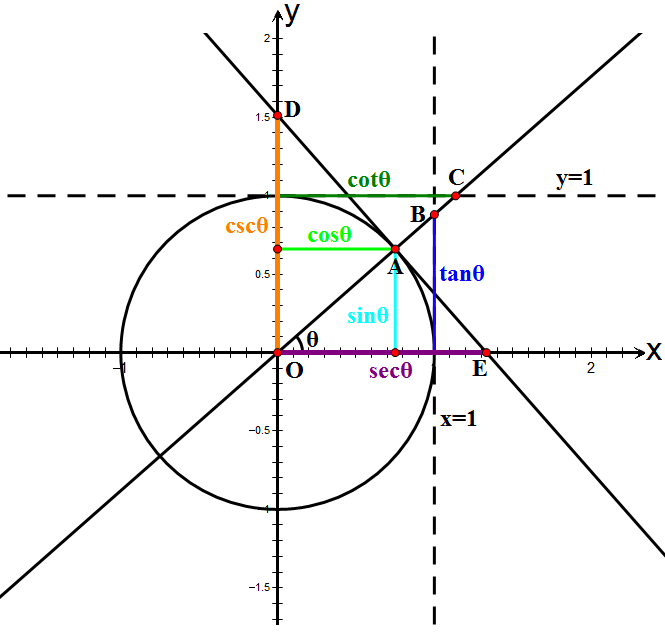
This diagram illustrates how the six trigonometric functions of an angle —, , , , , and —are defined using segments on the unit circle. It highlights that reciprocal and quotient relationships arise naturally from the geometry, supporting the strategy of rewriting functions in terms of and . The figure contains additional geometric detail not required in the AP syllabus. Source.
It visually connects each function and its reciprocal to coordinates or line segments, reinforcing the idea that they are different “views” of the same underlying geometry. Rewriting an expression is not algebraic busywork; it is a strategic step that prevents errors, highlights structure, and supports more efficient differentiation.
Fundamental Strategy: Rewrite Before Differentiating
The guiding principle is to express a trigonometric function in a form that makes its derivative straightforward. Students should look for opportunities to transform complicated products, quotients, or compositions into expressions involving elementary trig functions whose derivatives are familiar.
Common objectives include:
Converting reciprocal or quotient-based trigonometric functions into sine–cosine forms.
Using Pythagorean identities to replace squared or composite expressions.
Restructuring expressions to make the product rule, quotient rule, or chain rule cleaner to apply.
Core Trigonometric Identities Used in Differentiation
When preparing an expression for differentiation, several identities recurrently streamline the process. They allow a function to be rewritten without changing its value while significantly reducing derivative complexity.
Trigonometric Identity: An equation involving trigonometric functions that is true for all values in the domain of the functions involved.
A brief list of highly useful identities for this subsubtopic includes:
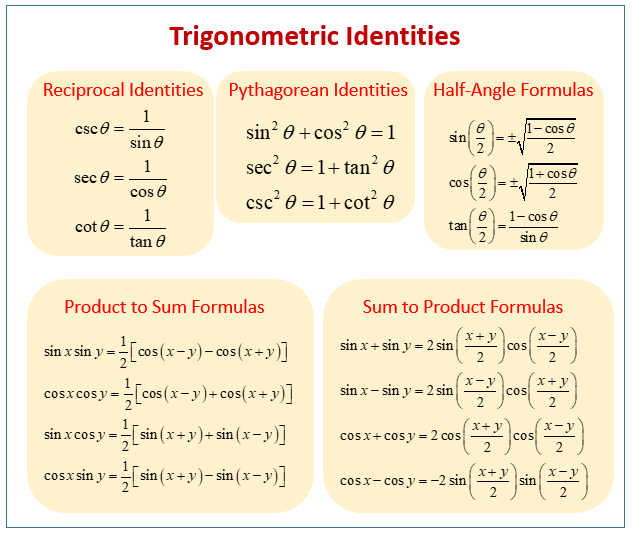
This chart summarizes key trigonometric identities, including the reciprocal and Pythagorean identities essential for rewriting , , , and in terms of and . Its structured layout highlights relationships used to prepare expressions before differentiating. The image contains extra formulas (e.g., half-angle and product-sum identities) not required for this AP subsubtopic. Source.
Reciprocal identities
Pythagorean identity
Other rearrangements
(in certain contexts)
These identities do not yet require differentiation; instead, they prepare the function so that standard rules become easier to apply.
Why Rewriting Helps When Applying Derivative Rules
Many derivative errors originate from applying rules to functions in unnecessarily complicated forms. Rewriting resolves this by clarifying functional structure.
Key advantages include:
Revealing hidden products or quotients, enabling correct use of product or quotient rules.
Transforming unfamiliar composite expressions into forms built from basic trig functions, whose derivatives are already memorized.
Minimizing algebraic manipulation after differentiation.
Product Rule and Quotient Rule Readiness
Because tangent, cotangent, secant, and cosecant frequently appear in combinations, preparing them properly avoids misidentifying functional relationships.
Product Structure: A form in which a function is represented as , signaling the need for the product rule.
A normal sentence is included here to maintain required spacing before the next definition.
Quotient Structure: A representation of a function as , indicating that the quotient rule is necessary for differentiation.
Once a function is explicitly written as a quotient, students can confidently apply derivative procedures without guessing about the underlying structure.
Using Sine–Cosine Forms to Simplify Derivatives
Rewriting every tangent, cotangent, secant, or cosecant expression in terms of sine and cosine is often the single most effective preparation technique.
Benefits of sine–cosine rewriting:
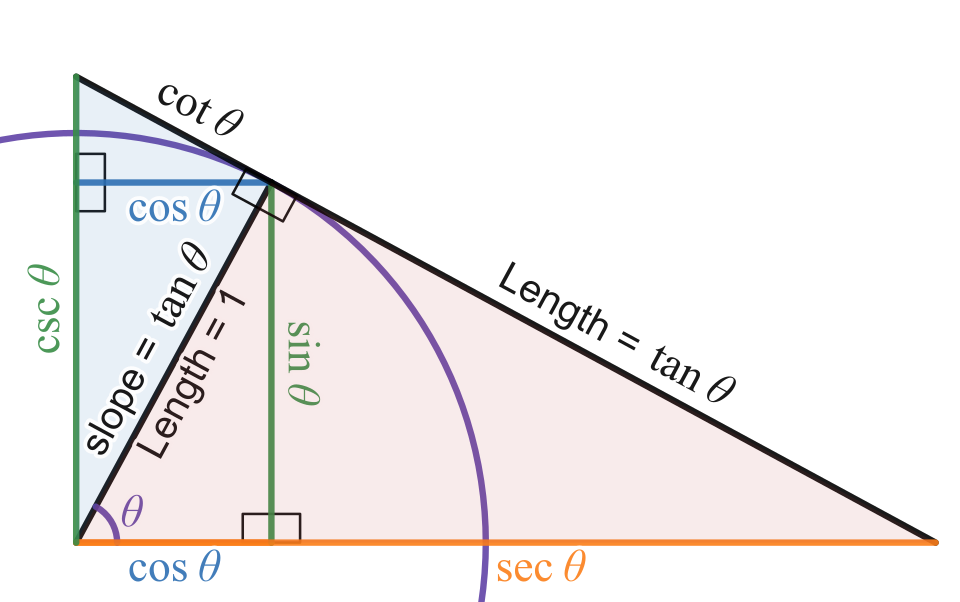
This diagram shows how each trigonometric function and its reciprocal correspond to specific geometric line segments for the same angle . Viewing reciprocal pairs together reinforces why identities like and hold. The color-coding and additional labeling provide more detail than required in the AP syllabus but clarify how identities guide algebraic rewriting. Source.
Only and are primary trig functions, and their derivatives are well known.
Algebraic simplification becomes more predictable when dealing with standard functions.
The resulting expressions integrate seamlessly with rules for products, quotients, and chains.
When to Apply Identities Before Differentiating
Students should deliberately choose to rewrite using identities when:
The original form obscures whether a product or quotient rule is required.
The function contains reciprocal trig expressions that become cleaner in sine–cosine form.
An identity converts a multi-layered composition into a simpler equivalent.
Squared or higher-order trig expressions produce more manageable derivatives when replaced using Pythagorean identities.
Process for Preparing Trig Expressions
A structured approach promotes consistency and accuracy:
Identify the trigonometric expressions that may complicate differentiation.
Select an appropriate identity based on whether the expression can be rewritten as a product, quotient, or simpler function.
Rewrite using sine, cosine, or relevant identities.
Confirm functional structure (product, quotient, or basic function).
Proceed with differentiation rules once the expression is in its clearest form.
Efficiency and Correctness Through Identity Use
Using identities before differentiating is not optional refinement; it is an essential skill that ensures alignment with AP Calculus AB expectations. These identity-based rearrangements promote mathematical clarity, highlight inherent relationships among trig functions, and enhance the precision of derivative calculations.
Practice Questions
Question 1 (1–3 marks)
Rewrite the expression f(x) = sec x tan x using only sine and cosine. Hence state which differentiation rule (product or quotient) would be most appropriate after rewriting.
Question 1
• 1 mark: Correct rewriting of sec x as 1/cos x.
• 1 mark: Correct rewriting of tan x as sin x/cos x.
• 1 mark: Recognition that the rewritten expression forms a quotient, so the quotient rule would be most appropriate.
Question 2 (4–6 marks)
A function is defined by
g(x) = cot x csc x.
(a) Rewrite g(x) entirely in terms of sine and cosine.
(b) Simplify the resulting expression so that only one quotient remains.
(c) Explain why this rearranged form is more efficient to differentiate than the original expression.
Question 2
(a)
• 1 mark: Correct rewriting of cot x as cos x/sin x.
• 1 mark: Correct rewriting of csc x as 1/sin x.
(b)
• 1 mark: Correct multiplication to obtain cos x divided by sin squared x.
• 1 mark: Final simplified single quotient form (cos x / sin²x or equivalent).
(c)
• 1–2 marks: Explanation that the quotient form clearly shows the structure of the expression, making it easier to apply the quotient rule; or that the original product of reciprocal functions obscures the underlying quotient structure.
FAQ
Differentiating directly can hide the true structure of an expression. Reciprocal functions often appear as products, but they behave more cleanly as quotients.
Rewriting exposes whether the product or quotient rule is actually required, reducing the number of steps and limiting algebraic errors that commonly occur when dealing with layered trig expressions.
Choose sine–cosine form when the expression involves reciprocal functions such as sec, csc, tan, or cot, because their definitions become immediately visible.
Choose a Pythagorean identity when squared expressions appear and a simplification can remove unnecessary terms, making subsequent differentiation more efficient.
Yes. Expanding an expression unnecessarily may produce multiple products or quotients that overcomplicate the derivative.
A good guideline is to avoid rewriting if:
• The expression is already a simple quotient or product.
• An identity creates more terms or powers than you began with.
Cotangent and cosecant tend to obscure the underlying quotient structure when left in their reciprocal forms.
Rewriting reveals how they relate directly to sine and cosine, which:
• Simplifies algebra.
• Makes the derivative rules more transparent.
• Ensures consistency with familiar differentiation patterns.
A fast diagnostic approach is:
• Check whether the expression contains reciprocal trig functions.
• Look for factors that conceal a quotient or product.
• Identify any squared trig terms that could collapse using an identity.
If any of these features appear, rewriting is likely to streamline the derivative.