AP Syllabus focus:
‘Interpret notations such as f′(x), y′, and dy/dx as representing the derivative of y = f(x) with respect to x in equations, graphs, and word problems.’
Understanding derivative notation is essential for interpreting how a quantity changes with respect to another, allowing students to connect symbolic forms with graphical behavior and contextual meaning.
Interpreting Derivative Notation
Derivative notation communicates how a function’s output changes relative to its input. Each notation reflects the instantaneous rate of change, emphasizing how sensitive the function value is to small variations in the input. In AP Calculus AB problems, students must recognize these notations across formulas, graphs, and real-world settings and understand that they all represent the same underlying concept.
The Function Notation f′(x)
When a function is written as , its derivative is denoted by , meaning the derivative of with respect to . This notation highlights the derivative as a new function with its own set of inputs and outputs.
Derivative Function: The function whose value at gives the instantaneous rate of change of the original function with respect to .
Because is itself a function, it can be evaluated, graphed, or substituted into expressions just like the original function. Students will often encounter statements such as “find ” or “determine where is positive,” each requiring interpretation grounded in rate-of-change meaning.
The Notation y′ and Its Use in Equations
In equations where the dependent variable is written explicitly as , the derivative is written as , pronounced “y prime.” This notation is compact and frequently used when is defined by an explicit formula without naming a function.
: Symbol representing the derivative of with respect to when is understood to be a differentiable function of .
Because emphasizes the variable rather than the function name, it often appears in algebraic manipulations, differential equations, and expressions describing slope. This versatility makes the notation especially useful in symbolic work where the focus is on relationships rather than functional labels.
The Leibniz Notation dy/dx
The notation highlights the derivative as a ratio of differentials, reflecting how a small change in influences the corresponding change in .
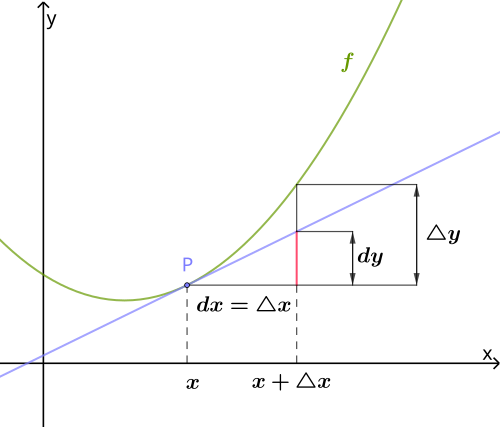
This diagram illustrates as a linear response to a small change , highlighting the idea that the derivative measures the instantaneous change in output relative to input. It reinforces the interpretation of the derivative as a local linear approximation. Some advanced visual cues appear, but they are not required for AP Calculus AB. Source.
: Symbol expressing the instantaneous rate of change of with respect to , interpreted as the limit of ratios of small changes in the variables.
This notation is especially prevalent in word problems where relationships between variables carry practical meaning, such as speed, growth, or rates of accumulation. In such contexts, the structure of reinforces the idea of “change in output per unit change in input,” echoing units like meters per second or dollars per year.
Connections Among Derivative Notations
Although , , and look different, they express the same mathematical idea. Recognizing when each is appropriate helps students move fluidly through various representations.
Use cases include:
when working with named functions or matching functions to graphs.
when manipulating equations or expressing derivatives succinctly in symbolic contexts.
when interpreting rates in real-world tasks or applying units to derivative expressions.
Understanding these distinctions allows students to interpret derivative expressions accurately, regardless of the notation chosen in the problem.
Derivative Notation in Graphs
Students often encounter derivative notation when analyzing graphical behavior. For a graph of :
corresponds to the slope of the tangent line at each point.
Positive or negative derivative values describe whether the graph is rising or falling.
The magnitude of communicates how steeply the graph changes.
Graphical tasks may ask students to estimate by observing the tangent line at or to determine intervals where the derivative is positive, zero, or negative.
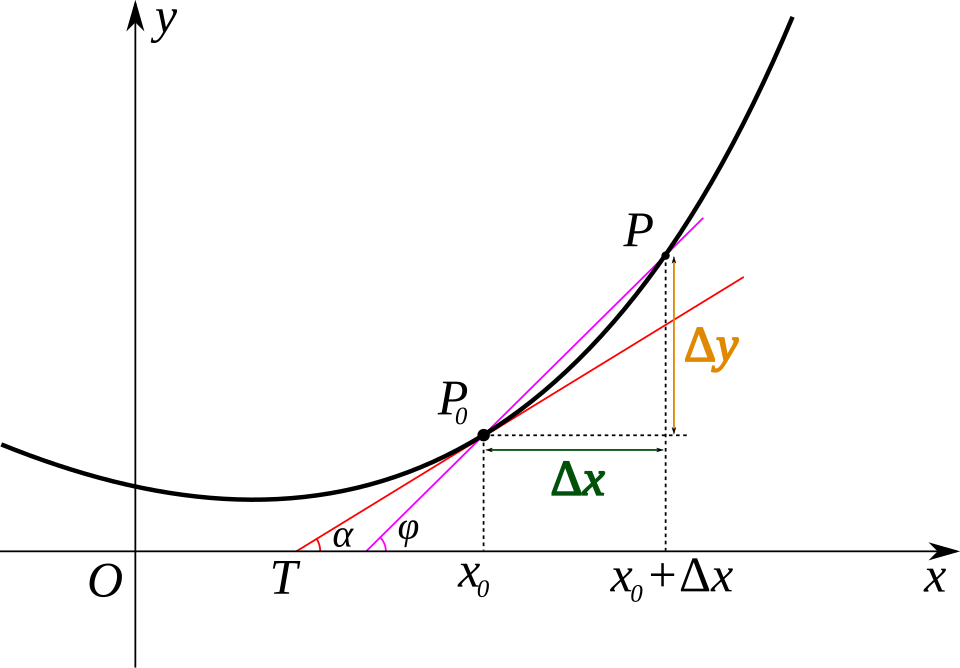
This diagram shows a function’s graph with a tangent line, illustrating the geometric meaning of the derivative as the slope of the tangent. The labeled components highlight changes in output relative to changes in input. Extra annotations support intuition but exceed what the syllabus strictly requires. Source.
Derivative Notation in Word Problems
In real-world applications, derivative notation reflects meaningful relationships between measurable quantities. Expressions such as may indicate a growth rate, speed, or rate of consumption depending on the context.
Important features include:
Units associated with reinforce its interpretation as a rate.
Statements like “” signal decreasing output at a specified input value.
Word problems may mix notations, requiring translation between symbols and verbal descriptions.
Summary of Notational Roles
To navigate AP Calculus AB problems effectively, students must identify derivative notation in multiple settings:
Symbolic: manipulating expressions involving , , or .
Graphical: associating notation with tangent-line slopes and qualitative behavior.
Applied: interpreting derivatives as instantaneous rates with meaningful units.
Mastery of these forms enables students to interpret derivatives consistently and recognize their significance regardless of the notation presented.
Practice Questions
Question 1 (1–3 marks)
A function f is represented in the graph below. At x = 2, the slope of the tangent line to the curve is estimated to be -1.5.
(a) State the value of f'(2).
(b) Explain in words what this value means in the context of the graph.
Question 1
(a) 1 mark:
• Correct value stated as f'(2) = -1.5
(b) 1–2 marks:
• 1 mark for stating that the derivative represents the instantaneous rate of change or slope of the tangent.
• 1 mark for explaining that at x = 2 the function is decreasing at a rate of 1.5 units of output per unit of input.
Total: 2–3 marks
Question 2 (4–6 marks)
A particle moves along a straight line, and its position at time t is given by y = f(t). The table below gives selected values of f(t).
t: 1 2 3
f(t): 4 7 6
(a) Using appropriate notation, estimate the instantaneous rate of change of y with respect to t at t = 2.
(b) Explain why this estimate represents dy/dt at t = 2.
(c) Interpret the meaning of your answer in the context of the particle’s motion.
Question 2
(a) 1–2 marks:
• 1 mark for using correct derivative notation, such as f'(2) or dy/dt at t = 2.
• 1 mark for estimating using symmetric difference: (f(3) − f(1)) / (3 − 1) = (6 − 4)/2 = 1
(b) 1–2 marks:
• 1 mark for explaining that this estimate uses values on both sides of t = 2.
• 1 mark for noting that the symmetric difference quotient approximates the instantaneous rate of change.
(c) 1–2 marks:
• 1 mark for interpreting the derivative as the particle’s instantaneous velocity.
• 1 mark for describing that at t = 2 the particle’s position is increasing at approximately 1 unit per unit time.
Total: 4–6 marks
FAQ
Choose the notation that best matches the representation of the function.
• Use f'(x) when the function is named explicitly as f.
• Use y' when the function is written simply as y in an equation.
• Use dy/dx when the problem emphasises relationships between variables or units.
In ambiguous cases, using dy/dx is often safest because it clearly indicates which variable depends on which.
People refer to dy/dx informally as a ratio because it behaves like one in many manipulations, especially in separable differential equations.
However, dy and dx are not actual finite quantities but symbols representing infinitesimal changes.
The limit process makes dy/dx meaningful, even though dy and dx do not exist independently.
The notations always represent the same mathematical concept but can emphasise different perspectives.
• f'(x) highlights the derivative as a function.
• y' highlights the derivative as a symbolic part of an equation.
• dy/dx highlights dependency between variables.
In modelling situations, dy/dx often carries an interpretive advantage because it makes units and variable roles explicit.
Match the notation to what the graph shows.
If the graph labels the vertical axis as y and the horizontal as x, then dy/dx expresses the slope of the curve at a point.
If the graph labels the function as f, f'(x) is more appropriate.
Regardless of notation, the derivative corresponds to the steepness of the tangent line.
In applied contexts, it is usually clearer to express the rate using variable names that describe the quantities involved.
For example, writing dv/dt immediately tells you the dependent variable (v) and the independent variable (t).
This clarity makes dy/dx especially useful when interpreting physical rates, economic change, or biological growth.