AP Syllabus focus:
‘Use the derivative at a point as the slope of the tangent line to the graph of a function and write equations of tangent lines in point-slope form.’
The tangent line captures how a function behaves locally, offering a linear approximation that reflects the function’s immediate rate of change at a specific point.
Tangent Lines and Derivatives at a Point
Understanding the Tangent Line Concept
A tangent line is a line that touches the graph of a function at exactly one point near which it reflects the graph’s local direction. The slope of this line represents how the function is changing at that instant. Because of this, the tangent line is deeply connected to the derivative, which quantifies instantaneous change.
Tangent Line: A line that locally touches a curve at a single point and has a slope equal to the function’s instantaneous rate of change at that point.
In calculus, the tangent line provides a powerful tool for local linear modeling, helping describe behavior that may otherwise be complicated to compute directly.
The Derivative as the Slope of the Tangent Line
The derivative at a point measures the instantaneous rate of change of a function. At , this derivative value, , becomes the slope of the tangent line to the graph of .
= Instantaneous rate of change of at
Since slope represents rise over run, the derivative expresses how rapidly the output changes relative to a small change in the input. This relationship is fundamental when connecting graphical behavior with symbolic computations.
“The derivative at , written , is the slope of the tangent line to the graph of at the point .”
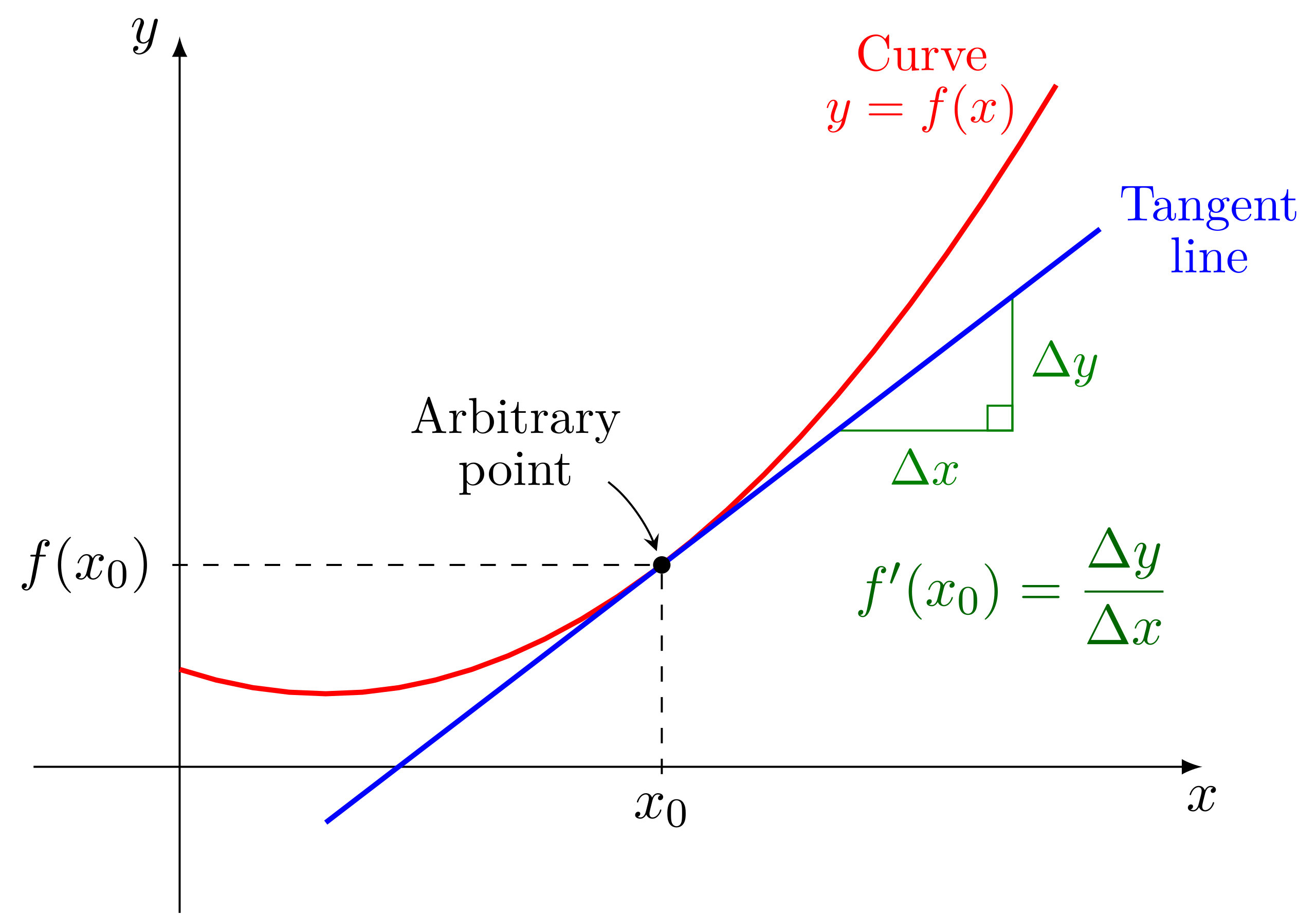
The curve is shown with its tangent line at , where the slope is illustrated using and . The geometric relationship reinforces that the derivative represents the slope of the tangent line. This image visually supports the idea that instantaneous rate of change corresponds to the tangent line’s slope. Source.
Writing the Equation of a Tangent Line
When constructing the tangent line, we use point-slope form, which relies on knowing one point on the line and its slope. For a differentiable function at , the point on the curve is and the slope is .
= Function value at
= Derivative at , slope of tangent line
Because point-slope form centers the equation around the specific point of tangency, it provides a precise representation of local linear behavior.
A tangent line equation is considered complete when all quantities are substituted, but for conceptual understanding, recognizing the structure is most important at this stage.
Why the Tangent Line Matters
The tangent line is not only a helpful geometric object but also a key analytical tool. Its importance stems from several features:
It approximates the function near the point of tangency, aiding in interpretation and prediction.
It encodes instantaneous change, which is essential in modeling motion, growth, and optimization.
It bridges graphical understanding with algebraic structure, reinforcing the connection between shape and rate.
By examining how the tangent line sits relative to the graph, students can infer whether the function is increasing or decreasing and how rapidly these changes occur.
Visual and Analytical Characteristics of Tangent Lines
To fully understand tangent lines, it is useful to connect their analytic form to their geometric appearance.
Key ideas include:
A positive derivative corresponds to an upward-sloping tangent line.
A negative derivative corresponds to a downward-sloping tangent line.
A zero derivative indicates a horizontal tangent, often found at local maxima or minima.
The steepness of the line reflects the magnitude of the derivative; the larger the absolute value of , the steeper the tangent.
These characteristics allow students to move fluidly between the algebraic computation of derivatives and visual interpretations on graphs.
Steps for Constructing and Interpreting Tangent Lines
To ensure clarity when working with tangent lines, students should follow a structured approach:
Identify the point of tangency and compute .
Determine the derivative to obtain the slope.
Substitute values into the point-slope form.
Interpret how the tangent line reflects local behavior of the original function.
This layered process keeps the emphasis on the connection between derivative values and geometric meaning.
Relationship Between Local Linearization and Tangent Lines
Because the tangent line models a function near a single point, it plays a central role in local linearization, a technique used to approximate function values close to . Even though full applications extend beyond this subsubtopic, recognizing that the tangent line acts as the function’s best linear approximation underscores its conceptual value.
“Near , the tangent line provides a local linear approximation to , so its values stay close to the actual function values for inputs near .”
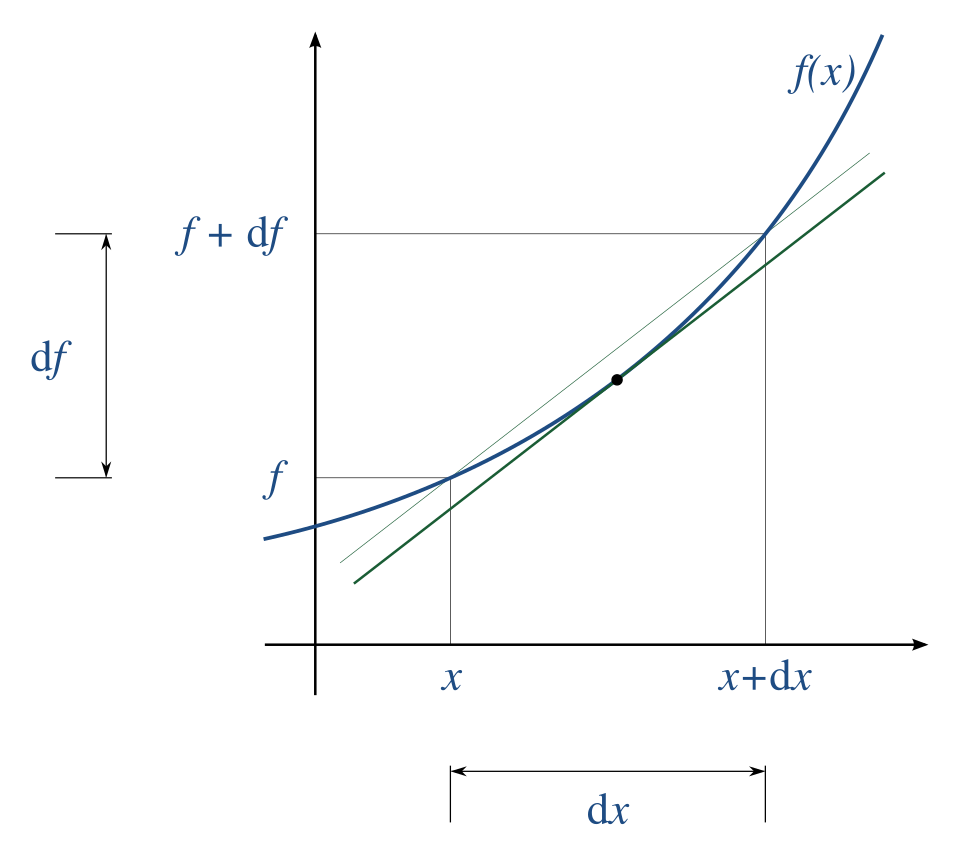
The curve is shown with its tangent line and nearby points at and , illustrating changes and . The slope matches the tangent line’s slope, emphasizing the derivative as a measure of instantaneous change. Labels such as and exceed AP requirements but visually reinforce the idea of local linear approximation. Source.
Situations Where Tangent Lines Provide Insight
Students encounter tangent lines in several contexts within calculus:
Interpreting instantaneous velocity in motion problems.
Assessing sensitivity or marginal change in economic models.
Understanding the shape of a graph in relation to its increasing or decreasing behavior.
Predicting the direction of a function’s change at specific input values.
By tying together these ideas, tangent lines become one of the most versatile and foundational tools in the study of differentiation.
Practice Questions
The graph of a differentiable function f passes through the point (2, 5). The derivative at this point is f ’(2) = −3.
Write the equation of the tangent line to the graph of f at x = 2.
(1–3 marks)
Question 1 (1–3 marks)
• 1 mark: Correct use of point-slope structure (e.g., y − 5 = −3(x − 2)).
• 1 mark: Correct substitution of derivative value as slope.
• 1 mark: Final correct linear equation in any equivalent form (e.g., y = −3x + 11).
A function g is differentiable for all real numbers. The table below gives selected values of g and its derivative.
x: 1 2 3 4
g(x): 4 7 6 10
g ’(x): 2 −1 4 3
(a) Find the equation of the tangent line to g at x = 3.
(b) Use your tangent line from part (a) to estimate g(3.2).
(c) The actual value of g(3.2) is 6.9. Comment on whether your estimate is an overestimate or an underestimate, justifying your answer using the sign of g ’(x) or information about the behaviour of g near x = 3.
(4–6 marks)
Question 2 (4–6 marks)
(a)
• 1 mark: Recognition that slope at x = 3 is g ’(3) = 4.
• 1 mark: Correct use of point (3, 6) in point-slope form.
• 1 mark: Final correct tangent line equation, such as y − 6 = 4(x − 3) or y = 4x − 6.
(b)
• 1 mark: Substitution of x = 3.2 into the tangent line.
• 1 mark: Correct estimated value, 6.8.
(c)
• 1 mark: Statement identifying whether the estimate is an overestimate or underestimate (underestimate).
• 1 mark: Valid justification, such as: g ’(x) increases from −1 at x = 2 to 4 at x = 3 and 3 at x = 4, suggesting the function is rising more steeply past x = 3 than the tangent line predicts, making the tangent-line estimate too small.
FAQ
If the graph is concave up near the point, the tangent line lies below the curve, giving an underestimate.
If the graph is concave down, the tangent line lies above the curve, giving an overestimate.
You can also observe how quickly the function bends away from the tangent; sharper curvature increases the inaccuracy of the linear approximation.
Point-slope form anchors the equation to a specific point and a known slope, which aligns perfectly with the information a derivative provides.
It avoids unnecessary algebraic rearrangement and makes it easier to substitute numerical values for differentiation and approximation tasks.
A tangent line cannot be defined because the slope does not exist at that point, even though the graph may be unbroken.
This typically occurs at corners, cusps, or points with a vertical tangent, where the function changes direction too abruptly for a single supporting line to be drawn.
The accuracy depends on the function’s curvature around the point.
A tangent line is most reliable very close to the point of tangency.
As distance increases:
Small curvature: the approximation remains useful over a wider interval.
Large curvature: accuracy deteriorates quickly because the function bends away more rapidly from the line.
Among all possible lines through the point, the tangent line minimises the error between the function and the linear approximation in an infinitesimally small neighbourhood.
Its slope precisely matches the function’s instantaneous rate of change, ensuring that function and line share the closest possible local behaviour.