

AP Syllabus focus:
‘Use the 10% rule to estimate that only about 10% of energy is transferred from one trophic level to the next.’
Energy moves through ecosystems in a one-way flow, and most is lost at each feeding step.
An energy pyramid showing primary producers through apex predators, with approximate percentages (about 10% passed upward per level) and explicit arrows for heat loss and energy routed to decomposers. This diagram helps students connect the 10% rule to the major loss pathways (metabolic heat and detrital pathways) that prevent most energy from becoming new consumer biomass. Source
The 10% rule is a practical shortcut for estimating how much energy reaches higher trophic levels.
What the 10% Rule Means
Energy transfer between trophic levels
10% rule: A rule of thumb stating that, on average, only about 10% of energy in one trophic level becomes biomass energy available to the next trophic level.
This “about 10%” figure represents typical trophic transfer efficiency across many ecosystems, not a fixed constant.
Energy stored vs energy used
Trophic transfer efficiency (ecological efficiency): The percentage of energy at one trophic level that is converted into new biomass at the next trophic level.
The key idea is that consumers can only pass on energy that becomes their new biomass (growth and reproduction), because that biomass is what the next level can potentially eat.
Estimating Energy Available to Higher Levels
The 10% rule is commonly used to approximate energy flow upward through a food chain without measuring every loss pathway.
= Estimated energy available to the next trophic level (energy per unit area per unit time)
= Energy available at the current trophic level (energy per unit area per unit time)
Because it is an estimate, scientists and students use it to compare scenarios and interpret ecosystem patterns rather than to produce exact values.
Why So Much Energy Is Not Transferred
Energy losses between trophic levels occur because organisms must use energy to stay alive, and because not all biomass is consumed or converted into new tissue. Major reasons include:
Not all biomass is eaten
Predators may not capture all prey.
Herbivores may avoid tough, toxic, or inaccessible plant parts (e.g., bark, roots).
Not all eaten biomass is digested
Some food is indigestible and leaves the body as feces (e.g., cellulose, bones, chitin).
Energy is used for metabolism rather than growth
Cellular processes (movement, maintenance, immune function) require energy that ultimately dissipates as heat.
Energy leaves as waste products
Urine and other nitrogenous wastes represent chemical energy and matter not converted into consumer biomass.
These losses help explain why only a small fraction of energy becomes net biomass production that can support the next trophic level.
What the 10% Rule Predicts About Ecosystems
Energy pyramids and trophic structure
Because energy availability declines rapidly from one level to the next, ecosystems tend to form energy pyramids where:
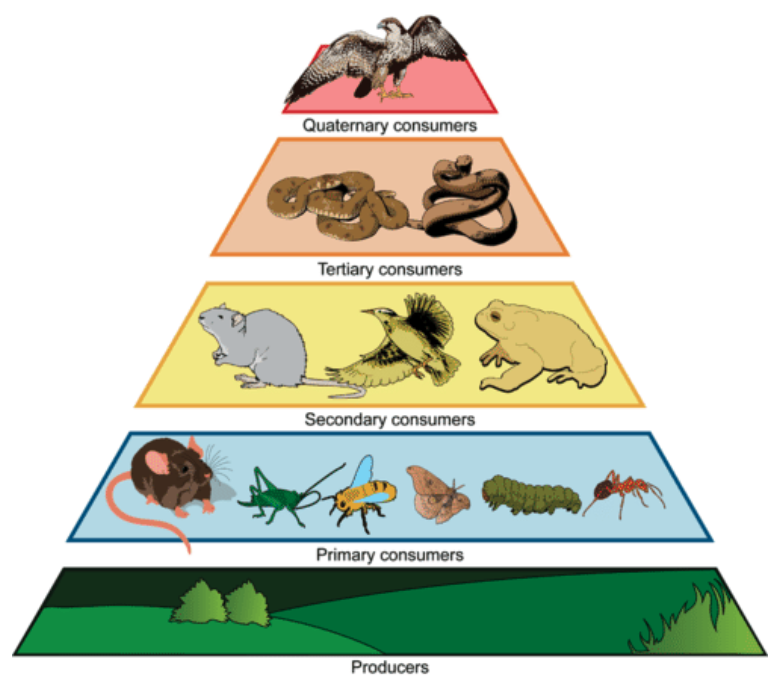
A trophic pyramid that labels producers at the base and progressively higher consumer levels toward the top, illustrating the trophic structure of a food chain. This visual supports the idea that higher trophic levels are constrained by reduced energy availability, helping explain why upper-level consumers are typically less abundant. Source
Producers support the greatest total energy base.
Primary consumers have substantially less available energy than producers.
Secondary and tertiary consumers have progressively less, so populations are typically smaller and less abundant.
Limits on food chain length
The 10% rule implies that long food chains are difficult to sustain because:
Energy becomes too scarce to maintain large-bodied or numerous organisms at very high trophic levels.
Top predators are often rare and vulnerable to disturbances that reduce energy at lower levels.
Variation around “10%”
The 10% rule is a convenient average; actual efficiencies vary with conditions such as:
Food quality
Energy transfer tends to be lower when producers contain lots of indigestible structural material.
Consumer physiology
More energy is retained as biomass when organisms spend less on metabolic heat and maintenance.
Ecosystem type
Systems dominated by easily digested producers can have higher transfer efficiencies than those dominated by low-quality plant material.
Even when the true efficiency differs, the central AP Environmental Science skill is using the 10% rule to estimate the steep decline in energy from one trophic level to the next.
Practice Questions
State what the 10% rule indicates about energy transfer between trophic levels, and give one implication for the size of populations at higher trophic levels. (2 marks)
1 mark: States that only about 10% of energy at one trophic level is transferred to the next (as biomass/available energy).
1 mark: Correct implication, e.g. higher trophic levels support smaller populations/less biomass/fewer individuals due to reduced available energy.
Explain three distinct reasons why energy transfer efficiency between trophic levels is low, and describe how the 10% rule can be used to estimate energy available to a higher trophic level. (6 marks)
Up to 3 marks (1 each): Three valid, distinct reasons, e.g.:
Not all biomass is consumed (prey escape/inedible parts).
Not all consumed biomass is digested (faecal losses/indigestible material).
Energy used in respiration/metabolism is lost as heat.
Energy lost in excretory wastes (e.g. urine).
1 mark: States that the 10% rule is a rule of thumb/approximation for estimating transfer.
2 marks: Describes correct method: multiply energy at the current trophic level by (or repeatedly by per step) to estimate energy available at the higher trophic level.
FAQ
No. It is a broad average that can vary widely.
Transfer efficiency depends on producer digestibility, consumer metabolism, and community structure. Some systems may be closer to $5%$, others may exceed $15%$ under favourable conditions.
Aquatic primary producers (e.g. algae) are often more edible and less woody than terrestrial plants.
This can increase the fraction that is consumed and assimilated, raising trophic transfer efficiency compared with ecosystems dominated by high-cellulose plant tissues.
They estimate energy or biomass production at successive trophic levels over time.
Common approaches include measuring growth/reproduction rates, calorimetry to convert biomass to energy content, and using stable isotopes to assign trophic positions before comparing production between levels.
Endotherms (e.g. birds, mammals) spend substantial energy maintaining body temperature, reducing the proportion converted to biomass.
Ectotherms (e.g. many fish, reptiles) often convert a larger fraction of assimilated energy into growth under similar conditions, potentially increasing transfer efficiency.
It can mislead when a trophic level relies heavily on detritus, when diets span multiple trophic levels, or when assimilation varies strongly (e.g. seasonal food quality shifts).
In such cases, a single fixed percentage oversimplifies real energy pathways and efficiencies across the community.
