

AP Syllabus focus:
‘Describe how energy flows from the sun to producers at the lowest trophic level and then upward to higher trophic levels in terrestrial and near-surface marine communities.’
Energy flow explains how ecosystems are powered and why biomass is not evenly distributed among organisms. This page traces energy from sunlight into producers and through successive consumers in land and surface-ocean communities.
Core idea: energy enters, then moves upward
Energy enters ecosystems primarily as sunlight, is captured by producers, and then moves upward as organisms eat other organisms. Unlike matter, energy is not recycled; it is continually transformed as it passes between organisms.
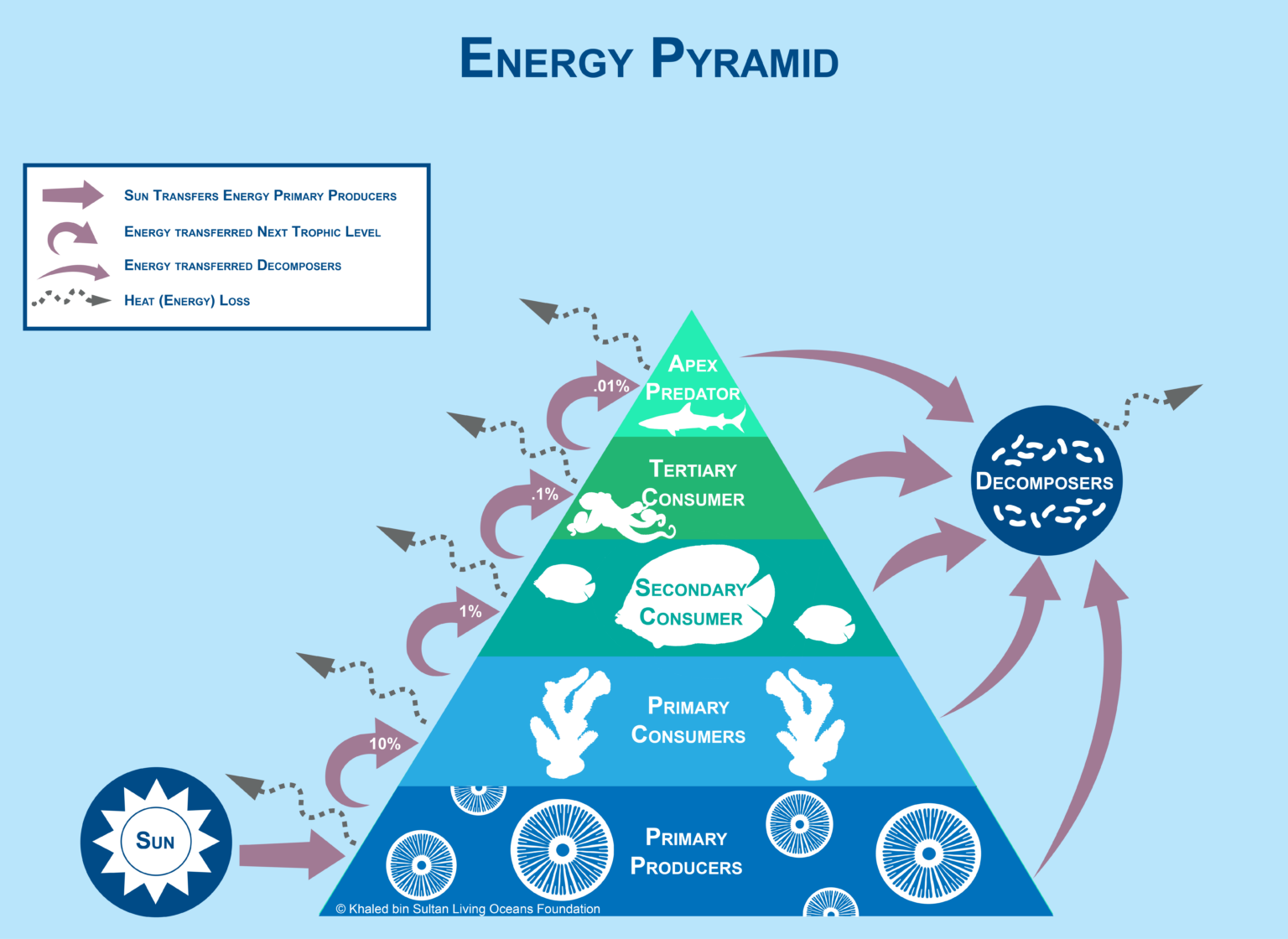
This energy pyramid summarizes directional energy flow from the sun into primary producers and then upward through consumer trophic levels. It also highlights why energy decreases with each transfer: substantial energy is lost as metabolic heat and some energy is routed to decomposers via wastes and dead biomass. The labeled percentages reinforce the common approximation that only a small fraction of energy becomes biomass available to the next level. Source
Trophic levels as “steps” of energy movement
Trophic level: A feeding position in an ecosystem that indicates how an organism obtains energy (for example, producer, primary consumer, secondary consumer).
Trophic levels describe directional energy flow (bottom to top) rather than physical height or size.
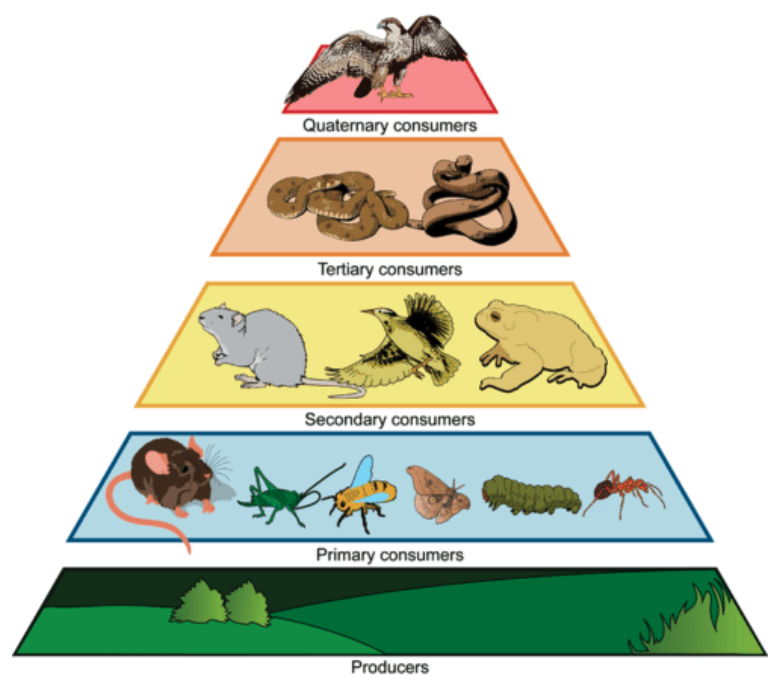
This trophic pyramid illustrates how organisms are grouped into feeding levels, from producers at the base to higher-level consumers at the top. The stacked layers make the “stepwise” nature of trophic levels visually concrete, which helps when mapping food-chain examples onto an ecosystem model. It also reinforces the directional idea that energy moves upward through feeding relationships. Source
Producers: the gateway for solar energy
Producer (autotroph): An organism that captures energy (usually sunlight) to build organic matter from inorganic materials, forming the base of trophic levels.
In both terrestrial and near-surface marine communities, producers are the first biological step after the sun:
Terrestrial producers: grasses, shrubs, trees, and other plants
Near-surface marine producers: phytoplankton, algae, and photosynthetic microbes in the sunlit (photic) zone
Producers convert a portion of incoming solar energy into chemical energy stored in sugars and other organic compounds. That stored energy becomes available to other trophic levels through feeding.
Movement to higher trophic levels: consumers and feeding pathways
Energy moves upward when organisms consume biomass (living or recently living organic matter). Common consumer trophic levels include:
Primary consumers (herbivores): eat producers (e.g., deer grazing; zooplankton eating phytoplankton)
Secondary consumers: eat primary consumers (e.g., snakes eating rodents; small fish eating zooplankton)
Tertiary consumers and higher: eat other predators (e.g., hawks; tuna)
How energy actually transfers between trophic levels
Energy transfer occurs through feeding and assimilation:
A consumer ingests producer/consumer biomass.
Some ingested energy becomes new consumer biomass (growth and reproduction), which can be eaten by the next trophic level.
A substantial portion is used for metabolism and movement, and leaves the organism as heat or as chemical energy in wastes and uneaten parts.
As a result, less energy is available at each higher trophic level, helping explain why ecosystems typically support many producers, fewer herbivores, and even fewer top predators.
Terrestrial vs near-surface marine energy flow
Energy flow follows the same trophic-level logic in both settings, but producer communities differ.
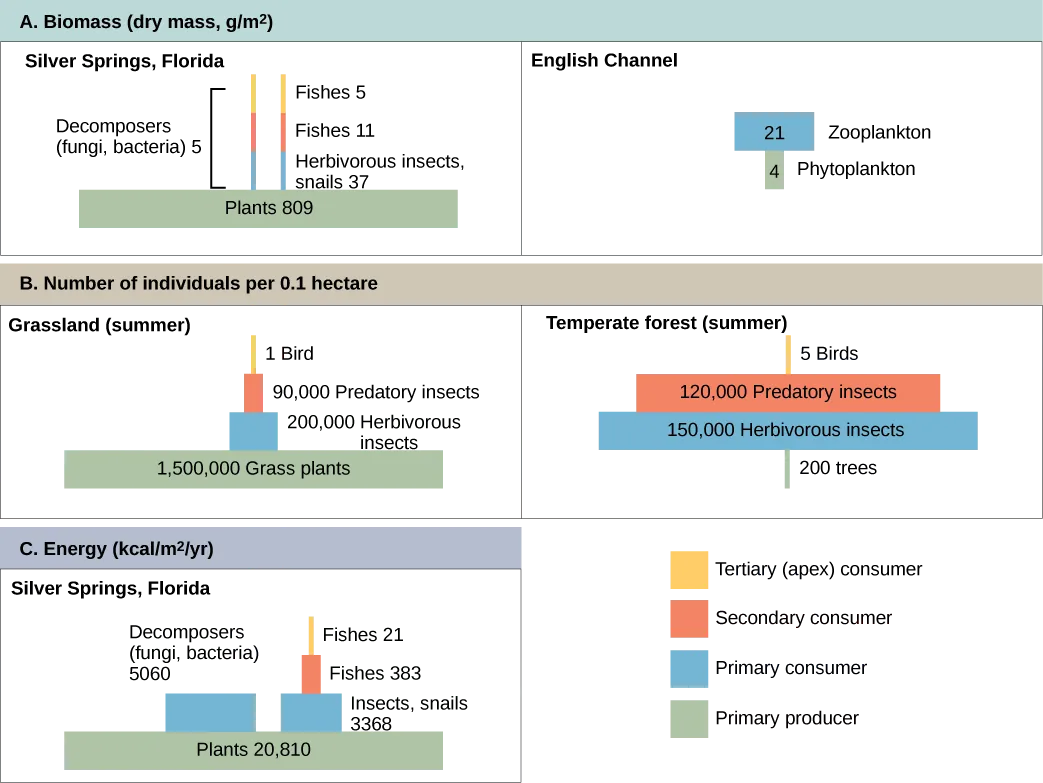
This figure compares ecological pyramids for biomass, number of individuals, and energy across different ecosystems. It explicitly shows that aquatic biomass pyramids can be inverted (e.g., lower standing biomass of phytoplankton than zooplankton) because producers can have rapid turnover despite low momentary biomass. The energy pyramid panel remains upright, emphasizing that usable energy declines at higher trophic levels even when biomass patterns differ. Source
Terrestrial communities
Producers are often large and long-lived (trees, perennial plants).
A major share of producer biomass can be structural (wood, cellulose), which is harder for herbivores to digest.
Energy may move upward through grazing, but a lot of plant material is not eaten immediately.
Near-surface marine communities
Producers are often small, fast-growing phytoplankton.
Because phytoplankton are easily consumed and reproduce quickly, energy can move efficiently from phytoplankton → zooplankton → fish in the sunlit surface waters where photosynthesis occurs.
The “near-surface” emphasis matters because sunlight declines with depth, limiting producer energy capture below the photic zone.
Ecological implications tied directly to energy flow
Food availability and predator abundance depend on how much producer energy is captured at the base and how much becomes biomass at each step.
Top predators are naturally limited by the reduced energy available at higher trophic levels.
Ecosystem productivity patterns (lush forests vs sparse deserts; plankton blooms vs low-productivity waters) set the overall energy budget that can move upward through trophic levels.
Practice Questions
State the direction of energy flow through trophic levels in an ecosystem, starting with the original energy source. (2 marks)
Energy enters from the sun / sunlight (1)
Energy flows to producers then to higher trophic levels (consumers) (1)
Describe how energy flows from the sun to producers and then upward through trophic levels in a near-surface marine community. Include at least one reason why less energy is available at higher trophic levels. (5 marks)
Sunlight is the initial energy source (1)
Producers (e.g., phytoplankton/algae) capture solar energy and store it as chemical energy in biomass (1)
Primary consumers (e.g., zooplankton) obtain energy by feeding on producers (1)
Higher consumers (e.g., fish/predators) obtain energy by feeding on lower-level consumers (1)
Less energy is available at higher trophic levels because energy is used in metabolism/movement and lost as heat and/or remains in waste/uneaten parts (1)
FAQ
Photosynthesis requires light, which decreases rapidly with depth. Most producer-driven energy entry happens in the photic zone, so trophic-level energy flow is strongest near the surface.
Blooms can shift energy into producer biomass that is poorly transferred upward due to toxins or low palatability, diverting energy into microbial processing and reducing support for higher consumers.
Dissolved organic matter can be taken up by bacteria, then passed to small protists and zooplankton. This adds extra steps, often reducing the rate at which energy reaches larger consumers.
Yes. Endotherms expend more energy maintaining body temperature, often leaving less energy for growth. Ectotherms typically allocate less to heat production, potentially leaving more for biomass.
Seasonal light and temperature alter producer growth. Energy entry rises during growing seasons, supporting more herbivory and reproduction, then drops in winter or dry seasons, tightening energy constraints upward.
