

AP Syllabus focus:
‘Describe how positive and negative feedback loops can operate within food webs and influence ecosystem stability.’
Food webs are dynamic networks where population changes ripple through feeding relationships. Feedback loops describe how these ripples either counteract change (stabilising) or reinforce it (destabilising), shaping overall ecosystem stability.
Core concept: feedback within a food web
Feedback loop: A chain of cause-and-effect interactions in which a change in one population indirectly influences itself through food-web pathways.
Feedback loops arise because each species both affects and is affected by others through consumption, resource limitation, and indirect interactions. In AP Environmental Science, the key distinction is whether the loop dampens or amplifies an initial change.
Two main types
Negative feedback: pushes the system back toward prior conditions.
Positive feedback: pushes the system further away from prior conditions.
Negative feedback loops (stabilising)
Negative feedback loop: A set of interactions in which an initial change triggers effects that reduce that change, promoting regulation and stability.
Negative feedback is common in predator–prey and consumer–resource links because limits (like food supply) and biological responses (like predation) tend to constrain growth.
Typical stabilising pathway (predator–prey regulation)
Prey increases
More prey supports predator increase (more food, higher survival/reproduction)
More predators raise predation pressure
Prey decreases toward earlier levels
Reduced prey then limits predator growth, preventing predator overexpansion
Other ways negative feedback appears in food webs
Resource depletion: if a consumer population rises, it can reduce its own food base, lowering future growth.
Behavioural responses: prey may increase vigilance or shift habitat use as predators rise, reducing predation success and damping swings.
Density-dependent disease/parasites: higher host density can increase transmission, lowering host abundance and indirectly limiting predator growth.
Negative feedback tends to produce bounded fluctuations (populations may cycle but remain within a range), supporting persistence of multiple interacting species.
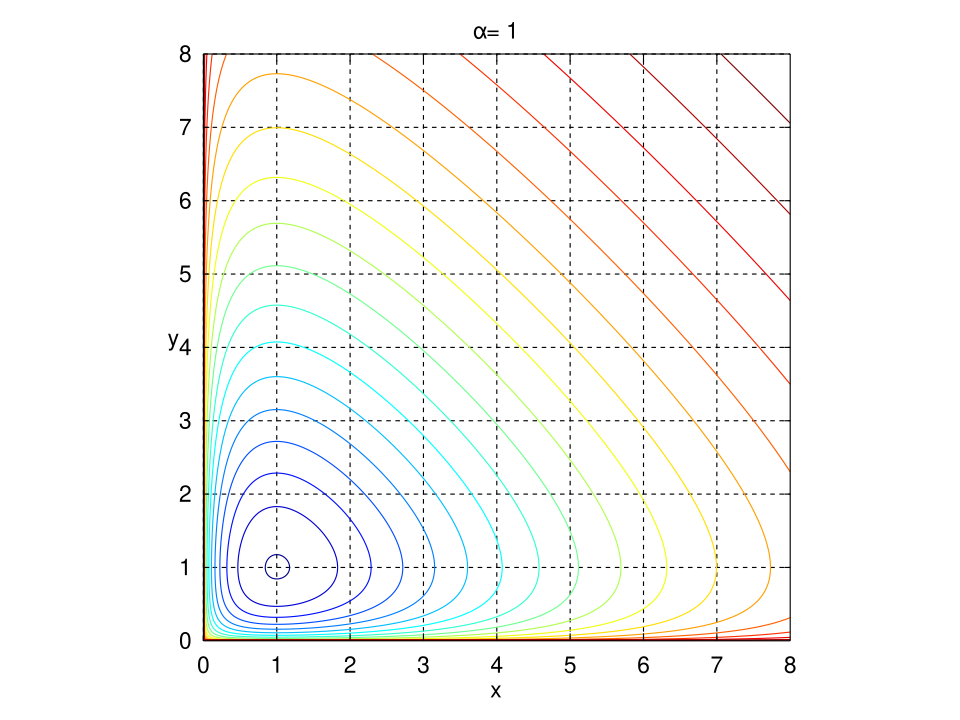
Phase-plane trajectories from a Lotka–Volterra predator–prey model (prey on the x-axis, predators on the y-axis). The closed loops illustrate bounded oscillations: as prey rise, predators later increase, which then suppresses prey, followed by a predator decline—an overall stabilizing negative-feedback pattern that prevents runaway growth or collapse. Source
Positive feedback loops (amplifying)
Positive feedback loop: A set of interactions in which an initial change triggers effects that increase that change, promoting amplification and potential instability.
Positive feedback is more likely when interactions create “runaway” reinforcement (often involving habitat change, strong indirect effects, or sharp thresholds).
Examples of amplifying pathways within food webs
Consumer release and overconsumption
Consumer increases → food resource declines → competitors weaken → consumer faces even less competition → consumer increases further.
Vegetation loss reducing habitat/refuge
Plant decline → less cover for prey or juveniles → higher mortality → fewer grazers/foragers that support plant recovery (or more pressure on remaining plants) → further plant decline.
Algal dominance in aquatic food webs (conceptual)
Increased algae can reduce light to other producers and alter oxygen conditions, shifting the community toward organisms that further favor algae, reinforcing the new state.
Positive feedback can rapidly reduce biodiversity, simplify the web, and make recovery difficult—especially if the system crosses a threshold into an alternative structure.
How feedback loops influence ecosystem stability
Ecosystem stability in this context is mainly about how a food web responds to disturbance.
Stability-related outcomes to know
Resistance: negative feedback can limit the size of change after a disturbance.
Resilience: negative feedback can speed return toward typical population ranges.
Instability and regime shifts: positive feedback can magnify disturbances, making large, persistent changes more likely.
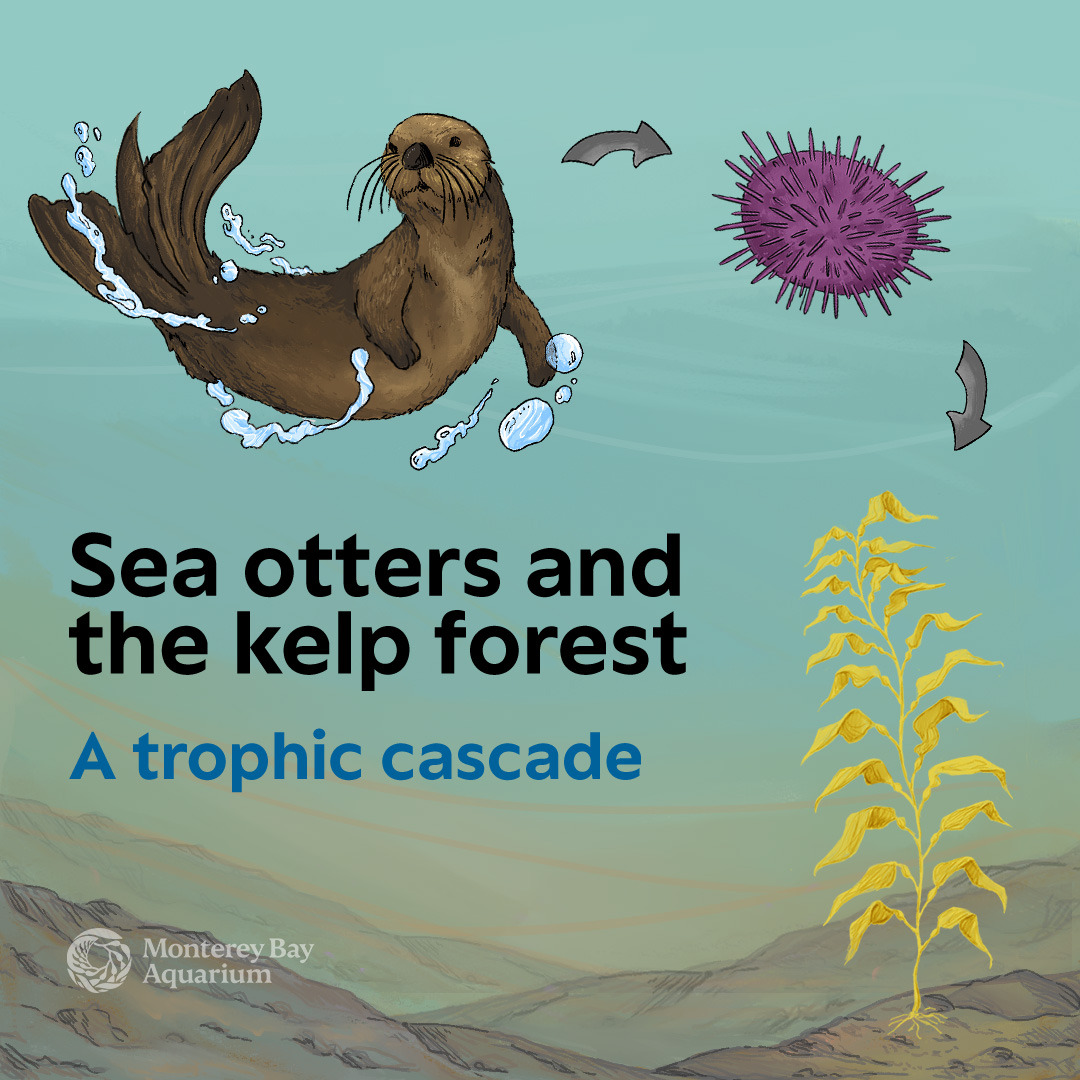
Diagram of a kelp-forest trophic cascade highlighting strong top-down control: sea otters suppress sea urchins, which reduces grazing pressure on kelp and helps maintain kelp-dominated community structure. This is a canonical example of indirect food-web effects, where changing one predator population can propagate through multiple trophic levels and shift the system between alternative states (kelp forest vs. urchin-dominated barrens). Source
Why real food webs can contain both
Multiple pathways operate simultaneously (predation, competition, detrital pathways).
Interaction strength matters: strong, focused feeding links can produce larger feedback effects than weak, diffuse links.
Time lags can weaken stabilisation: if predators respond slowly to prey increases, prey may overshoot before regulation occurs.
What to look for in a food-web diagram or description
Closed loops (A affects B, B affects C, C affects A).
Links that change survival, reproduction, or resource availability.
Whether the net effect of returning to the starting species is opposite (negative feedback) or same-direction (positive feedback) relative to the initial change.
Practice Questions
State what is meant by (i) a negative feedback loop and (ii) a positive feedback loop in the context of a food web. (3 marks)
(i) Negative feedback: a change causes responses that counteract/reduce the original change (1).
Context: through species interactions in a food web (e.g., predation/resource limitation) (1).
(ii) Positive feedback: a change causes responses that amplify/increase the original change (1).
A prey population increases in a grassland food web. Explain how a negative feedback loop could stabilise the prey population, and explain one way a positive feedback loop could instead make the change larger. (6 marks)
Prey increase provides more food/energy to predators (1).
Predator survival and/or reproduction increases, so predator population rises (1).
Increased predators raise predation rate on prey (1).
Prey population declines towards previous levels/within bounds (1).
Positive feedback example described as an amplifying chain within the food web (1).
Clear explanation that the effects reinforce the initial prey increase (or reinforce a related change) leading to greater instability (1).
FAQ
Time lags (e.g., slow predator reproduction) can cause overshoot.
A prey rise may persist long enough for resources to be depleted or habitat altered, weakening the damping effect and making oscillations larger.
Yes. Feeding across trophic levels can “spread” interaction strength.
If one prey drops, an omnivore may switch foods, reducing extreme booms/busts.
This can dampen strong negative feedback cycles or interrupt amplifying pathways.
Hysteresis means the path of decline and recovery differ.
After a shift reinforced by positive feedback, simply reversing the original disturbance may not restore the original web; stronger changes may be needed to flip it back.
They look for linked, directional responses over time.
Common evidence includes correlated population changes with expected delays, interaction experiments (exclosures/enclosures), and statistical models that test whether changes in one group predict later changes in another.
Subsidies (e.g., food waste, nutrient runoff) can rewire interaction strengths.
They may boost certain consumers or producers, changing who controls whom and potentially creating new positive feedbacks that lock in simplified, human-dominated food-web states.

