

AP Syllabus focus:
‘Define a food web as an interlocking network of food chains that models energy and nutrient flow across two or more linked chains.’
Food chains and food webs are simplified models ecologists use to describe feeding relationships. Understanding how to read these diagrams helps explain how energy and nutrients move through ecosystems and why real communities are interconnected.
Core ideas: chains vs webs
Food chains (linear pathways)
Food chain: A linear sequence of organisms in which each is eaten by the next, showing a single pathway of energy and nutrient transfer.
A food chain emphasizes a straightforward “who eats whom” pathway, typically starting with a producer and moving through one or more consumers. Because it shows only one pathway, a chain is useful for clarity but often oversimplifies real feeding relationships.
Key features of a food chain:
Single route for energy and nutrient flow
Often shown as: producer → primary consumer → secondary consumer → tertiary consumer
Most realistic for highly simplified systems or when focusing on one dominant interaction
Food webs (interlocking pathways)
Food web: An interlocking network of food chains that models energy and nutrient flow across two or more linked chains.
A food web connects multiple food chains to show that most organisms have more than one food source and more than one predator.
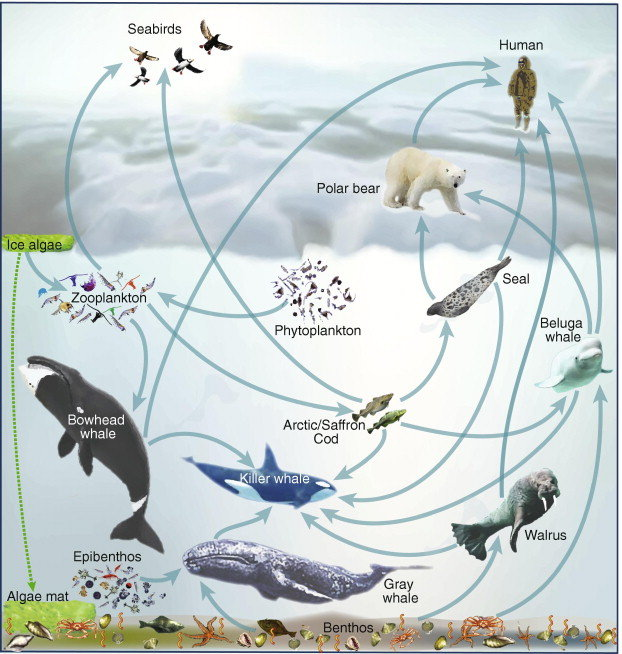
A simplified Arctic marine food web linking primary producers (ice algae, phytoplankton) to consumers across multiple trophic levels (zooplankton, fish, seals, whales, polar bears, and humans). The many arrows illustrate how real communities contain multiple overlapping feeding pathways rather than a single linear chain, and they visually reinforce the convention that energy flows from the organism being eaten to the organism doing the eating. Source
This directly matches the syllabus focus: food webs model energy and nutrient flow across two or more linked chains, making them better representations of natural communities.
Reading diagrams: what the arrows mean
In AP Environmental Science, arrows in both chains and webs generally point from food (energy source) to consumer:
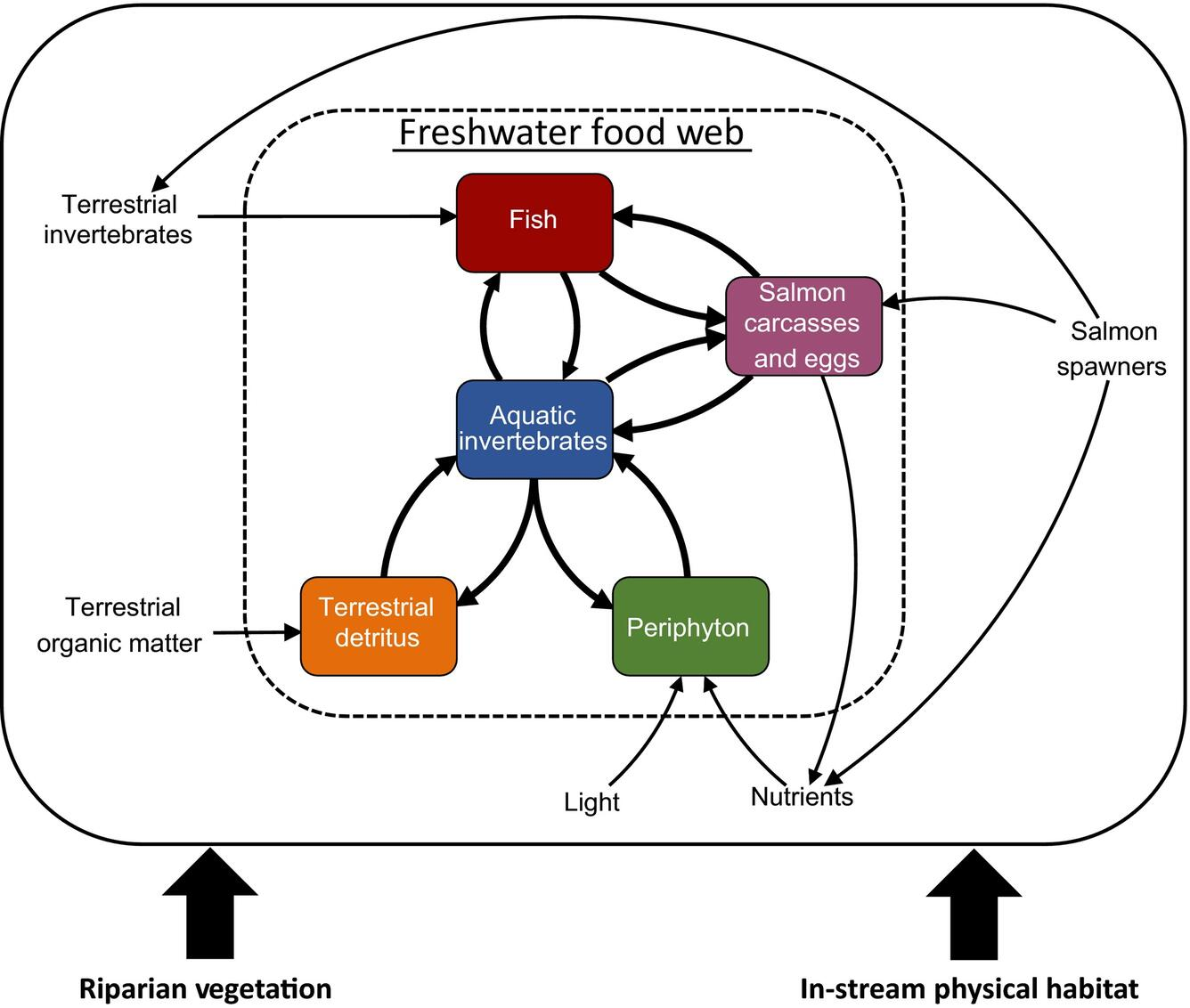
A freshwater food-web conceptual model that includes producers (periphyton), consumers (aquatic invertebrates, fish), and detrital inputs (terrestrial detritus, salmon carcasses and eggs). The arrows depict resource-to-consumer transfers while also showing key external drivers (light and nutrients) and cross-boundary subsidies that can connect ecosystem compartments. Source
Arrow direction: prey/food → predator/consumer
The arrow represents transfer of:
Energy (chemical energy in biomass)
Matter/nutrients (atoms in organic molecules)
Common reading checkpoints:
Identify producers at the base (autotrophs like plants, algae)
Trace multiple arrows into omnivores or generalist predators in webs
Recognize that one species can occupy multiple feeding roles depending on what it eats
Why food webs are more realistic than food chains
Food webs better capture community complexity because:
Many consumers are omnivores (feeding at more than one position in a chain)
Predators often switch prey based on availability
Multiple species may share the same food resources, linking chains together
Populations are embedded in a network, so changes in one link can affect others through alternative pathways
Modelling energy and nutrient flow (what the models can and cannot do)
Food chains and webs are conceptual models, not complete ecosystem budgets. They help you:
Visualise pathways of energy and matter transfer
Compare how connected different communities are
Identify species that act as important connectors (many links)
Limits to remember:
They rarely show amounts transferred (no quantities implied unless stated)
They may omit life stages, seasonal diets, or rare feeding interactions
Most simplified webs under-represent decomposer pathways unless explicitly included
Building a web from chains (the key syllabus skill)
To move from chains to a web, you combine overlapping chains by linking shared organisms:
Start with two or more plausible chains in the same habitat
Merge them where they share:
the same producer (e.g., grass eaten by several herbivores), or
the same consumer/predator (e.g., a predator eating multiple prey)
The result is a single network that shows energy and nutrient flow across linked chains
Practice Questions
Define a food web and state one way it differs from a food chain. (2 marks)
1 mark: Defines food web as an interlocking network of food chains modelling energy and nutrient flow across two or more linked chains.
1 mark: Difference stated (e.g., web has multiple feeding pathways/links; chain is linear single pathway).
Explain how a food web models the movement of energy and nutrients through a community, referring to linked food chains and arrow direction. (6 marks)
1 mark: States that a food web links two or more food chains into a network.
1 mark: Describes arrows as showing transfer from food/prey/resource to consumer/predator.
1 mark: Identifies producers as the starting point for most energy entering the web.
1 mark: Explains that multiple arrows indicate organisms have multiple food sources and/or predators.
1 mark: Links the model to energy flow through feeding interactions (chemical energy in biomass).
1 mark: Links the model to nutrient/matter flow via consumption (atoms transferred in organic matter).
FAQ
They combine multiple evidence sources, such as gut content analysis and field observation.
More recent approaches include:
DNA metabarcoding of stomach contents
Stable isotope signatures (e.g., $^{15}!N$ patterns)
Connectance describes how many feeding links exist relative to how many are possible in a web.
Higher connectance generally indicates more alternative pathways for feeding relationships.
Food webs depend on study goals and sampling intensity.
Differences often arise from:
seasonal diets
omission of rare interactions
grouping species into broader categories
Some webs include a detritus node (dead organic matter) linked to detritivores and microbes.
This highlights nutrient transfer through decay-related feeding, even when decomposers are not drawn as full species lists.
Topological webs show presence/absence of links only.
Weighted webs assign strengths to links (e.g., frequency or biomass flow), making the model closer to real energy and nutrient transfer magnitudes.
