

AP Syllabus focus:
‘Explain how adding or removing a species from a food web can affect the rest of the web through changes in interactions and energy flow.’
Ecosystems are interconnected, so changing one population can ripple through many others. Understanding trophic cascades helps predict unintended outcomes of species introductions, removals, and management decisions in real food webs.
Trophic cascades in food webs
Core concept: indirect effects spread through interactions and energy flow
Trophic cascade: A chain reaction in a food web where changes in the abundance of one species (often a consumer) indirectly alter populations at other trophic levels through shifting interactions and energy flow.
A trophic cascade is not just “predators eat prey.”
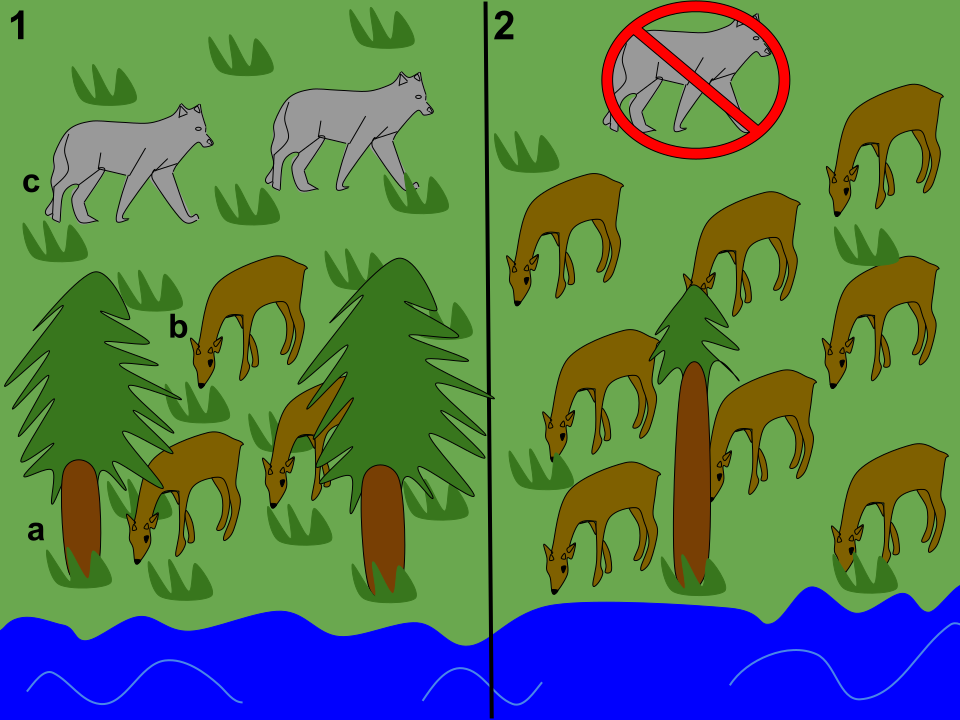
Side-by-side schematic of a top-down trophic cascade: reducing an apex predator releases herbivores, which increases grazing/browsing pressure and lowers producer biomass. The labels by trophic level make the indirect effect on producers visually explicit, reinforcing how energy flow and interactions propagate through the web. Source
It is the indirect effect: when one interaction changes, it alters who eats whom, how much biomass is transferred upward, and how much energy remains available for other pathways.
Species with outsized influence
Keystone species: A species whose impact on community structure is disproportionately large relative to its abundance, so its addition or removal can trigger major food web changes.
Keystone species often (but not always) occupy high trophic positions; their importance comes from strong interaction strength (they strongly limit or facilitate other populations) and limited ecological “backups.”

Kelp-forest cascade illustrating keystone predation: sea otters suppress sea urchins, which reduces herbivory on kelp and helps maintain kelp-forest structure. This example highlights how a single consumer can stabilize community structure by indirectly supporting primary producers and the habitat they create. Source
How adding a species can restructure the web
Addition types
Reintroduction (restoring a native predator or herbivore)
Range expansion (a species naturally moves into a new area)
Invasive introduction (human-assisted movement)
Biological control (adding a predator/parasitoid to suppress a pest)
Common cascade pathways
Top-down control strengthens: a new predator reduces prey, which can increase the prey’s resources (often producers).
New competition: an added consumer may reduce food available to resident consumers, shifting their populations and diets.
Diet switching and prey release: predators may focus on a newly abundant prey, indirectly allowing another prey species to increase.
Energy re-routing: more energy may be channelled into one food chain, leaving less for alternative links in the web.
Mesopredator release: An increase in mid-level predators after top predators are removed (or fail to establish), often intensifying predation pressure on smaller prey.
Introductions can also cause behaviour-mediated cascades: prey change habitat use, foraging time, or grouping to avoid a new predator, indirectly changing plant consumption and energy transfer even if prey numbers do not immediately drop.
How removing a species can destabilize the web
Removal drivers
Overharvesting (hunting, fishing)
Habitat loss/fragmentation
Pollution or toxic exposure
Disease outbreaks
Targeted eradication (often aimed at an unwanted species)
Typical outcomes
Predator removal: prey populations may rise, increasing consumption of producers and shifting energy away from higher trophic levels.
Herbivore removal: producer biomass may increase, potentially supporting higher populations of other herbivores later (if they can access the resource).
Producer loss: less energy enters the web overall, often reducing consumer populations broadly and simplifying interactions.
Loss of mutual prey/hosts: specialist predators/parasites may decline rapidly, while generalists may switch prey and spread impacts.
Removals can also reduce food web redundancy (fewer alternative links). With fewer pathways for energy flow, the system becomes more sensitive to additional disturbances.
Why cascades vary among ecosystems
Factors that strengthen or weaken cascades
Food web complexity: more links and omnivory can dampen single-species effects by providing alternative energy routes.
Interaction strength: strong, consistent predation/herbivory produces clearer cascades.
Life history and turnover: fast-reproducing species can amplify rapid swings in abundance.
Spatial context: immigration from nearby areas can refill removed populations, muting effects.
Human subsidies: supplemental food (e.g., garbage, crops) can weaken predator dependence on natural prey, altering predicted outcomes.
Management relevance (what APES expects you to be able to explain)
Adding/removing a species changes interactions (predation, competition) and therefore energy flow across trophic levels.
Cascades can be intended (restoration) or unintended (invasive species, overharvest).
Predicting outcomes requires identifying likely direct effects and tracing plausible indirect effects through multiple links.
Practice Questions
Define a trophic cascade and state one way removing a top predator can affect energy flow in a food web. (2 marks)
1 mark: Correct definition linking a change in one species to indirect effects across trophic levels.
1 mark: Removal of top predator increases prey/mesopredators, shifting more energy to lower levels (e.g., increased herbivory reduces producer biomass) or reducing energy transfer to higher levels.
A new predator is introduced to control an abundant herbivore. Explain two possible trophic cascade outcomes (including at least one indirect effect) and why the outcomes might differ between two ecosystems. (5 marks)
1 mark: Predator reduces herbivore abundance or alters herbivore behaviour (direct effect).
1 mark: Indirect effect on producers (e.g., reduced grazing increases plant biomass).
1 mark: Indirect effect on another consumer (e.g., competitor herbivore increases due to reduced competition, or mesopredator declines due to increased predation).
1 mark: Explain ecosystem differences using food web complexity/omnivory/alternative prey or interaction strength.
1 mark: Explain ecosystem differences using spatial context (immigration) or human subsidies altering predator diet.
FAQ
They compare changes in abundance/biomass across trophic levels after a perturbation.
Common indicators include effect size ratios (consumer change vs producer change) and consistency across sites and seasons.
Yes.
If much energy flows through detritus and decomposers, changes in grazing or predation may have smaller effects on producer standing biomass because energy is redirected through dead organic matter.
Invasive predators may face little resistance (few competitors/parasites) and prey may lack effective defences.
This can increase interaction strength and produce rapid, outsized indirect effects.
No.
Predator addition can reduce dominant prey and allow coexistence, but it can also drive vulnerable prey locally extinct, simplifying the web depending on prey traits and refuges.
Refugia (physical shelter or inaccessible habitats) reduce effective predation.
By lowering encounter rates, refugia can stabilise prey populations and dampen indirect effects on lower trophic levels.

.svg)