

AP Syllabus focus:
‘Identify rocks and sediments with phosphorus-bearing minerals as the main reservoirs in the phosphorus cycle.’
Phosphorus cycles differently from many other nutrients because its largest stores are locked in Earth materials. Understanding rocks and sediments as phosphorus reservoirs helps explain slow ecosystem replenishment and long-term controls on biological availability.
Core idea: where most phosphorus is stored
In the phosphorus cycle, the dominant stores are geologic rather than biological. Most phosphorus exists as phosphate (phosphorus bonded with oxygen), commonly represented as , and is incorporated into solid materials.
Main reservoirs (largest long-term stores):
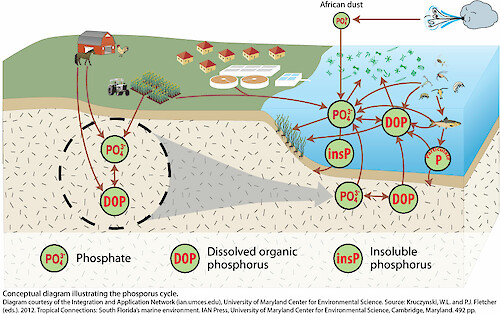
Conceptual diagram of the phosphorus cycle emphasizing major reservoirs and fluxes. It helps visualize how phosphate moves from rock/mineral sources into soils and waters, and then back into long-term sediment storage through deposition and burial. Source
Rocks containing phosphorus-bearing minerals
Sediments on lake bottoms, floodplains, and especially the ocean floor
These reservoirs hold phosphorus for long periods, so they strongly control how quickly phosphorus becomes available to organisms.
Phosphorus-bearing rocks (primary reservoir)
Rocks serve as the principal reservoir because phosphorus is built into mineral structures during rock formation and persists until physical and chemical processes release it.
Phosphate minerals that store phosphorus
Phosphorus is often stored in phosphate minerals, especially apatite (a common phosphate mineral group) found in many igneous, metamorphic, and sedimentary rocks.
Key features of rock storage:
Phosphorus is chemically bound within minerals
Storage is typically long-term (geologic timescales)
Accessibility to ecosystems depends on rock exposure at Earth’s surface
Why rock reservoirs matter for ecosystems
Because so much phosphorus is locked in rock, ecosystems may experience limited phosphorus supply unless rock-derived phosphate is gradually released.
Conditions that increase effective phosphorus supply from rocks:
Exposed bedrock or young soils
Higher weathering rates (warm/wet climates generally increase chemical weathering)
Physical breakdown that increases surface area for chemical reactions
Sediments (secondary major reservoir)
Sediments are another major reservoir because phosphate can become incorporated into deposited particles and buried over time, especially in aquatic settings.
Reservoir: A natural storage location where a substance is held for a period of time before moving elsewhere in a cycle.
Sediment storage is especially significant in marine environments, where vast areas of seafloor accumulate phosphorus-containing particles.
How phosphorus is stored in sediments
Phosphorus becomes part of sediments through several common pathways:
Mineral particles containing phosphate settle out of water
Phosphate adsorbs (sticks) to surfaces of clay minerals and iron/aluminium oxides
Phosphorus becomes incorporated into organic matter, which can be buried before fully decomposing
Under some conditions, phosphate can precipitate as solid phosphate compounds and become part of the sediment matrix
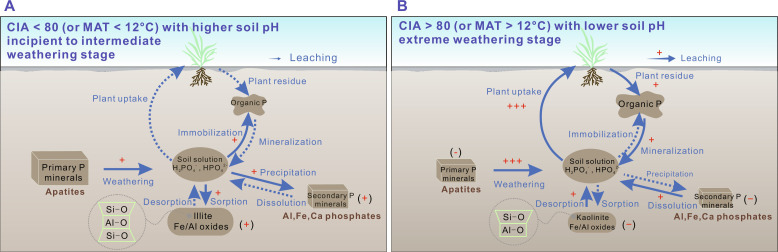
Schematic diagram comparing soil phosphorus cycling under different weathering stages. The figure highlights how weathering releases phosphate into soil solution and how phosphate can be retained by adsorption to clays and Fe/Al oxides, linking geologic sources to biological availability. Source
Sediment burial and long-term storage
Once buried, phosphorus may remain stored for long periods, particularly if sediments are not disturbed. Over time, burial can convert biologically relevant phosphorus into forms that are effectively unavailable to most organisms.
Important controls on sediment storage:
Deposition rate (how quickly particles accumulate)
Mixing/disturbance by currents or organisms (bioturbation)
Chemical conditions that influence whether phosphate remains bound to particles
Distinguishing “big reservoirs” from “usable phosphorus”
Even though rocks and sediments contain most phosphorus, only a small fraction is readily accessible to living things at any moment.
Large reservoir size does not imply high availability
Much phosphorus is locked in:
Mineral lattices (rock)
Buried or particle-bound forms (sediments)
This reservoir–availability mismatch is central to why phosphorus supply to ecosystems can be slow and uneven across landscapes and aquatic systems.
Spatial patterns in phosphorus reservoirs
The dominance of rocks and sediments as phosphorus reservoirs leads to predictable geographic differences in potential phosphorus supply.
Higher potential supply where:
Landscapes expose phosphate-rich rocks
Uplift or erosion reveals fresh mineral surfaces
Lower potential supply where:
Soils are very old and heavily leached, leaving less accessible mineral phosphate
Phosphorus is mainly stored in deep sediments or buried layers away from biological uptake zones
Practice Questions
Identify the main reservoirs of phosphorus in the phosphorus cycle and name a phosphorus-bearing mineral found in rocks. (2 marks)
Rocks and sediments identified as main reservoirs (1)
Example mineral such as apatite named (1)
Explain why rocks and sediments are considered the major phosphorus reservoirs, and describe two ways phosphorus can be stored in sediments. (5 marks)
Phosphorus is largely locked into phosphorus-bearing minerals in rocks (1)
Rock storage is long-term/geologic timescales (1)
Sediments accumulate phosphorus-containing particles leading to long-term storage/burial (1)
Two valid sediment storage mechanisms described (2), e.g. adsorption to clays/iron oxides; burial of organic matter; precipitation into phosphate solids; settling of mineral particles
FAQ
They commonly measure $P_2O_5$ content and identify phosphate minerals (e.g. apatite) using petrography and geochemical methods (such as X-ray diffraction or spectroscopy).
Phosphate rock is sedimentary rock with unusually high phosphate mineral content, often formed in marine settings where upwelling and sedimentation favour phosphate accumulation and retention.
Yes. If chemical conditions change (for example, reduced oxygen near the sediment surface), particle-bound phosphate can be released (“internal loading”), increasing dissolved phosphate in overlying waters.
Phosphate forms stable surface complexes with iron/aluminium oxides and hydroxides, which can immobilise phosphate until conditions shift (e.g. changes in redox or pH).
Fine-grained sediments (clays, silts) typically store more phosphorus because they have higher surface area for adsorption and often contain more reactive mineral coatings than coarse sands.
