

AP Syllabus focus:
‘Define the phosphorus cycle as the movement of phosphorus-containing atoms and molecules between sources and sinks.’
Phosphorus is essential to life but moves through ecosystems in distinctive ways.
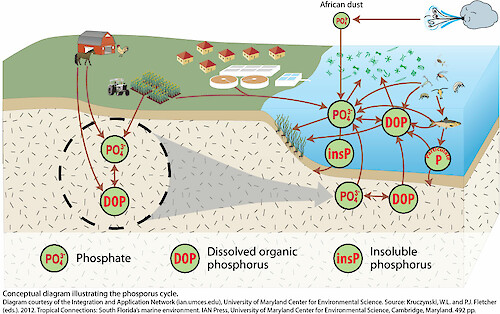
Conceptual diagram of the phosphorus cycle showing how phosphate moves among land, water, and living biomass. The figure highlights key transfers (e.g., runoff, uptake, and remineralization) and major sinks such as sediment accumulation in aquatic environments. Source
This page defines the phosphorus cycle by tracking how phosphorus shifts among sources and sinks across Earth’s systems.
Core idea: sources and sinks
Phosphorus cycle: The movement of phosphorus-containing atoms and molecules between sources and sinks.
A useful way to learn any biogeochemical cycle is to identify (1) where material enters a system (sources), (2) where it is stored or removed (sinks), and (3) the processes that transfer it between them.
Source and sink: A source releases phosphorus into a system faster than it is removed; a sink stores or removes phosphorus from a system faster than it is added.
In AP Environmental Science, “system” is often an ecosystem (like a lake), but it can also be a larger scale (like the ocean).
What “phosphorus” means in environmental systems
In environmental contexts, phosphorus is typically discussed as:
Phosphate (often written as phosphate ions), the most common biologically available form in soils and water
Organic phosphorus, phosphorus incorporated into living tissue (DNA, ATP, phospholipids) and detritus
Because organisms need phosphorus to build critical molecules, ecosystems often respond strongly when phosphorus inputs rise or fall.
Major sources of phosphorus
A phosphorus source is any process or location that increases phosphorus availability in a given system.
Natural sources
Weathering and erosion: Rock and soil particles break down and release phosphate that can enter soils, streams, and lakes.
Runoff from land: Rain or snowmelt transports dissolved phosphate and phosphorus attached to sediments into aquatic systems.
Decomposition and excretion: Waste products and the breakdown of dead biomass release phosphorus back into soil or water, increasing local availability.
Human-amplified sources (as sources to ecosystems)
Even when the ultimate phosphorus originates in geologic material, human activities can act as strong ecosystem-level sources by accelerating transfer:
Fertiliser application: Adds concentrated phosphorus to agricultural soils; some is transported away by runoff and erosion.
Manure and organic waste: Livestock operations can create high phosphorus loads that enter waterways if not contained.
Wastewater inputs: Effluent can introduce dissolved and particulate phosphorus to rivers, lakes, and coastal waters.
Major sinks of phosphorus
A phosphorus sink is any process or location that locks phosphorus away or removes it from active cycling in a system.
Common sinks in ecosystems
Biomass uptake and storage: Plants, algae, and microbes assimilate phosphate into tissues; phosphorus remains stored until organisms excrete, die, or are consumed.
Soil retention: Phosphate can bind to soil particles; this reduces immediate availability and can slow movement through the ecosystem.
Sedimentation in aquatic systems: Phosphorus attached to particles settles to the bottom of lakes, reservoirs, estuaries, or oceans, reducing water-column phosphorus.
Longer-term sinks (conceptual, without extra detail)
Burial in sediments: Over time, phosphorus can become buried and less available to organisms, acting as a strong sink at ecosystem and regional scales.
Transfers between sources and sinks (key movements)
Phosphorus moves between sources and sinks through physical, chemical, and biological transfers:
Physical transport: Erosion, runoff, streamflow, and sediment deposition move phosphorus across landscapes.
Biological uptake: Producers take up phosphate; consumers obtain phosphorus by eating biomass.
Recycling: Decomposition returns phosphorus from organic matter to inorganic forms that can be reused.
Understanding the phosphorus cycle as “movement between sources and sinks” helps predict where phosphorus will accumulate (for example, in sediments) versus where it will be readily available (for example, in biologically active soils or surface waters).
Practice Questions
Define the phosphorus cycle in terms of sources and sinks. (2 marks)
Defines the phosphorus cycle as movement of phosphorus-containing atoms/molecules (1)
States movement is between sources and sinks / identifies sources add and sinks remove or store phosphorus (1)
A lake receives increased phosphorus input after land is converted to intensive agriculture. Explain, using sources and sinks, how phosphorus can move through the lake ecosystem and where it may be stored. (5 marks)
Identifies agriculture/fertiliser/manure runoff as a phosphorus source to the lake (1)
Describes uptake by producers (algae/plants) as transfer into biomass (1)
Describes transfer through feeding/food web into consumers as movement of phosphorus (1)
Explains decomposition/excretion recycles phosphorus back into water/soil as a source within the lake (1)
Identifies sedimentation/settling/burial or binding to particles as a sink storing phosphorus (1)
FAQ
No. It can adsorb to clay or iron/aluminium oxides, or become part of particles.
Availability depends on pH, mineral surfaces, and contact time with sediments.
Export varies with erosion risk and flow pathways.
Key factors include soil texture, slope, vegetation cover, storm intensity, and whether runoff is overland or infiltrates then moves slowly.
They typically filter the sample (commonly around 0.45 µm).
Phosphorus passing through is operationally “dissolved”; retained material is “particulate,” then analysed separately after digestion.
External loading comes from the catchment (runoff, inflows, effluent).
Internal loading comes from lake sediments releasing phosphorus back into the water column under certain chemical conditions.
Slow water movement promotes settling of particles.
Phosphorus bound to sediments is deposited, and repeated inputs can build long-term stores even if water-column concentrations fluctuate.
