

AP Syllabus focus:
‘Explain that the sun powers the hydrologic cycle, moving water among solid, liquid, and gaseous phases between sources and sinks.’
Water is constantly recycled through Earth’s systems. Understanding the hydrologic cycle means tracking how solar energy drives water’s movement and phase changes, and how water is stored and transferred between major reservoirs.
Core idea: solar energy drives cycling and phase changes
The sun provides the energy that moves water through the environment by powering evaporation and influencing atmospheric circulation. As water moves, it commonly changes state among solid (ice/snow), liquid (water), and gas (water vapour). Gravity then returns water to lower elevations through precipitation, runoff, and groundwater flow.
The hydrologic (water) cycle: sources, sinks, and fluxes
Hydrologic (water) cycle: The continuous movement of water among Earth’s reservoirs, driven by solar energy and gravity, through physical processes that transport water and change its state.
In AP Environmental Science, it is especially important to connect (1) where water is stored and (2) which processes move it.
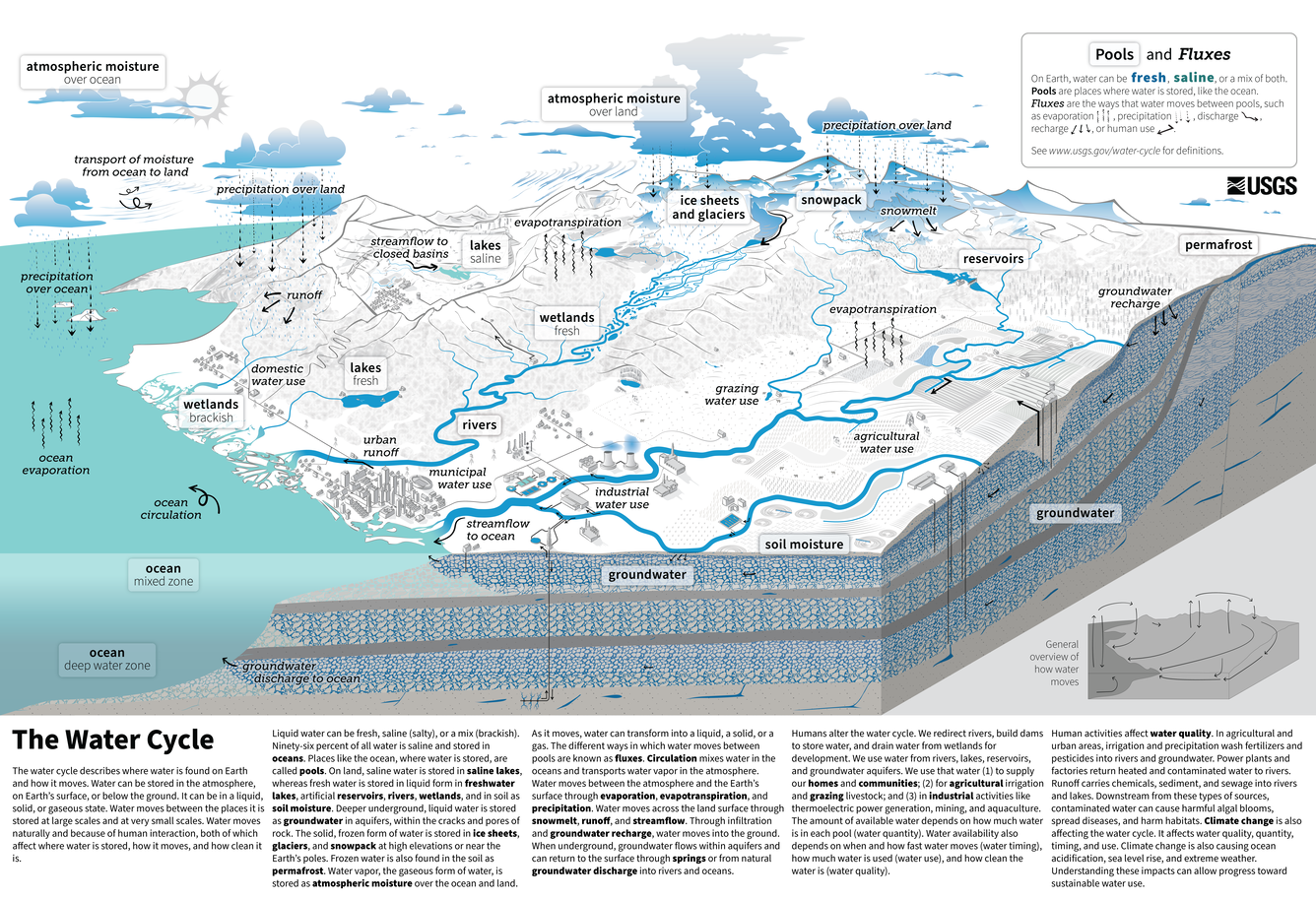
USGS’s modern water-cycle diagram summarizes the major reservoirs (oceans, land, atmosphere, groundwater, ice) and the fluxes that connect them, with arrows that distinguish surface pathways from subsurface movement. It is especially useful for seeing how evapotranspiration, condensation, precipitation, runoff, infiltration, percolation, and groundwater discharge link “sources and sinks” across Earth systems. The labeled processes also make it easier to explain which parts of the cycle are primarily driven by solar energy versus gravity. Source
Storage locations are often described as sources and sinks, depending on whether they release or absorb water in a given context.
Source and sink: A source is a reservoir or location that releases water to another part of the cycle; a sink is a reservoir or location that absorbs and stores water (temporarily or longer-term).
Key processes that move water (and its state)
Phase-change processes (state changes)
Evaporation (liquid → gas): Solar energy breaks intermolecular attractions in liquid water, producing water vapor that enters the atmosphere.
Transpiration (liquid → gas via plants): Plants move water from roots to leaves and release it through stomata; together with evaporation this is often discussed as evapotranspiration.
Condensation (gas → liquid): As moist air cools, water vapor condenses onto tiny particles (condensation nuclei) to form cloud droplets or fog.
Freezing (liquid → solid): Liquid water becomes ice when temperatures drop sufficiently; this can store water seasonally (snowpack) or long-term (glaciers).
Melting (solid → liquid): Warmer temperatures convert snow and ice back to liquid water, feeding streams and soils.
Sublimation (solid → gas): Ice or snow converts directly to vapor in cold, dry, sunny, or windy conditions, bypassing the liquid phase.
Deposition (gas → solid): Water vapor forms ice crystals directly (for example, frost), bypassing the liquid phase.
Transport processes (movement between reservoirs)
Precipitation: Water returns from the atmosphere to Earth’s surface as rain, snow, sleet, or hail after droplet/ice-crystal growth in clouds.
Infiltration: Liquid water soaks into soil pores from the surface; infiltration is influenced by soil texture, structure, and saturation.
Percolation: Infiltrated water moves downward through soil and permeable rock under gravity, contributing to groundwater.
Runoff: Water flows over land into streams, rivers, lakes, and the ocean when precipitation exceeds infiltration capacity or when soils are saturated.
Groundwater flow: Subsurface water moves slowly through connected pore spaces and fractures, eventually discharging to springs, streams, wetlands, or coastal waters.
Advection (atmospheric transport): Winds move water vapor and clouds horizontally, redistributing water from ocean to land and between regions.
Linking “sources and sinks” to reservoirs and pathways
At different moments, the same place can act as a source or a sink. For example, the ocean surface is often a sink for precipitation but a major source of water vapor through evaporation. Snowpack can be a sink in winter (accumulation) and a source in spring (meltwater).
To stay aligned with the syllabus focus, always connect:
Energy input (sunlight) → enables evaporation/sublimation and atmospheric motion
Gravity → returns water via precipitation, runoff, and downward percolation
State changes → shift water among solid, liquid, and gas as it moves between reservoirs
Practice Questions
State two processes powered by the Sun in the hydrologic cycle and, for each, identify the change of state involved. (3 marks)
Names a valid Sun-powered process (e.g. evaporation, transpiration, sublimation) (1)
Correctly links it to the appropriate change of state (1)
Second valid process with correct change of state (1)
Explain how water can move from the ocean to a river in a drainage basin, including the role of the Sun, at least two phase changes, and at least two transport processes. (6 marks)
States that solar energy drives evaporation from the ocean (1)
Includes evaporation as liquid gas (1)
Includes condensation as gas liquid (cloud formation) (1)
Describes precipitation delivering water to land (1)
Describes infiltration/percolation to groundwater and/or surface runoff as transport towards a river (1)
Mentions advection/wind transport moving moist air from ocean to land, or groundwater flow feeding streams (1)
FAQ
Condensation often requires particles called condensation nuclei.
More aerosols can increase droplet number but reduce droplet size, which can delay rainfall.
Cleaner air can produce fewer, larger droplets that may fall out more readily.
Sublimation is promoted by low humidity and strong sunlight or wind.
It can remove snow without melting, reducing spring meltwater and shifting when water becomes available to ecosystems and streams.
Residence time is the typical length of time water stays in a reservoir before moving on.
It varies due to storage volume and flow rates; for example, fast atmospheric turnover versus slow movement through deep groundwater.
The dew point is the temperature at which air becomes saturated and water vapour begins to condense.
If air cools to the dew point (often by rising and expanding), clouds or fog can form even without adding more water vapour.
Infiltration capacity depends on factors such as:
soil texture and compaction
antecedent moisture (already-wet soils absorb less)
surface crusts, vegetation cover, and pore connectivity
These control whether water soaks in or becomes runoff.
