

AP Syllabus focus:
‘Identify the oceans as the primary surface reservoir of water, with ice caps and groundwater as much smaller reservoirs.’
Water on Earth is unevenly stored across a few major reservoirs. Knowing where most water resides—and in what physical state—helps explain freshwater availability, sea level change, and why some water sources renew slowly.
Big Picture: Earth’s Major Water Reservoirs
A reservoir in the hydrologic cycle is any location where water is stored for a period of time.
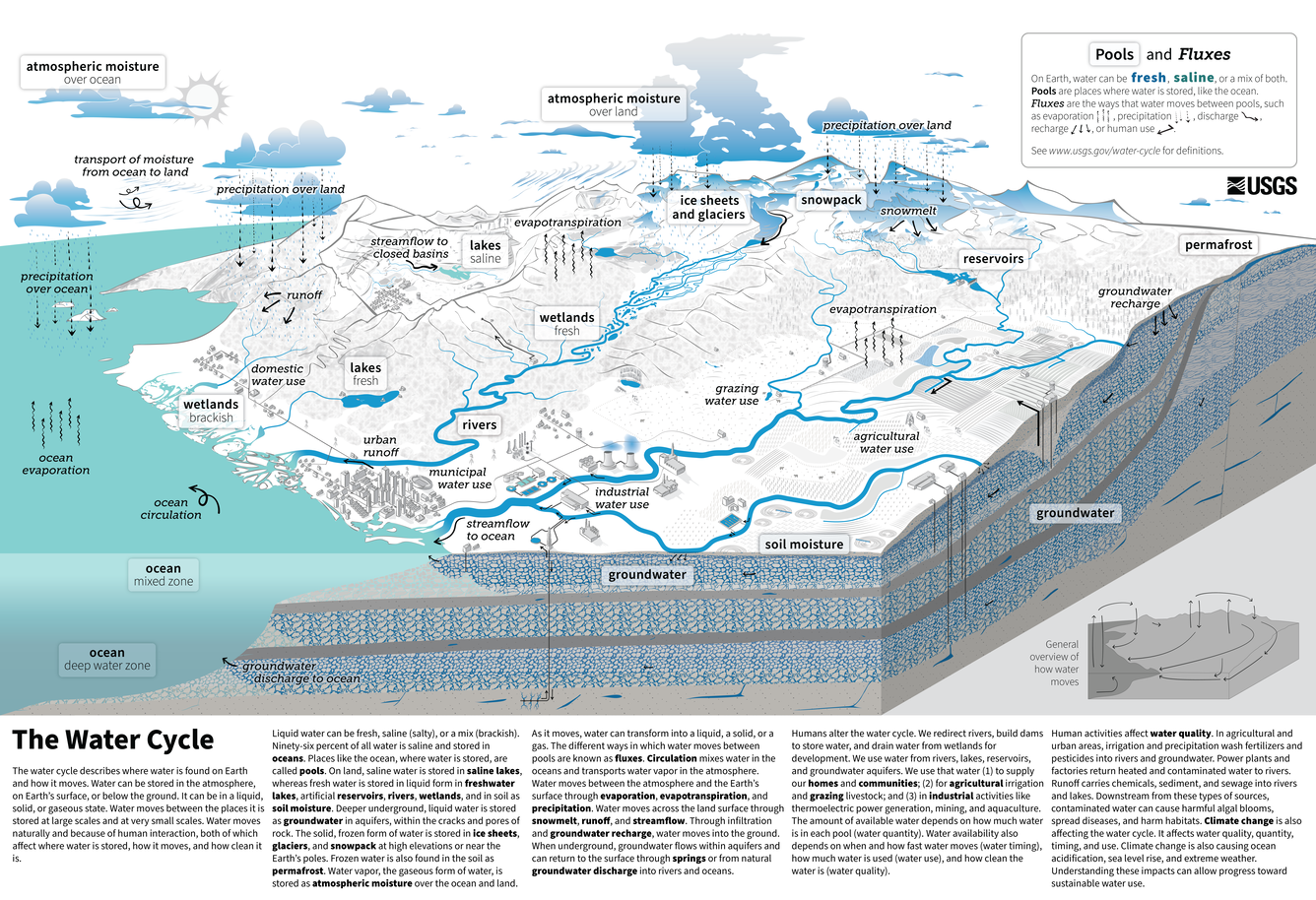
A USGS water-cycle diagram shows the major places water is stored (including ocean water, ice/snow, and groundwater in aquifers) and the pathways that move water among them. The labeled cutaway of the subsurface is especially useful for visualizing groundwater storage and recharge. Use it to distinguish “where water sits” (reservoirs/pools) from “how it moves” (fluxes like precipitation, runoff, and infiltration). Source
For AP Environmental Science, the key comparison is that the oceans dominate Earth’s surface water, while ice caps and groundwater store much smaller—but critically important—amounts.
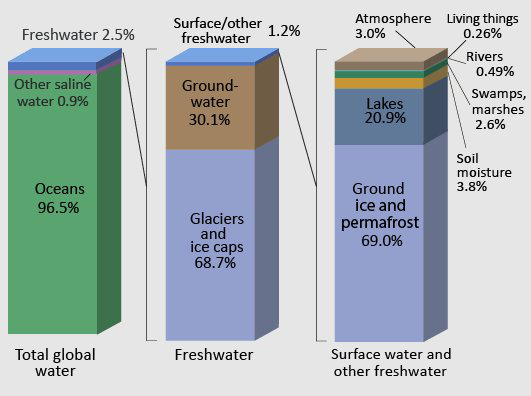
Stacked bar charts compare the size of Earth’s major water reservoirs. The figure emphasizes that oceans contain the vast majority of total global water, while most freshwater is stored in glaciers/ice caps and groundwater rather than in lakes and rivers. This visualization helps connect “where the water is” to real limits on accessible freshwater. Source
Water reservoir: A natural storage location in the hydrologic cycle where water accumulates (for example, oceans, ice, or groundwater) before moving to another part of the system.
Reservoir size matters because it influences:
How much water is readily accessible for human use
How quickly water can move back into the atmosphere or into ecosystems
How sensitive the reservoir is to climate variability and warming
Oceans: The Primary Surface Reservoir
What makes oceans “primary”?
The oceans hold the overwhelming majority of Earth’s liquid water and are the largest surface reservoir. This directly satisfies the syllabus emphasis: oceans are the primary surface reservoir, while ice caps and groundwater are smaller reservoirs.
Key implications of ocean storage
Most ocean water is saline, so it is not directly usable for drinking or irrigation without desalination.
Because the ocean reservoir is so large, small percentage changes can still mean large absolute changes in:
Sea level
Coastal flooding risk
Saltwater intrusion into coastal aquifers (a groundwater issue caused by ocean water pushing inland)
Ocean water as “active storage”
Although oceans store huge amounts of water, their importance here is storage rather than detailed cycling. The ocean reservoir sets baseline conditions for global water distribution and is the primary source for water that later becomes atmospheric moisture and precipitation.
Ice Caps and Glaciers: Frozen Freshwater Storage
Where ice fits in the reservoir comparison
Ice caps and glaciers store water in the solid phase for long periods. Even though their total volume is much smaller than the oceans, they represent a large share of Earth’s stored freshwater (water with very low dissolved salts).
Cryosphere: The portions of Earth where water is stored as ice or snow (including ice caps, glaciers, and permanent snowfields).
Why ice storage matters
Freshwater locked away: Ice is not readily accessible in many locations, making it a “stored” resource rather than an immediately usable supply.
Sea level sensitivity: When land-based ice melts, it adds water to the ocean, contributing to sea level rise.
Seasonal vs long-term storage: Seasonal snowpack can be a short-term reservoir, but ice caps function more like long-term storage that changes slowly—until warming accelerates loss.
Groundwater: Subsurface Storage in Aquifers
What groundwater is
Groundwater is water stored beneath Earth’s surface in soil and rock pore spaces and fractures. It is a major freshwater reservoir even though it is still smaller than the ocean reservoir in total volume.
Groundwater: Water stored underground in the pores and fractures of soil and rock, often supplying wells and springs.
Groundwater is commonly stored in aquifers (water-bearing layers of permeable rock or sediment). Access depends on depth, geology, and recharge.
Why groundwater is important despite being “smaller”
Direct human use: Groundwater supplies drinking water and irrigation in many regions.
Slow renewal: Many aquifers recharge slowly; some groundwater is effectively “fossil” water stored for very long times.
Hidden vulnerability: Because it is out of sight, depletion can proceed for years before impacts are obvious (dry wells, sinking land, reduced spring flow).
Storage characteristics that affect availability
Permeability and porosity determine how much water can be stored and how easily it moves.
Confined vs unconfined aquifers influence how quickly recharge can occur and how sensitive groundwater is to contamination and overpumping.
Depth affects pumping cost and the time scale for replenishment.
Comparing the Three Reservoirs (What You Must Be Able to State)
You should be able to clearly identify and compare:
Oceans as the primary surface reservoir of water
Ice caps and groundwater as much smaller reservoirs
The practical difference that oceans are mostly saline, while ice and much groundwater represent key freshwater storage
Practice Questions
State which reservoir is the primary surface reservoir of water on Earth, and name two smaller reservoirs highlighted in the specification. (2 marks)
Oceans are the primary surface reservoir. (1)
Ice caps and groundwater are smaller reservoirs (award 1 for naming both; 0.5 each if allowed). (1)
Explain two reasons why groundwater, despite being a much smaller reservoir than the oceans, can be highly important for human societies. Include one point about storage/recharge and one point about accessibility or vulnerability. (6 marks)
(6 marks) Award up to 3 marks per reason (max 6)
Reason 1 (storage/recharge focus), e.g.:
Groundwater can have slow recharge/long residence times. (1)
Over-abstraction can deplete aquifers faster than recharge. (1)
This leads to long-term supply issues such as falling water tables/dry wells. (1)
Reason 2 (accessibility/vulnerability focus), e.g.:
Groundwater is often a major source of drinking water via wells and boreholes. (1)
It can be more reliable than surface supplies in drought-prone regions. (1)
It is vulnerable to issues such as saltwater intrusion or contamination, reducing usable supply. (1)
FAQ
They combine borehole measurements, geophysical surveys, and geological maps.
Common approaches include:
Measuring water table levels in monitoring wells
Estimating aquifer thickness and porosity from rock/sediment data
Using satellite-based gravity changes to infer large-scale groundwater loss
Recharge may be extremely slow in arid climates or in deep, confined aquifers.
Water can enter during past wet climates, then become isolated by low-permeability layers, so modern rainfall contributes little to replenishment.
Ice caps are broad, dome-shaped ice masses covering highland areas; glaciers are moving rivers of ice confined by valleys or topography.
Both store freshwater, but their shapes and flow patterns affect where meltwater emerges and how quickly mass can change.
When freshwater pressure drops (often from pumping), seawater can move inland into aquifers.
This can:
Increase chloride and salinity in wells
Make water unsuitable for drinking or irrigation without treatment
Persist because flushing saline water can take a long time
Floating sea ice already displaces its volume in seawater, so melting has little direct effect on sea level.
Land-based ice (ice sheets, glaciers) adds new water to the oceans when it melts, increasing sea level.
