

AP Syllabus focus:
‘Define primary productivity as the rate at which sunlight is converted into organic compounds by photosynthesis over time.’
Primary productivity links solar energy to the living biosphere.
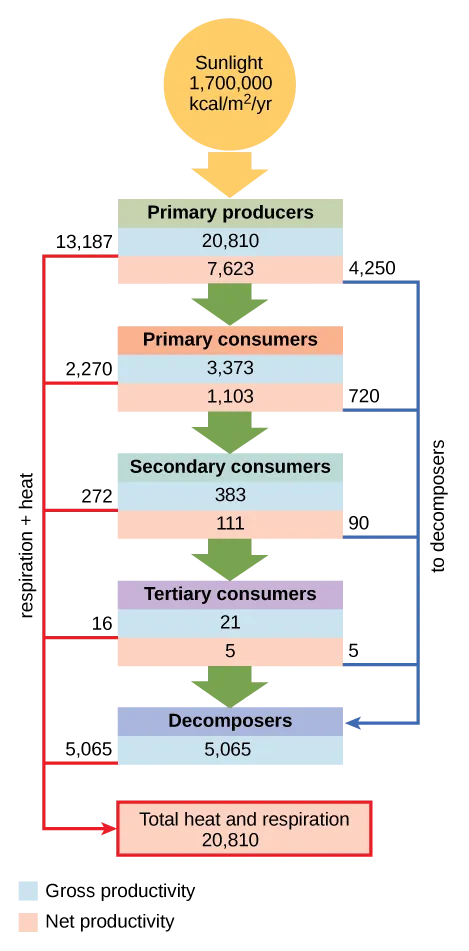
Compartment model of energy flow through an ecosystem (Silver Springs), showing how energy captured by primary producers is transferred to consumers and decomposers and lost as respiration/heat at each step. The diagram makes it clear that primary productivity provides the energy base for the entire food web, but only a fraction is converted into biomass that can move upward through trophic levels. Source
It describes how quickly producers turn sunlight into chemical energy, setting the pace at which new organic matter is created in an ecosystem.
Core idea: what primary productivity describes
Primary productivity as a rate of energy-to-biomass conversion
Primary productivity: The rate at which sunlight is converted into organic compounds by photosynthesis over time.
In practice, “organic compounds” means energy-rich, carbon-based molecules (such as sugars) that can be built into biomass. Because it is a rate, primary productivity depends on both the capacity of producers and the environmental conditions controlling photosynthesis rate.
Primary producers and where productivity happens
Primary producers (autotrophs such as plants, algae, and cyanobacteria) carry out photosynthesis, converting radiant energy into chemical energy stored in carbon bonds. Primary productivity therefore occurs wherever photosynthetic organisms can capture light and acquire inputs like water and carbon dioxide, and it can change over seasons or as conditions shift.
Photosynthesis rate as the mechanism behind primary productivity
Photosynthesis converts light energy into stored chemical energy
Photosynthesis is the biological process that directly generates the organic compounds counted by primary productivity. When photosynthesis speeds up, primary productivity rises; when photosynthesis slows (due to limiting conditions), primary productivity falls.
= Carbon dioxide (reactant; source of carbon)
= Water (reactant)
= Glucose (representative organic compound produced)
= Oxygen (product)
Although ecosystems store organic matter in many forms (cellulose, lipids, proteins), the key idea is that photosynthesis transfers energy from sunlight into chemical bonds, increasing the amount of organic material available to support life.
Light capture and photosynthetic efficiency
Only some wavelengths are useful for photosynthesis, and producers vary in how effectively they absorb and use light.
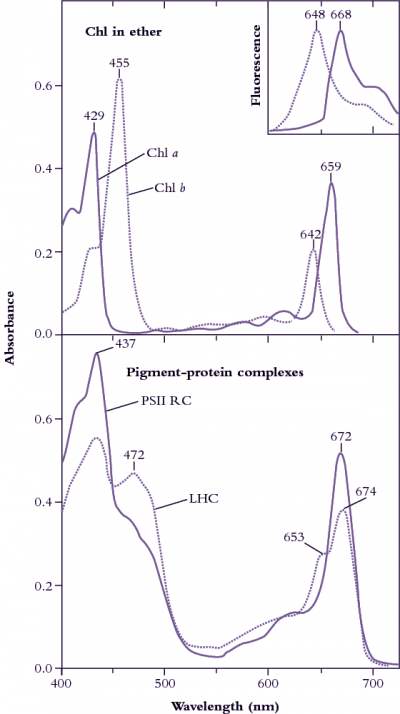
Absorption spectra for chlorophyll a and chlorophyll b across the visible spectrum, highlighting strong absorption in the blue and red regions and weak absorption in green wavelengths. This visual explains why chlorophyll-bearing producers appear green and why pigment composition affects how efficiently different light environments can drive photosynthesis. Source
Chlorophyll and accessory pigments influence how much light is captured, while leaf structure or algal cell traits influence how much of that captured energy is converted into organic compounds rather than lost as heat.
Environmental controls on photosynthesis rate (and thus productivity)
Limiting factors that regulate primary productivity
Primary productivity is often constrained by whichever required resource is in shortest supply relative to demand (a limiting factor). Common controls include:
Light availability
Lower light reduces the rate of energy capture and carbon fixation.
Shading within dense plant canopies can lower productivity for understory plants.
Temperature
Enzyme-driven reactions speed up to an optimum, then decline if proteins destabilize or water stress increases.
Water availability
Drought reduces photosynthesis by limiting reactant supply and causing stomata to close, restricting entry.
Carbon dioxide availability
Lower inside leaves can reduce carbon fixation, especially when stomata close during dry or hot conditions.
Nutrient availability
Nutrients such as nitrogen (for chlorophyll and enzymes) and phosphorus (for ATP and genetic material) can constrain the ability to build photosynthetic machinery and new biomass.
Stress and disturbance effects
Factors that damage photosynthetic tissues or reduce producer abundance can decrease primary productivity, such as herbivory pressure, disease, severe storms, wildfire, or pollution that harms leaves or photosynthetic microbes. Recovery depends on how quickly producers regrow and how rapidly limiting resources return.
Why primary productivity matters in environmental science
Primary productivity determines how much carbon is pulled from inorganic forms (like atmospheric or dissolved ) into living matter over time. It also sets the potential supply of organic material that can move through ecosystems as organisms consume, decompose, and recycle matter.
Practice Questions
Define primary productivity and state its direct biological cause. (2 marks)
Defines primary productivity as the rate at which sunlight is converted into organic compounds by photosynthesis over time. (1)
States that it is caused by photosynthesis carried out by primary producers/autotrophs. (1)
Explain how three different limiting factors can change photosynthesis rate and therefore primary productivity in an ecosystem. (6 marks)
Names three valid limiting factors (e.g., light, temperature, water, , nutrients such as nitrogen/phosphorus). (3; 1 each)
For each factor, explains a correct mechanism linking it to photosynthesis rate (e.g., drought closes stomata reducing uptake; low light reduces energy capture; sub/over-optimal temperature slows enzyme activity). (3; 1 each)
FAQ
Remote sensing uses reflected light to infer vegetation “greenness” (often via indices such as NDVI) and models to convert that signal into estimated carbon uptake.
These estimates are calibrated using field measurements (flux towers, plot data) and adjusted for local climate and vegetation type.
PAR is the portion of sunlight usable by photosynthetic pigments (roughly 400–700 nm).
Primary productivity depends more on PAR than on total sunlight because infrared and some ultraviolet wavelengths are not effectively used for photosynthesis.
Different carbon-fixation pathways affect efficiency under stress:
C3 plants are more prone to photorespiration in heat.
C4 plants reduce photorespiration and often perform better in high light/heat.
CAM plants conserve water by taking in $CO_2$ mainly at night, trading speed for water savings.
Photoinhibition occurs when light energy exceeds a producer’s capacity to process it, damaging photosystems or forcing protective energy dissipation.
This can lower photosynthesis rate even when light is abundant, especially under cold or nutrient-poor conditions that slow repair.
Productivity may be constrained by multiple limitations (co-limitation). If nitrogen is added but phosphorus or water is still limiting, photosynthesis and growth may not increase much.
Imbalances can also shift energy into maintenance and stress responses rather than new biomass.
