

AP Syllabus focus:
‘Describe biogeochemical cycles as essential for life and as demonstrations of the conservation of matter.’
Matter does not vanish when organisms grow, excrete, or decompose; it is continually rearranged and reused. Biogeochemical cycles track how essential elements move through living things and Earth’s physical environment.
Biogeochemical cycles: what they are and why they matter
Biogeochemical cycles describe how chemical elements move through biotic (living) and abiotic (nonliving) components of Earth systems. They are “bio” (organisms), “geo” (rocks, soils, water, air), and “chemical” (transformations among forms).
Biogeochemical cycle: the repeated movement of an element or compound through living organisms and the physical environment via biological, geological, and chemical processes.
In AP Environmental Science, thinking in cycles helps you connect organism needs (nutrients, water) to ecosystem-scale patterns (productivity, nutrient limitation) without treating any single location as isolated.
Essential for life
Life depends on a steady supply of matter (atoms and molecules), especially elements required to build biological structures and run metabolism (for example, carbon in organic molecules, nitrogen in proteins). Biogeochemical cycles are essential because they:
Replenish usable forms of elements for organisms (plants, microbes, animals)
Move nutrients among major environmental compartments so they don’t become permanently inaccessible
Link ecosystem processes such as growth, waste production, and decomposition into a continuous system of reuse
Conservation of matter in ecosystems
Ecosystems are not “factories” that create new atoms; they are networks that transform and transfer existing matter.
Conservation of matter: matter cannot be created or destroyed in ordinary chemical and biological processes; atoms are rearranged into new substances, but the total mass remains constant.
Because of conservation of matter, any apparent “loss” of a nutrient from one part of an ecosystem must be explained as a transfer to another place or transformation into another chemical form.
Tracking matter: reservoirs and fluxes
To apply conservation of matter, ecologists describe where matter is stored and how it moves.
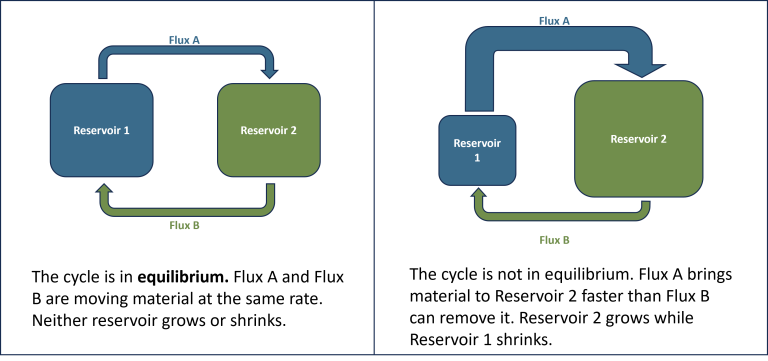
A conceptual “two-box” model of matter cycling: material is stored in reservoirs and transferred by fluxes between them. The left panel illustrates a steady-state (inputs and outputs balanced), while the right panel shows how changing a flux causes one reservoir to grow and the other to shrink—an intuitive visualization of mass-balance thinking. Source
Reservoirs (storage pools): places where an element accumulates (organisms, soil organic matter, sediments, ocean water, the atmosphere)
Fluxes (flows): movement rates between reservoirs (uptake by plants, excretion, leaching, sedimentation, gas exchange)
Transformations: chemical changes that alter form and biological availability (often driven by microbes)
These concepts allow you to account for matter even when it changes form (for example, dissolved vs particulate, organic vs inorganic).
= change in stored matter in a defined reservoir or system (e.g., kg C or g N)
= total matter entering that reservoir/system per time (e.g., kg/year)
= total matter leaving that reservoir/system per time (e.g., kg/year)
This mass-balance approach is the practical expression of conservation of matter: if storage increases, inputs must exceed outputs, and vice versa.
What “cycling” looks like in real ecosystems
Matter cycles because organisms continuously exchange materials with their environment:
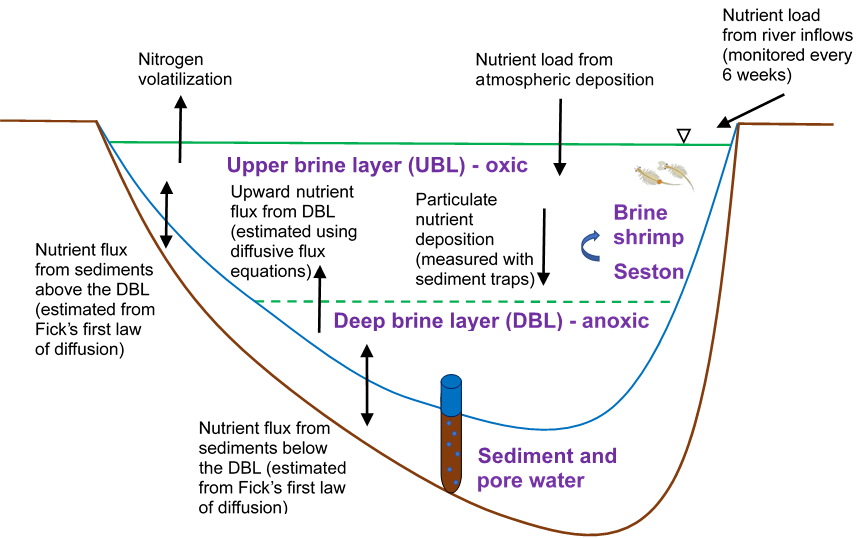
A USGS schematic of nutrient loading and internal cycling in a lake system, showing major nutrient pools (water column, biota, sediments) and pathways such as inflows, biological uptake, sinking organic matter, recycling, burial, and atmospheric exchange. It’s a concrete example of how biogeochemical cycling connects ecosystem processes (food webs and decomposition) with physical reservoirs (sediments and water). Source
Assimilation: producers and consumers incorporate atoms into biomass
Trophic transfer: matter moves through feeding, but much returns to the environment as waste and dead tissue
Decomposition: decomposers break down detritus, returning nutrients to soil or water and releasing some products to air or dissolved pools
Unlike energy (which flows through and is lost as heat), matter is reused, so ecosystem functioning depends on maintaining pathways that return nutrients to biologically available forms.
System boundaries and why they matter
A local ecosystem can be open to matter (inputs/outputs occur), even though Earth is approximately closed to matter overall. Defining boundaries (a lake, a watershed, a forest plot) determines what counts as an input or output and makes conservation-of-matter accounting possible.
Practice Questions
State what is meant by conservation of matter and explain how it applies to nutrient movement in an ecosystem. (2 marks)
1 mark: States that matter cannot be created or destroyed; atoms are rearranged.
1 mark: Applies to ecosystems (e.g., nutrients move between reservoirs/forms rather than disappearing).
Describe how biogeochemical cycles are essential for life and explain how they demonstrate conservation of matter. Include reference to reservoirs, fluxes, and transformations. (6 marks)
1 mark: Biogeochemical cycles move elements through biotic and abiotic components.
1 mark: Explains essentiality (supply of nutrients/matter needed for biomass/metabolism).
1 mark: Defines/uses idea of reservoirs as storage pools.
1 mark: Defines/uses idea of fluxes as movements between reservoirs.
1 mark: Notes transformations change chemical form/availability without destroying matter.
1 mark: Links to conservation of matter (tracking shows transfers/transformations account for “losses”).
FAQ
They combine field sampling (soil, water, biomass) with flow measurements (stream discharge, gas exchange) and calculate loads using concentration × flow over time.
Residence time is the average time matter remains in a reservoir before leaving, estimated from reservoir size relative to output rate.
It may be exported in runoff, leached to groundwater, taken up into biomass, or transformed into a dissolved or gaseous form that was not measured.
Stable or radioactive isotopes act as tracers, letting scientists distinguish sources and follow pathways by measuring isotope ratios in different reservoirs.
It studies the balance of elements (e.g., C:N:P) in organisms and environments, helping explain when the supply ratio of cycled nutrients constrains growth.
