

AP Syllabus focus:
‘Explain that ecosystems require a continuous inflow of high-quality energy to maintain structure and function while cycling matter through biogeochemical processes.’
Ecosystems persist only by continually capturing usable energy, mostly from sunlight, to power biological work. That energy supports organisms, maintains ecosystem organisation, and drives the cycling of matter through essential chemical pathways.
Ecosystems as energy-dependent systems
An ecosystem can recycle matter (atoms like carbon, nitrogen, and phosphorus), but it cannot recycle energy. Energy is transformed as it moves through organisms and is ultimately dispersed as low-quality heat, so it must be replaced by new inputs.
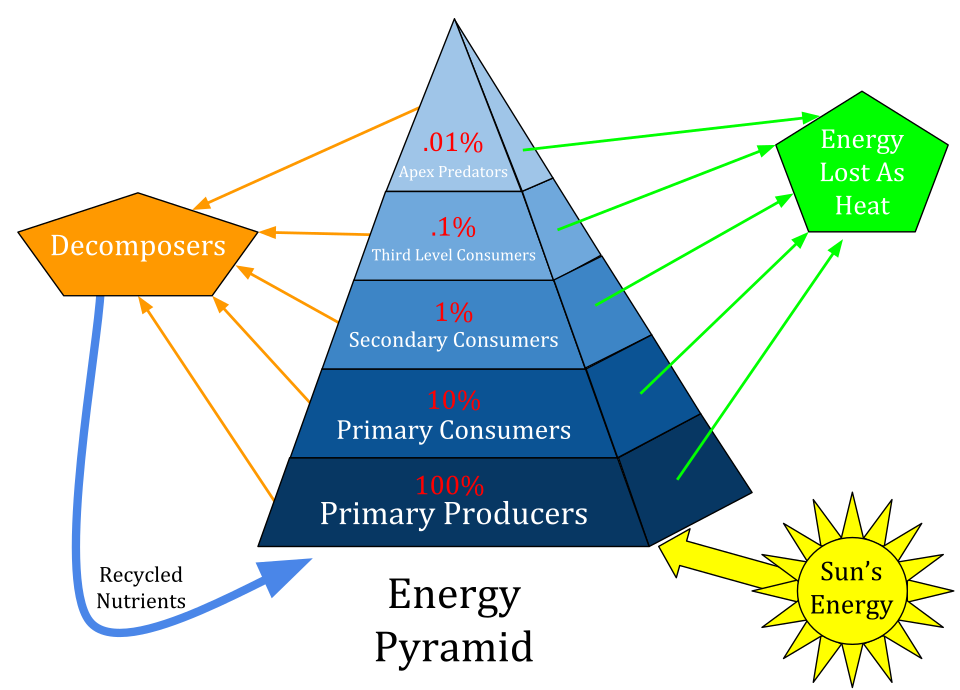
An energy pyramid shows how energy available to organisms decreases sharply from producers to higher trophic levels. Only a small fraction of energy stored in biomass is transferred upward, while most is lost as heat during metabolic processes. This visualization helps explain why ecosystems require continuous external energy inputs to maintain structure and function. Source
Key idea: energy flow vs matter cycling
Energy flows one-way: enters (usually as sunlight) and exits (as heat).
Matter cycles: atoms are repeatedly rearranged and reused via biogeochemical processes.
Because biological processes require energy, the cycling of matter depends on energy input.
What “high-quality energy” means in ecology
High-quality energy is energy that can do useful work (e.g., building tissues, active transport, movement, reproduction). In most ecosystems, this is captured when producers convert sunlight into chemical energy.
High-quality energy: Energy in a form that is readily usable to perform biological work; in ecosystems it is typically captured as chemical energy in organic molecules.
A continuous inflow is necessary because each transformation (photosynthesis to biomass, biomass to metabolic work) increases disorder and reduces the fraction of energy still available to do work.
Why continuous energy input is required
Maintaining ecosystem structure
Ecosystem structure includes the composition and relative abundance of organisms and their interactions. Continuous energy input supports:
Primary production (formation of biomass that supports all other organisms)
Population maintenance (growth and reproduction)
Repair and replacement of biomass lost to death, predation, disease, and disturbance
Without ongoing energy capture, stored biomass is consumed and decomposed, populations decline, and the community’s structure shifts or collapses.
Maintaining ecosystem function
Ecosystem function includes processes that keep the system operating over time. Continuous energy input powers:
Metabolism (cellular work, enzyme activity, maintenance of internal conditions)
Decomposition and detritus processing (microbial breakdown requires energy from organic matter)
Physical and chemical transformations that keep nutrients moving through living and nonliving components
Coupling energy to biogeochemical processes
Biogeochemical cycles involve moving and transforming nutrients among organisms, soils, water, and air. Energy is required to:
Build complex organic molecules from simpler inputs (an “uphill” process)
Transport materials within organisms (e.g., moving ions against concentration gradients)
Support microbial transformations in soils and sediments that change nutrient forms and availability
When energy input falls (for example, reduced light), nutrient cycling often slows because there is less biological demand and less biological processing.
Major sources of energy input
Sunlight (dominant for most ecosystems)
Most ecosystems rely on solar radiation captured by photosynthetic producers (plants, algae, cyanobacteria). The captured chemical energy:
Supports producers’ growth and maintenance
Provides the energy basis for consumers and decomposers
Indirectly drives many nutrient transformations by sustaining living biomass and microbial activity
Chemical energy (in some ecosystems)
In environments with little or no light (e.g., deep ocean vents), some microbes use chemical energy from inorganic compounds to build organic matter.
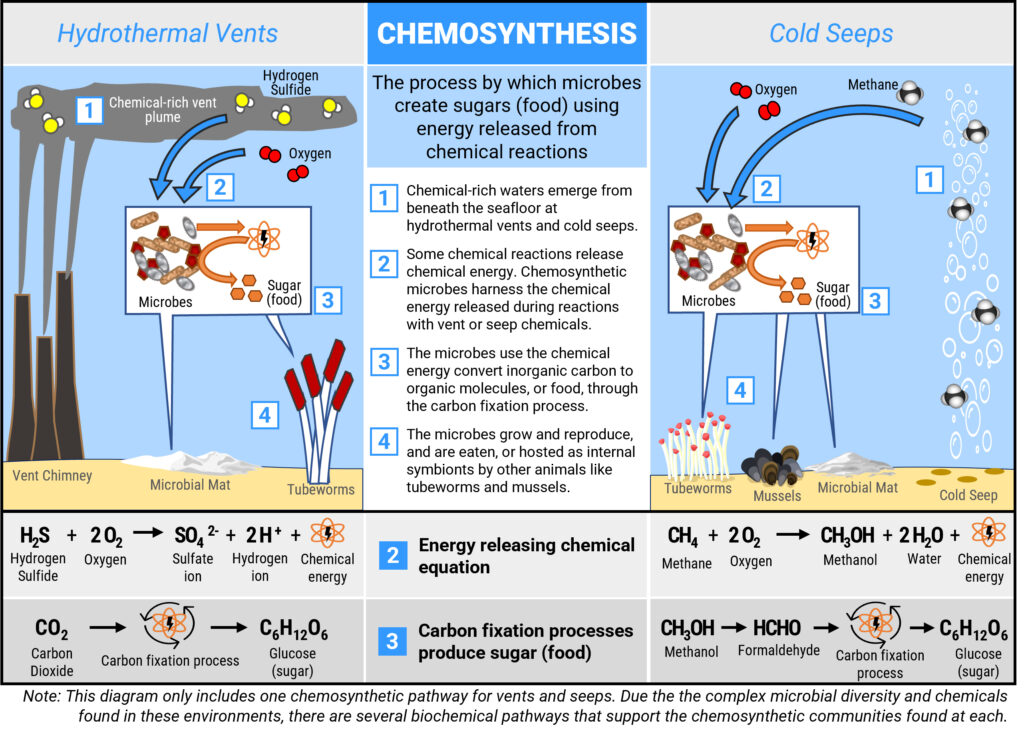
This diagram illustrates a chemosynthetic pathway in which microbes use chemical energy from reduced compounds (common at vents and seeps) to build organic molecules. It highlights that the energy supporting the ecosystem enters from the environment as chemical potential energy rather than sunlight. The figure makes clear that even “no-light” ecosystems depend on a continuous external energy supply to sustain biomass and ecological processes. Source
These systems still require a continuous external energy source; it is simply chemical rather than solar.
What happens without sufficient energy input
Lower biomass production: less organic matter is created to support organisms.
Reduced biological activity: fewer energy-demanding processes (growth, reproduction, active transport) occur.
Slower nutrient cycling: fewer organisms and lower metabolic rates reduce the transformation and movement of nutrients.
Simplification of communities: fewer niches are supported; diversity and population sizes may decline.
Why “continuous” matters (time and variability)
Energy input varies daily and seasonally, but ecosystems persist when longer-term energy capture is sufficient to offset ongoing losses. Disturbances that reduce energy capture (e.g., prolonged shading, turbidity reducing light penetration, severe defoliation) can push ecosystems toward lower productivity states, altering both structure and function.
Practice Questions
Explain why ecosystems require a continuous input of high-quality energy. (2 marks)
Energy cannot be recycled and is ultimately lost as heat / becomes less available for work (1).
New high-quality energy is needed to power biological processes that maintain ecosystem structure and function (1).
Describe how continuous energy input supports biogeochemical processes in an ecosystem and what may occur if energy input is reduced. (6 marks)
States that matter cycles but energy flows one-way and must be replenished (1).
Links energy capture to building/maintaining biomass (1).
Explains that organismal metabolism requires energy and drives nutrient transformations (1).
Explains that decomposers use energy in organic matter to break down material, aiding nutrient recycling (1).
Predicts reduced productivity/biomass if energy input falls (1).
Predicts slower nutrient cycling and/or simplified community structure if energy input falls (1).
FAQ
Sunlight is concentrated energy that can be converted into chemical energy. Heat at typical environmental temperatures is diffuse, so much less of it can be harnessed to do biological work.
Only briefly. Stored biomass can be consumed, but as it is metabolised, energy is dissipated as heat and the store shrinks, so the system trends towards reduced activity and biomass.
They rely on seasonal pulses of energy: intense production during light periods supports food webs through dormancy, slow metabolism, migration, and use of stored reserves during dark periods.
Exergy is the fraction of energy capable of doing useful work. Ecosystems require a steady inflow of high-exergy energy (sunlight or chemical energy) because exergy declines with each transformation.
Examples include changes to light availability (urban shading, increased turbidity from sediment runoff) or vegetation removal altering canopy structure; both can reduce energy capture even if nutrients remain present.

